Value of December Building Permits Rebound 4.8%
Feb 13, 2018
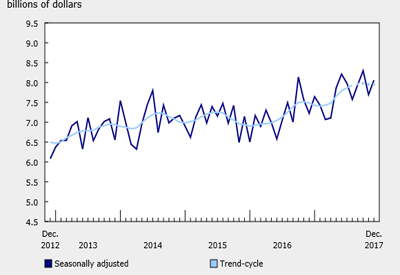
Canadian municipalities issued $8.1 billion in building permits in December, up 4.8% following a 7.3% decline in November. The increase stemmed from higher construction intentions in the residential sector. Across Canada, all components climbed in 2017, up 10.4% from the previous year, led by the multi-family dwelling component.
Single-family dwellings lead the rise in December
Construction intentions for single-family homes led the rise in December. Canadian municipalities issued $2.8 billion (8.9%) in permits for single-family dwellings, the largest month-over-month increase in 2017. Ontario reported the largest gain, up 15.7% from the previous month. Permits issued for new single-family housing developments in the census metropolitan areas (CMAs) of Kitchener-Cambridge-Waterloo and Barrie helped offset the 12.1% decline in the CMA of Toronto.
Value for multi-family dwellings in BC nearly doubles in December
The value of permits for multi-family dwellings increased to $2.4 billion in December, up 7.0% from the previous month. Higher construction intentions in British Columbia led to the rise, as the province outpaced Ontario and Quebec for the largest contribution to the national total.
The value of permits for multi-family dwellings in British Columbia hit $808.7 million in December, almost double the value from the previous month. On an annual basis, the value of permits for multi-family dwellings has outpaced that for single-family dwellings for the past six years. Furthermore, the value of permits for multi-family dwellings surpassed single-family dwellings in all four CMAs in British Columbia in 2017.
Nationally, construction intentions for multi-family dwellings have been trending upwards since 2009, closing the gap between the value of permits for single-family dwellings and multi-family dwellings. British Columbia and Quebec were the driving forces of this shift, specifically the CMAs of Vancouver and Montreal.
2017 year in review
The annual data presented in the remaining sections use unadjusted figures, as seasonal adjustment is used to facilitate month-to-month comparisons.
Nationally, all components were up in 2017, climbing 10.4% from the previous year. The value of permits in the residential sector has increased every year since 2009, primarily stemming from the multi-family component. In 2017, the residential sector increased 7.8%, pushed up by the multi-family component (+13.7%).
Canadian municipalities issued $35.4 billion in permits for non-residential structures in 2017, climbing 15.1% from the previous year and the first increase since 2014. The institutional component led the increase in 2017, rising $2.0 billion from 2016, followed by the industrial (+$1.9 billion) and commercial (+$840.5 million) components.
The value of permits for multi-family dwellings in British Columbia reached $7.0 billion in 2017, up 22.9% and the largest increase of all the provincial components. Quebec followed, issuing $6.1 billion in permits for multi-family dwellings, up 26.7% from the previous year. Meanwhile, single-family dwellings in the Prairie provinces gained $1.1 billion in 2017, up 17.1% from the previous year.
Value of building permits for five select CMAs in 2017
Municipalities in the CMA of Toronto issued $19.1 billion in building permits in 2017, accounting for approximately one-fifth of the national total. The value for all components increased, with the exception of that for single family dwellings, which declined 15.0% from the previous year. The industrial component saw the largest gain, rising 86.9% from 2016. The rise in this component stemmed primarily from transportation terminals such as those associated with the Toronto-York Toronto Transit Commission (TTC) Subway Extension.
Municipalities in the Montreal CMA issued $9.6 billion in building permits, up 29.5% from 2016. All components increased, led by multi-family dwellings, which climbed 42.7% to $4.2 billion. Construction intentions for multiple high-value apartment projects also contributed to the rise in this component.
In the CMA of Vancouver, the value of building permits climbed 14.2% to $9.4 billion. All components rose, with the exception of single-family dwellings, which declined 7.3% from the previous year. The value of permits for multi-family dwellings increased 16.1% to $5.0 billion and contributed over half of the CMA’s total value for the third consecutive year.
In the Calgary CMA, the value of building permits edged up 0.1% to $5.4 billion. The institutional component registered the largest increase, posting a value of $1.1 billion, more than double the previous year’s value. The single-family component followed, up 23.1% to $1.9 billion. The value of permits for multi-family dwellings posted the largest decline, falling 39.5% from 2016.
Municipalities in the CMA of Edmonton issued $5.2 billion in building permits in 2017, down 4.6% from the previous year. The commercial component experienced the largest decline, falling 34.8% from $1.5 billion in 2016 to $1.0 billion in 2017. The value of single-family dwellings increased 14.7% to $2.0 billion in 2017, exceeding the total value of permits for the non-residential sector.
Source: Statistics Canada, http://www.statcan.gc.ca/daily-quotidien/180207/dq180207a-eng.htm?CMP=mstatcan

![Guide to the Canadian Electrical Code, Part 1[i], 26th Edition– A Road Map: Section 74 — Airport installations](https://electricalindustry.ca/wp-content/uploads/2026/05/EIN-Stock-Guide-Code-Canada-Map-1200-768x403.png)



![Guide to the Canadian Electrical Code, Part 1[i], 26th Edition– A Road Map: Section 74 — Airport installations](https://electricalindustry.ca/wp-content/uploads/2026/05/EIN-Stock-Guide-Code-Canada-Map-1200.png)