BC Hydro Completes $714 Million Expansion, Update of Mica Hydroelectric Facility

BC Hydro Completes $714 Million Expansion, Update of Mica Hydroelectric Facility
BC Hydro has completed a $714 million project to add two new generating units at the Mica dam. With the addition of units five and six, the facility now has six generating units. “BC Hydro is making investments to secure our province’s future electricity needs,” says Bill Bennett, Minister of Energy and Mines. “An important part of this is looking at existing facilities to see if they can be upgraded to add even more power to the system. The two new units give us access to more clean power for decades. BC Hydro has also recently added one more unit at Revelstoke dam and will add another one at Revelstoke in the coming years.”

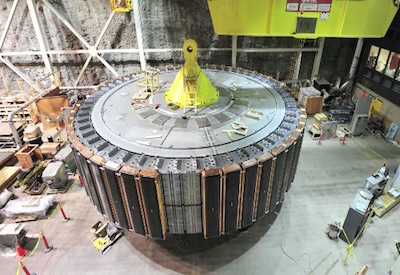
Mica produces power for more than 650,000 homes each year. The two new generating units increase Mica’s capacity by about 1,000 megawatts, bringing its total capacity to more than 2,805 megawatts (in the photo: a Mica upgrade rotor assembly). When Mica was built in the 1970s, it was built with four units and space for two more to be added in the future. Mica is the cornerstone of BC Hydro’s Columbia River generation system and now accounts for about 22% of BC Hydro’s generation capacity.

The addition of the turbines is one part of an eight-year upgrade and expansion of Mica. Unit five went into service last winter; unit six, this winter. BC Hydro also recently upgraded the facility’s aging switchgear equipment and constructed a new series capacitor station on the transmission line from Mica near Seymour Arm.

To date, construction activities for the Mica expansion and upgrade projects have created about 1,000 full time jobs for tradespeople in the region. BC Hydro is in the midst of a major capital plan to upgrade its generation, transmission and distribution infrastructure in BC. BC Hydro completed construction of the new, high-voltage, Interior to Lower Mainland transmission line in November. The line is the first 500-kilovolt transmission line added to the system in 30 years. It will bring power from facilities like Mica and Revelstoke to BC’s largest population centres to meet growing demand.


Related Articles


Latest Articles


Changing Scene

  • ABB Chosen to Supply Technology for BC Ferries’ New Major Vessels

    ABB Chosen to Supply Technology for BC Ferries’ New Major Vessels

    January 12, 2026 ABB will supply a complete package of power, propulsion and control technology for four new double-ended passenger and car ferries operated by British Columbia Ferry Services (BC Ferries). One of the largest ferry operators in the world, BC Ferries provides year-round vehicle and passenger service on 25 routes to 47 terminals, carrying Read More…

  • Federal Government Invests in Four Ontario Steel Companies

    Federal Government Invests in Four Ontario Steel Companies

    January 12, 2026 Through targeted investments, the Government of Canada is committed to providing support to help businesses in all sectors, including steel and automotive, to respond, adapt and compete amid shifting market conditions. Evan Solomon, Minister of Artificial Intelligence and Digital Innovation and Minister responsible for the Federal Economic Development Agency for Southern Ontario Read More…

  • Craftsman V20 150W Power Inverter Recalled Due to Fire Hazard

    Craftsman V20 150W Power Inverter Recalled Due to Fire Hazard

    January 12, 2026 This recall involves the Craftsman V20 150W Power Inverter (Model number: CMCB1150B). The product has a rectangular prism shape with dimensions of 8.13 x 7.62 x 11.68 cm. It is red and black and weighs 320 grams. It has three charging ports for Type-C, Type-A, and AC connections. It contains an LED Read More…

  • 2025 National Model Codes Now Available

    2025 National Model Codes Now Available

    January 12, 2026 New model codes introduce updates that advance the harmonization of building design and construction requirements across Canada, expand the range of compliance options available to code users, incorporate forward-looking climatic data in building design to help prepare buildings for future climate conditions while reducing the construction sector’s contribution to climate change, and Read More…