NEB Approves Power Line Between Ontario and Pennsylvania
February 2, 2017
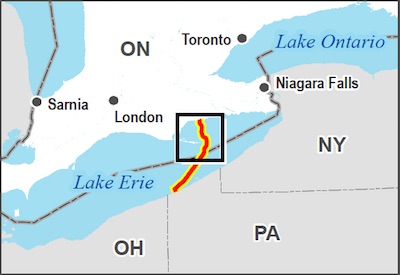
The National Energy Board (NEB) has approved the Lake Erie Connector Project, an international power line that will be buried under Lake Erie and transfer electricity between Ontario and Pennsylvania.
The Lake Erie Connector Project is an approximately 117-kilometre 1,000 megawatt 320 kilovolt high-voltage direct current bi‑directional electric transmission interconnection, plus associated facilities to transfer electricity between Nanticoke, Ontario and Erie County, Pennsylvania, crossing Lake Erie.
The estimated capital cost for the 49-kilometre Canadian portion of the project is $543.5 million. The proponent estimates that project construction in Ontario will generate $21.4 million in employment income, $38.2 million in gross domestic product, $8.8 million in government tax revenues, and 331 jobs.
The project will be the first direct interconnection between the Independent Electricity System Operator market in Ontario and the PJM Interconnection LLC electricity market, which coordinates the movement of wholesale electricity in 13 states and the District of Columbia (representing over 61 million people).
The decision imposed 42 conditions on project proponent ITC Lake Erie LLC, covering a wide range of topics such as environmental protection, safety and socio-economic matters. With the conditions and the proponent’s commitments, the NEB concluded that the project is unlikely to have significant adverse environmental effects. The NEB also determined that the project would provide benefits to Indigenous, local, regional, and provincial economies, allow greater flexibility for two large energy markets to meet changing energy needs, and increase market efficiency for Ontario and its rate payers.
The NEB’s decision follows a public hearing that included a scientific and technical examination of the evidence submitted by the proponent and participants.
Find out more: http://news.gc.ca/web/article-en.do?mthd=tp&crtr.page=1&nid=1180479&crtr.tp1D=1.






![Guide to the Canadian Electrical Code, Part 1[i], 26th Edition– A Road Map: Section 76 — Temporary Wiring](https://electricalindustry.ca/wp-content/uploads/2026/05/EIN-Stock-Guide-Code-Canada-Map-1200.png)