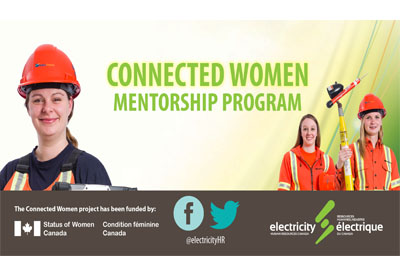
EHRC’s Connected Women Mentorship Program Goes Live
June 5, 2017
Electricity Human Resources Canada (EHRC), with the support of Status of Women Canada and industry partners, has launched the Connected Women Mentorship Program, a national mentorship program designed for women who are either already working in technical and/or trades occupations in the electricity sector, or are studying to enter the industry.
By matching mentees with experienced industry professionals over a six-month period, the program aims to increase career entry and advancement opportunities for professional women, while helping organizations solve pending labour shortages and diversify their workforce.
Mentors who take new workers under their wing help them gain familiarity with corporate processes and policies, provide guidance and reassurance when required, and pass on their knowledge and expertise to the next generation of workers. At the same time, mentees engage in reverse-mentoring by providing their mentor with fresh perspectives on the industry and perhaps share information about the latest technology or applications to bridge the gap between employee generations. “It’s a win-win situation,” says Michelle Branigan, CEO of EHRC.
“Having a mentor you can turn to for guidance and advice about career choices and advancement can make all the difference in getting to the next level,” says Maryam Monsef, Minister of Status of Women. “Our government is confident the launch of the Connected Women Mentorship Program will further attract and retain women in this industry… It’s going to make a real difference in the careers of many women across the country.”
“Women in the industry face a number of challenges that can affect their participation and advancement, including access to promotions and workplace culture,” says Nirav Patel, Director – Human Resources at Ontario Power Generation and Chair of the Connected Women Steering Committee. “Mentoring is a powerful way to overcome these challenges. It is relationship-oriented, so although specific skills or competencies may be used as a basis for creating the relationship, its focus goes beyond these areas to include such things as work/life balance, self-confidence, self-perception, and how the personal influences the professional. With the support of women and men already employed in the industry, we can help bridge the supply/demand gap for the sector and ensure women are given equal opportunity to access the multiple career opportunities that are available to them.”
The Connected Women Program was developed by EHRC and the Connected Women steering committee, which includes representatives from Algonquin College, Electrofederation/WESCO, Hydro Ottawa, Hydro One, International Brotherhood Electrical Workers (IBEW), Power Workers Union (PWU), Manitoba Hydro, Society of Energy Professionals, and Women in Nuclear. Learn more about the program here: http://electricityhr.ca/workplace-support/diversity-inclusion/connected-women-mentorship-program/
Photo courtesy of Merylin at Pixabay.