Desjardins and Hydro-Québec Partner to Create Quebec’s First Urban Vehicle-Charging Superstation
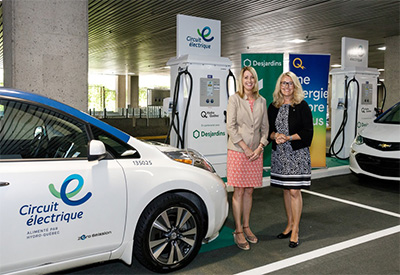
EIN 35 CS HydroQuebec EV 400

Aug 20, 2019

Desjardins in partnership with Hydro-Québec have commissioned Quebec’s first urban superstation for charging electric vehicles. The superstation, located at Complexe Desjardins, includes four 50-kilowatt charging stations, helping serve a large user base in the heart of downtown Montreal, at the Quartier des spectacles. 

The project is part of Desjardins’s plan to install 200 charging stations at caisses throughout Quebec and eastern Ontario by 2021, in partnership with Hydro-Québec and the Electric Circuit. These stations will boost the Electric Circuit’s existing network and help encourage Quebecers to adopt electric modes of transportation more quickly.

Given the ever-growing consequences of the climate crisis, Quebec’s socio-economic leaders must work together to find solutions that will quicken our shift toward a low-carbon economy.

 “We’re very proud of this project, of our partnership with Hydro-Québec, and of everyone’s commitment at Desjardins Group, particularly the caisses in our network that are providing the infrastructure for these charging stations to be built,” said Pauline D’Amboise, Secretary General and Vice-President Governance and Sustainable Development Division.

“This project is just one of the many important decisions we’ve made in recent years to accelerate the energy transition. We’ve also made our operations carbon-neutral, invested in renewable energy projects, lowered the carbon footprint of our investment portfolios, and given our members and clients the opportunity to do the same. What’s more, we’ve begun incorporating environmental, social and governance criteria into our investment and financing decisions. We’ll continue to work with Hydro-Québec to develop innovative and energy-efficient transportation solutions,” she added.

“More and more drivers are choosing electric vehicles, leaving fossil fuels behind and turning to the clean energy we provide,” said France Lampron, Director of Transportation Electrification at Hydro-Québec and President of Electric Circuit. “This project is just one of the ways we’re doing everything we can to ensure a healthier future that includes cleaner air, better public health and a higher trade balance,” she added.

Source

Related Articles


Latest Articles

  • What 2025 Revealed About Canada’s Electrical Industry

    What 2025 Revealed About Canada’s Electrical Industry

    December 16, 2025 By Carol McGlogan, President & CEO, Electro-Federation Canada The past year required Canada’s electrical industry to adapt to a rapidly changing environment. In 2025, businesses across the value chain navigated shifting trade conditions, evolving policy landscapes, and growing expectations tied to electrification and infrastructure expansion. Trade uncertainty introduced new complexity. Organizations reassessed… Read More…

  • Considerations for EV Charging Installation and Site Preparation

    Considerations for EV Charging Installation and Site Preparation

    December 15, 2025 By Blake Marchand As part of our recent discussion with LEDVANCE EVSE Product Manager, Erich Bockley, he emphasized the importance of site preparation Site preparation can be the most complicated part of the project, Bockley emphasized, a lot needs to be considered before the installation work begins. Many public charging applications will… Read More…

  • Ontario’s Multi-Family Component Leads Residential Sector Increases in October Building Permits

    Ontario’s Multi-Family Component Leads Residential Sector Increases in October Building Permits

    December 15, 2025 In October, the total value of building permits issued in Canada rose $1.8 billion (+14.9%) to $13.8 billion. The increase in construction intentions was led by the residential sector (+$1.1 billion). An increase was also observed in the non-residential sector (+$702.8 million). On a constant dollar basis (2023=100), the total value of building permits issued in… Read More…

  • Residential Investment in Building Construction Declines in September

    Residential Investment in Building Construction Declines in September

    December 15, 2025 Overall, investment in building construction decreased 1.1% to $22.4 billion in September. Investment in the residential sector declined 1.7%, while that in the non-residential sector was virtually unchanged. Year over year, investment in building construction grew 6.0% in September. On a constant dollar basis (2023=100), the total value of investment in building construction in September decreased 1.4%… Read More…


Changing Scene