ABB is Powering the Seabed for a Sustainable Energy Future
Nov 22, 2019
In an extreme underwater environment, a single cable, stretching up to 600km, will connect ABB’s world-first subsea power distribution and conversion system to the depths of the ocean – electrifying the seabed to help meet global energy demands. With commercial viability confirmed, remotely operated, increasingly autonomous subsea facilities powered by lower carbon energy are more likely to become a reality.
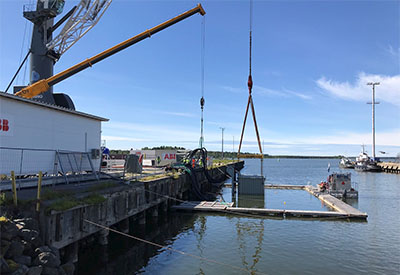
In Vaasa, Finland, a pivotal milestone has been achieved that will unlock new possibilities for the future of offshore oil and gas production. The functionality and thermal capability of ABB’s subsea power distribution and conversion technology has been validated in a 3000-hour shallow water test.
This is the first test of its kind to be completed worldwide – heralding an incredible achievement that has taken several years of collaborative effort from the brightest minds in the industry. Now, energy companies will be able to access a reliable and consistent supply of up to 100 megawatts of power, over distances up to 600 kilometers and down to 3,000 meters water depth, at pressures that could shatter a brick.
Benefits anticipated include improvements in reliability, safety, productivity, efficiency and performance. Using a specific field development case as one example, the new technology could offer CAPEX savings of more than $500 million, if eight consumers, such as pumps or compressors, are linked through a single cable over a distance of 200 km from other infrastructure.

“This milestone marks an outstanding achievement and is the culmination point of an inspirational technology development achieved through tremendous dedication, expertise and perseverance,” said Dr. Peter Terwiesch, President of ABB’s Industrial Automation business. “It is the result of intensive collaboration by over 200 scientists and engineers from ABB, Equinor, Total and Chevron in a multi-year, joint effort.”
Making this ingenious engineering achievement all the more remarkable will be the elegant, sleek connection that will provide secure and reliable access to power in this extreme and remote environment a single cable. This cable will electrify the ocean space to help operators better meet energy needs for the future. It will require little or no maintenance for up to 30 years, enabling oil and gas exploration and production feasible in new underwater frontiers, and bring the majority of the world’s offshore oil and gas resources in reach for electrification.
The changing energy mix
Energy consumption is increasing at an unprecedented pace with growth in the global economy. Total global energy consumption in 2018, for example, was 13,82 billion tons of oil equivalent, with fossil fuels meeting nearly 70 percent of the demand. Even as the energy mix evolves, it is anticipated as much as 40 percent of global energy consumption will continue to be met by fossil fuels by 2050.
Offshore oil and gas operators have a clear vision for a safer, more energy efficient future. As available resources are used in mature basins, the focus of energy operators will shift to new and remote subsea frontiers. By powering pumps and compressors on the seabed, closer to the reservoir, ABB’s subsea power distribution and conversion technology can significantly reduce power consumption. There is potential for substantial energy savings, with reduced carbon emissions using power from shore.
Unlocking groundbreaking innovation: the JIP
The $100 million research, design and development Joint Industry Project (JIP) between ABB and Equinor with its partners Total and Chevron was first initiated in 2013. With a history of developing innovative solutions to technical challenges, ABB was an ideal choice for the project. In the years since, and in close collaboration with Equinor, Total and Chevron, ABB has been through the most extensive design, modelling, testing, verification and qualification programs in the history of its involvement in upstream oil and gas.
The JIP’s initial focus was to understand how electrical components such as capacitors and transistors behave when subjected to pressures of up to 300 bar, which is about four times greater than what a nuclear submarine can survive. The normal mechanical and electrical properties of materials change when they are subjected to this degree of stress, and those changes had to be understood at a basic physical and chemical level.
As part of the project, four specialized subsea labs were created by ABB. Each subsea lab was equipped with pressure vessels to simulate 3,000-meter water depth. A lab in Oslo, Norway tested electronic components and printed circuit boards. In Turgi, Switzerland, subsea drive power electronics were tested, while power electronic components were tested at the research center in Daetwill, Switzerland. Chemical compatibility was tested at a lab in Vesterås, Sweden. The researchers created a high-resolution digital facsimile of a subsea power grid and combined it with a control system that automates its operations, while detecting and diagnosing problems before they occur.
The technology
Previously, the transmission cable and subsea step-down transformer were only proven to operate underwater. Today, ABB’s complete subsea power distribution and conversion system includes a step-down transformer, medium voltage variable speed drives and switchgear, control and low voltage power distribution, and power electronics and control systems. ABB Ability™ System 800xA has controlled the rigorous testing for the JIP.
“ABB is at the forefront of automation as we innovate and collaborate to deliver powerful solutions for tomorrow’s world,” said Kevin Kosisko, Managing Director, Energy Industries, ABB. “Oil and gas companies now have access to technology that will completely transform how they operate.”

The subsea facility of the future
Offshore hydrocarbon production facilities typically rely on power generated locally by gas turbines located topside either from fixed floating platforms or from ships. For subsea purposes, power is transported to equipment via multiple cables located close by, which then power consumers, such as pumps and compressors located on the seabed. These are commonly known as long step-out solutions.
ABB’s subsea power technology can link to any power source, enabling future integrations with renewable energy. In a bold vision for a subsea facility of the future, control and reliability will be optimized with remote operations via onshore control rooms. Having fewer people offshore will reduce risks and enhance overall safety. By installing electrification systems closer to the load, space and weight are reduced on topside facilities, response time to wellheads is lowered and power supply demands are reduced. Additionally, with a subsea facility on the seabed, less maintenance would be required.