Canada’s Zero Carbon Building Standard Celebrates First 10 Certifications
EIN CaGBC Mohawk 400

Nov 27, 2019

The Canada Green Building Council is helping Canada eliminate carbon emissions with ten projects certifying under its Zero Carbon Building (ZCB) Standard. These pioneering projects include new and existing offices, schools and warehouses, each demonstrating that buildings of all types and age can achieve zero carbon emissions.

Introduced two years ago, the ZCB Standard was designed to guide the industry in building to zero and help Canada meet its international emissions targets by 2030. Since its launch, CaGBC’s made-in-Canada standard has shifted the green building conversation to focus on carbon as its key performance metric. A carbon metric recognizes the true climatic impact of a building and brings to light aspects not considered by energy efficiency, including the importance of selecting low-carbon construction materials and energy sources for building operations. The market response has been encouraging, with over 20 projects (including 10 certifications) now registered under the ZCB Standard.

See CaGBC’s Zero Carbon Case Studies here

Achieving both Design and Performance certifications – a first

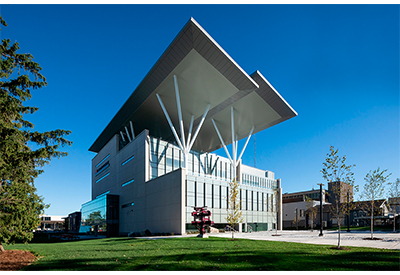
One of the first Zero Carbon pilot projects, The Joyce Centre for Partnership and Innovation at Mohawk College announced it is the first building to achieve both ZCB Design and Performance certifications. Design certification assures a project has been designed according to zero carbon building requirements while Performance certification demonstrates the project has achieved zero carbon emissions over one year of operation as required by annual verification.

The Joyce Centre design reflects a strong focus on zero-carbon, with an innovative high-performance building envelope that minimizes heating and cooling demand, an all-electric geoexchange system, and a striking rooftop photovoltaic (PV) system.

The careful, integrated design and construction process paid off and building operations have demonstrated better-than-expected performance – enabling the project to achieve ZCB-Performance certification.

“The Joyce Centre is a beautiful and functional example of what a sustainable learning space can offer. We are proud to provide our students, and the community, with a successful model of climate action at work while setting a new benchmark for green building operations in Canada,” said Mohawk College President Ron McKerlie. “This Canada Green Building Council Performance certification confirms that we have been operating The Joyce Centre effectively and that we are meeting the goals we set out in the building’s design.”

“Zero carbon buildings, like The Joyce Centre at Mohawk College, represent a great opportunity for cost-effective emissions reduction. These projects spur innovation in design, building materials and technology while creating new skills and expertise for tradespeople and professionals,” said Thomas Mueller, President and CEO, CaGBC and CEO, GBCI Canada. “Owners are also recognizing the benefits a zero-carbon building can bring, including increased resiliency to extreme weather events, meeting occupant expectations for comfort and corporate leadership, and future-proofing against rising carbon costs.”

Zero Carbon Showcase

The CaGBC is showcasing the ten ZCB-certified buildings at cagbc.org. There you can view videos of early pilot projects, review new case studies, and read CaGBC research demonstrating both the technical viability and financial feasibility of the standard.

The CaGBC will also be sharing updates to the ZCB Standard early in 2020, as they release ZCB v2 to the market. Updates will include feedback from the ZCB pilot projects, and will feature more stringent requirements for energy use and embodied carbon.


Related Articles


Latest Articles

  • Ottawa Day 2026: EFC Members Engage with Parliamentarians on Canada’s Electricity Future

    Ottawa Day 2026: EFC Members Engage with Parliamentarians on Canada’s Electricity Future

    March 16, 2026 By Electro-Federation Canada Following EFC’s recent update on our 2026 Ottawa Day, we are pleased to share photo highlights from two days of engagement on Parliament Hill, where members met with federal decision-makers to discuss the future of Canada’s electricity system. More than 40 EFC member leaders and Government Relations representatives travelled Read More…

  • Industrial Construction Intentions Drive Increase in Non-Residential Sector in January

    Industrial Construction Intentions Drive Increase in Non-Residential Sector in January

    March 13, 2026 In January, the total value of building permits issued in Canada increased $607.0 million (+4.8%) to $13.3 billion. The increase was led by the non-residential sector (+$464.0 million) and supported by the residential sector (+$143.0 million). On a constant dollar basis (2023=100), the total value of building permits issued in January rose 4.3% from the previous month Read More…

  • Multi-Unit Construction Drives Growth in December Residential Construction Investment, 2025 Review

    Multi-Unit Construction Drives Growth in December Residential Construction Investment, 2025 Review

    March 13, 2026 The total value of investment in building construction increased $442.9 million (+1.9%) to $23.7 billion in December. The residential sector grew 2.4%, while the non-residential sector edged up 0.6%. Year over year, investment in building construction grew 12.2% in December. On a constant dollar basis (2023=100), the total value of investment in building construction in December rose 1.7% Read More…

  • 5 Strategic Reasons to Attend the Lumen Exhibition

    5 Strategic Reasons to Attend the Lumen Exhibition

    March 13, 2026 In a market where deadlines are tight and projects are increasingly complex, staying competitive is no longer just about technical skills. It also depends on having the right tools, the right information, and the right partners by your side. The Lumen Exhibition is more than just an event—it’s a strategic lever designed to Read More…


Changing Scene

  • A New Guillevin.com, Designed to Simplify Your Purchasing Experience

    A New Guillevin.com, Designed to Simplify Your Purchasing Experience

    March 16, 2026 Guillevin.com was built as a digital working tool, designed to support the way their customers plan, search for, and purchase products today. The goal is simple: to offer a fast, reliable, and intuitive online platform capable of supporting real-world operations; both on the job site and in the office. A platform built around Read More…

  • Nova Scotia Strengthens Housing Legislation to Accelerate Supply

    Nova Scotia Strengthens Housing Legislation to Accelerate Supply

    March 13, 2026 Amendments to existing legislation will mean more housing, improved efficiency in the sector and better alignment of related agencies. The changes extend the Executive Panel on Housing in the Halifax Regional Municipality and give the Minister of Housing new authority to ensure housing projects aren’t delayed. “We are strengthening how we plan, Read More…

  • Sonepar Company Opens a New Automated Distribution Center in Las Vegas

    Sonepar Company Opens a New Automated Distribution Center in Las Vegas

    March 13, 2026 Codale Electric Supply, a Sonepar company, is transforming electrical distribution with the launch of its central distribution center located just off the Las Vegas Strip, in October 2025. The site features a highly automated setup designed to improve speed, accuracy, and customer convenience. At the heart of the facility is an advanced Read More…

  • BC Introduces Public Sector Construction Projects Procurement Act

    BC Introduces Public Sector Construction Projects Procurement Act

    March 13, 2026 Kiel Giddens, MLA for Prince George-Mackenzie and Critic for Labour, has introduced the Public Sector Construction Projects Procurement Act, legislation aimed at ensuring publicly funded construction contracts are awarded through labour-neutral, merit-based procurement. “Here’s the simple question: if labour shortages are driving cost overruns, why would government limit who can work on public projects?” Read More…