Alpine Showcases for the Future of Electric Transport in Davos
Jan 24, 2020
Train, bus, lift or automobile: Davos’ clean, climate-friendly, sustainable and future-proof transport concept and its eco-friendly generation and distribution of electricity are the envy of cities around the world. ABB’s innovative technology helped make them possible.
If you’re looking for standout destinations in the Alps, there’s no ignoring Davos. For politicians and top management, it is the world-renowned host of the annual World Economic Forum (WEF). Wealthy tourists enjoy Davos as a fashionable winter sports resort and literature lovers cherish it as the setting of Thomas Mann’s famous novel, “The Magic Mountain”.
But in recent years Europe’s highest city has come to be appreciated from a completely new angle. As the world seeks answers to the current climate crisis, the little municipality (population: 11,000) has become something of an eco showcase, demonstrating how we can use existing resources sparingly in a range of areas from energy production to transport.
Although it may appear to be the result of some long-term master plan, that could not be further from the case. What happened was that a number of disparate, forward-looking projects gradually merged into a unique, green concept.
Looking back, however, there was always one constant: Switzerland’s ABB has been involved in nearly all these projects since the beginning of the last century – and remains the key provider of the latest, sustainability focused technology.
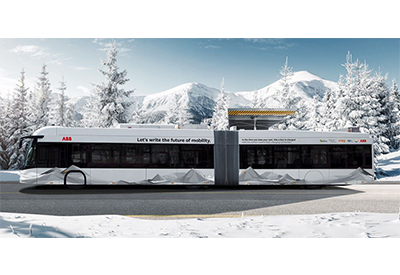
This was evident at WEF 2018, when new electric buses stopped in front of the Congress Center to chauffeur guests and delegates silently and emission-free from one conference site to the next or to the railway station.
The new TOSA e-buses were able to operate continuously, without the usual downtime for charging, thanks to new, fast-charging technology, developed by ABB, that earned the buses the Swiss Federal Office of Energy’s Watt d’Or 2018. At certain stops, an extending robotic arm on the bus roof connects to an overhead charging station to flash-charge the batteries with a 600 kW boost of power that lasts comfortably for 2–8 km of onward travel. The whole process takes as little as 20 seconds – no longer than the passengers need to board and exit.
To cater for environmentally aware guests who prefer to arrive by car, the municipality of Davos installed an extensive infrastructure for electric vehicles as part of a public-private partnership with ABB and the local energy supplier. Eight ABB Terra 53 charging points were installed for the occasion – and have been in operation ever since. These 50 kW stations are the bestselling variant in Europe and North America and can boost the charge level of an electric automobile from 0 to 80% in just 12 minutes.
Davos’ consistent, sustainable electro mobility infrastructure has attracted interest far beyond the bounds of the WEF and is now seen worldwide as a model for future-proof, clean, climate-friendly and sustainable transport.
However, both the municipality and ABB are keen to keep the momentum going. In 2019, visitors to the WEF were able to choose eco-friendly transport for the entire journey from Zurich airport to Davos. Car manufacturer Audi provided 50 E-Tron sedans and ABB installed 31 fast-charging stations under the aegis of IONITY, a joint venture charging infrastructure set up by leading car manufacturers.
Thus, ABB has continued its long tradition of providing the region with new and forward-looking forms of mobility. Last but not least, the electric funiculars and chair lifts on the slopes in and around Davos have always been powered by energy-efficient ABB motors. One of the early projects was the construction of the historic Schatzalp funicular, opened in 1924 and still in service today. Similarly, the Davos-Parsenn railway, which is central to Graubünden, was equipped by ABB predecessor and electrification pioneer Brown Boveri in the 1930s.
Over the years, ABB has also been involved in providing eco-friendly innovations for rail routes in the area. BBC supplied the legendary narrow gauge locomotives (known as“Crocodiles”) for the Rhaetian Railway, and the electrification specialist equipped the world-renowned “Allegra” trains, introduced in 2010, with highly energy-efficient drive packages. In terms of environmental impact, these trains allow passengers – including climate activist Greta Thunberg, who attended WEF 2019 – to travel with a clean conscience. The system, designed specifically for the challenges of the extremely steep, mountainous terrain, generates power through recuperationon downhill sections, thus feeding part of the energy consumed back into the grid. The pantographs also act as icebreakers by thawing frozen overhead lines with artificial flashes of lightning.
The fact that passengers have been able to travel from Landquart to Poschiavo for several years without a change of train is thanks to another special development created by ABB engineers, which enables the same railcars to travel on both the 1 kV direct current Bernina line and the other sections with 11 kV alternating current.
This may have been one of the reasons behind the Rhaetian Railway’s unusual move in 2015, when it decided to paint one of its traditional red railcars white and add a large logo. As it makes its way through the mountains around Davos, the striking “ABB Allegra” symbolizes more than 100 years of collaboration between the two pioneering companies.