Hilti and Ottobock Bring Exoskeleton Solutions to the Construction Industry
August 12, 2020
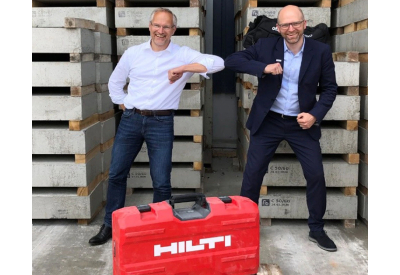
The Hilti Group has entered into a technology partnership with Ottobock SE & Co. KGaA to develop exoskeletal systems. Such solutions open new possibilities in terms of health protection and productivity and represent a future market in the construction industry.
The construction technology group Hilti and the medical technology company Ottobock are combining their know-how in the fields of safety, health protection and biomechanics to expand their portfolio of ergonomic solutions. Both companies have decades of experience in their respective fields and will cooperate in the area of research and development in the future.
“Exoskeletons are an important trend having great relevance for us. They provide relief for physically demanding tasks, such as those performed on construction sites every day. In Ottobock we have the ideal partner to combine our user protection and ergonomics knowledge with 100 years of biomechanical expertise. Our technology partnership will serve as the basis for the development of additional innovative and customer-oriented systems,” explains Johannes Wilfried Huber, Head of Hilti’s Diamond Systems Business Unit.
“We are delighted to be opening up a new area of application together with Hilti. We are building on our experience gained from more than 500 successful exoskeleton projects, including in the automotive industry and various trades. There is a great deal of potential for solutions that reduce the physical strain on workers in the construction industry. We want to jointly expand this pillar in the coming years,” explains Dr. Sönke Rössing, Head of Ottobock Industrials. This division has been developing industrial exoskeletons from the Paexo product range since 2012 to create healthier workplaces.
Hilti will launch the first joint product, the EXO-O1, in autumn 2020. It is a passive model that does not require an energy supply. The weight of the arms is transferred to the hips via the forearm supports using mechanical cable pulling technology. Independent studies and Ottobock research have shown that this reduces the peak load on the muscles and relieves shoulders by up to 47 percent.
Exoskeletons can therefore make a significant contribution to health protection, particularly regarding work performed above shoulder level and overhead work. In terms of the construction industry, this targets serial or continuous activities. Fatigue is also reduced. As a result, this type of work can be carried out over a longer period of time with much greater productivity.
Over the longer-term preventive relief can help reduce work-related musculoskeletal disorders in the shoulder area. These are some of the most common causes of worker disability in the construction industry and therefore pose a significant cost factor for companies and health care systems.