Canadian Building Permits for March Rose 5.7%
May 5, 2021
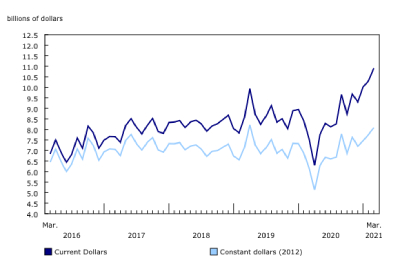
March 2021 marked the third consecutive month of record-setting numbers as building permits rose 5.7% to $10.9 billion, reflecting a booming residential sector.
Constant dollar estimates are available, for the first time, for the building-permit series dating back to 2011. On a constant dollar basis (2012=100), building permits increased by 4.0% to $8.1 billion, a number only surpassed by the April 2019 value of $8.2 billion.
Residential sector surges to new heights
The residential sector climbed 15.9%, clearing the $8.0 billion mark for the first time in March.
Multi-family dwellings jumped 24.5% compared with February to an unprecedented $4.3 billion. This gain resulted largely from permits being issued for residential towers in the cities of Toronto, Burlington, and Vaughan.
Single-family homes also reached new heights, increasing 7.6% to $3.8 billion. The census metropolitan area of Oshawa was responsible for just over one-third of this growth.
Declines in institutional and commercial components bring down the non-residential sector
Following a month in which several major permits were issued for care facilities, institutional permits fell 33.5% to $732.1 million. Eight provinces posted a decline in this component, with Quebec (-54.5%) recording the most significant drop.
Commercial permits decreased 14.6% to $1.5 billion, about 25% lower than the average monthly value reported in 2019. After declining slightly in the first two months of 2020, commercial permits took a large hit at the start of the pandemic, and have since averaged around the $1.5 billion mark observed in March.
Industrial permits, the only component to report a gain in the non-residential sector, rose 16.4% to $650.5 million. Several major permits were issued, including a new relay control centre for railroads in the city of Montréal and the Rutherford Station of the Go Transit system in the city of Vaughan.
Overall, the non-residential sector fell 15.6% to $2.8 billion.
Big start to 2021 leads to another record-setting quarter
Three consecutive monthly highs led to a record-setting first quarter, up 12.7% to $31.2 billion compared with the fourth quarter of 2020. Gains were reported in all components.
On a constant dollar basis, the first quarter of 2021 posted the largest value since the start of the series in 2011 ($23.3 billion), beating out the previous record of $22.3 billion in the second quarter of 2019.
The first three months of 2021 were the highest posted in the residential sector (+15.0%). Single-family homes (+22.8%) showed stronger quarterly growth than multi-family dwellings (+8.3%) and both reached new heights by breaking previous records set in the fourth quarter of 2020.
Despite rising 7.5% in the first quarter to $9.1 billion, construction intentions for non-residential buildings have not fully recovered from the effects of the pandemic, remaining well below the peak of $10.6 billion set in the fourth quarter of 2019.
To explore the data with an interactive user interface, visit the Building Permits Dashboard.
To explore the impact of COVID-19 on the socioeconomic landscape, please consult the Canadian Economic Dashboard and COVID-19.
For more information on housing, please visit the Housing Statistics Portal.
Statistics Canada has a Housing Market Indicators dashboard. This Web application provides access to key housing market indicators for Canada, by province and by census metropolitan area. These indicators are updated automatically with new information from monthly releases, giving users access to the latest data.
Go HERE for more informaiton