Point Source Ventilation And You – Part II
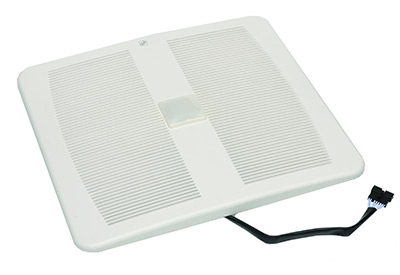
Some point source fans accommodate plug and play features.
Paul Laplante (LaplanteRicard&Associés), in collaboration with Milan Jovanovic
In last week’s article I discussed the topic of point source ventilation stemming from bath fans, the need for them to be certified for performance and sound levels, Canada’s national building codes pertaining to spot ventilation and finally in Quebec’s case the Novoclimat guidelines and requirements.
Let’s continue with information that hopefully will round out what you need to properly size /select/supply the proper amount of supply wiring in a given situation.
Many reliable manufacturers such as S&P (Soler Palau), Broan and Nutone now also show performance curves or charts at a level of 0.25 PSI in order to reflect the reality of most installations. In fact, it has been demonstrated when adding a couple of transitions (elbows) and taking into account the type of ducting used, the lengths found on average installs in housing projects or residences that the pressure rises substantially above normal standard HVI test requirements at 0.1 PSI.
How does this affect what you need? First and foremost, determine by rule of thumb, 1 CFM per square foot as a minimum. Once you have arrived at the result, look at the 0.25PSI level on the manufacturers’ data sheets and select the unit that meets the total CFM you calculated at that static level rather than the 0.1PSI.
So in a case where you believe you need 90 CFMs at .25 PSI, chances are you will have to move to a unit that shows 110 CFM at 0.1PSI with either a 4” or 6’’ transition collar (duct adapter).

Toggle Switches
Multi level condominium towers and you
The Canadian National Building Code CNB-2005 (Modified) Section 6.2.2 and/or 9.32.3 states in the event of inability to install a central HRV in each unit due to space and design constraints the following as an acceptable and recognised substitute: the installation of a 2 speed bath fan, with a mandatory continuous speed at all times always with the possibility of switching the unit off in the event of prolonged absence. S&P PC110X-2 model for example meets the minimum 90 CFM at 0.1 PSI in high speed at a level of less than 0.3 sones, while performing at 30 to 40 CFM in low speed continuous mode. The use of such a fan then meets or exceeds the minimum air change requirements of 1 complete air change in the housing unit, every 3 hours.
The catch: to avoid depressurization the above installation must have a way to compensate for the air extracted with new air. Depressurisation has negative effects on buildings (it can permit radon gas infiltration) and/or on mechanical products such as water heaters, fireplaces or stoves not equipped with outside air supplies (direct vents). Avoiding depressurization can be accomplished by means of a small duct system and 120 V damper and contactor linked to the operation of the fan while it is in continuous mode. Some colder areas of the country include a duct heater within the configuration.
How many supply wires do I need?
It is critical when using a 2-speed, positive off during prolonged absence to provide for a 3-wire feed in leading to a two commutator wall plug. In this fashion a PC110X-2 for example will be in the ‘’on’’ position of one of the commutators, switch the fan on continuous low. This must be first satisfied in order to then energise the second high speed thru the second wall switch. The key is that end user, should he select the off function cannot bypass the continuous low function when he arrives back from his prolonged absence and forgets to rearm it, and in it’s stead attempt to put the fan on high speed.

How it’s done.
Are 3 wires enough?
If I may, I would say no, not with today’s multi-featured bath fans. If anything, I would suggest in renovation projects to provide for 5 to 6 wires to the units.
Why? That’s a lot of wire in case… Yes but many of today’s fans can accept after-install accessories that upgrade them from simple fans to smart fans. Some accept add-on motion detectors, humidity detector, and even a complete change of grills to transform the ordinary unit in a beautiful light/night light grill configuration like S&P PC50 to 150 CFM units.
Finally, you are unsure that the fan you have selected and put in your truck to go on the job site is adequate for the job at hand. You get in the install area, make a quick recheck of the CFMs required with that rule of thumb I described and… the room is now larger than anticipated or the owners decided to add a separate shower or spa.
What are you going to do? Install the fan you have that you now know will not meet the needs of the area? Return it to your wholesaler? What a waste of time.
Consider the available alternates that the new DC motor technology has given the forward thinking ventilation manufacturers and your problems are solved.
Some manufacturers now offer a fan like Soler Palau’s PCD110 series that, through a series of selectable switches on the unit, will provide you from 80CFM- 90-110-120 right up to 140 CFMs.The performances will be certified providing you install it with the corresponding 4” or 6” inch duct collar that is provided. I suggest you use a 6’’ preferably for 110CFM and up.The technology even gives you the choice of selecting between one with a humidity sensor or another with a motion detector.
I do hope I have managed to give you more insight into the do’s and don’ts related to the spot ventilation market for bath fans. I am also hopefulthat with this information in mind that you will continue to distinguish yourself as the go-to company, contractor, builder,promoter,architect or engineer for your knowledge, your push for the best, and the best satisfaction experience for the one who will benefit most from that all this care — your end user and customer for a long time to come.
Paul Laplante is a manufacturing agent and co-owner of LaplanteRicard& Associates. He has worked in the electrical and ventilation fields for more than 35 years. Milan Jovanovic has worked in the field of mechanical ventilation for a number of years and is a former president of A.S.H.R.A.E.’s Quebec City chapter (2005-2006).