December Power Consumption Down 5.1% Year Over Year
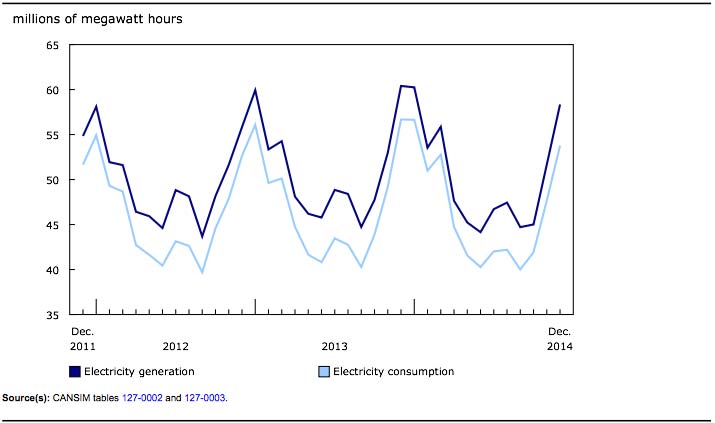
Canada consumed 53.8 million megawatt-hours (MWh) of electricity in December 2014, 5.1% less than the same month in 2013. The decline was driven by above average temperatures in Quebec. Nova Scotia also experienced a significant drop in the demand for electricity. Year over year, electric power generation in Canada fell 3.4% year over year to 58.3 million MWh. Exports to the United States totalled 5.4 million MWh in December, 12.0% higher than the previous year, while imports shed more than a quarter of their volume to total 0.8 million MWh.
Chart 1: Electricity generation and consumption
The affect of unseasonably warmer weather in Quebec was evident in provincial demand for electricity, which totalled 20.8 million MWh for the month, 10.5% below December 2013 levels. The average temperature in Quebec, where most homes use electric heating, was more than four degrees Celsius higher than the previous year. With the decline in demand, electric power generation in the province fell 9.0% to 19.7 million MWh on lower hydro generation levels.
Nova Scotia also experienced a significant drop in the demand for electricity, falling 14.1% year over year to 1.0 million MWh in December. Like demand, generation also declined to 1.0 million MWh, a 15.0% reduction over December 2013 levels. The bulk of the decline came from steam-conventional generation, which fell 20.9% to 0.7 million MWh. Some of the loss was mitigated by increased wind and hydro generation.
Electricity generation down in 2014
On an annual basis, Canada generated 600.5 million MWh of electricity in 2014, 1.7% less than in 2013. In 2014, six of the nine generation categories recorded reduced output, while tidal, solar and nuclear generation each posted gains.
Demand for electricity edged down 0.8% to 554.6 million MWh in 2014. Canada shipped 58.8 million MWh of electricity to the United States, 5.4% less than the previous year, while imports rose 20.0% to 12.8 million MWh. This was the largest increase in imports since 2006 and the first gain since 2010.
Source: Statistics Canada, http://www.statcan.gc.ca/daily-quotidien/150226/dq150226d-eng.htm?cmp=mstatcan.
![Guide to the Canadian Electrical Code, Part 1[i], 26th Edition– A Road Map: Section 74 — Airport installations](https://electricalindustry.ca/wp-content/uploads/2026/05/EIN-Stock-Guide-Code-Canada-Map-1200-768x403.png)




![Guide to the Canadian Electrical Code, Part 1[i], 26th Edition– A Road Map: Section 74 — Airport installations](https://electricalindustry.ca/wp-content/uploads/2026/05/EIN-Stock-Guide-Code-Canada-Map-1200.png)