Q3 Investment in Non-Residential Building Down 0.5%, Institutional Up 2.2%
Building Permits 1


Jan 22, 2016

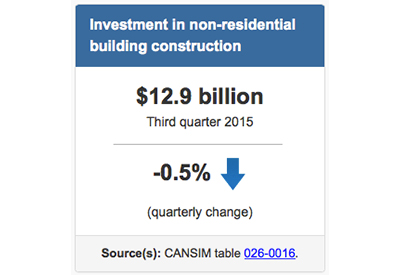
Investment in non-residential building construction amounted to $12.9 billion in the third quarter, down 0.5% from the previous quarter. This was the third consecutive quarterly decline and largely reflected lower spending on the construction of commercial and industrial buildings.Institutional investment continued to increase, an upward trend that began in the first quarter of 2014.

Chart 1: Investment in non-residential building construction

Building Permits 2


Overall, total investment fell in four provinces in the third quarter, with Quebec registering the largest decline, followed by Manitoba. In Quebec, the decline was mainly as a result of lower spending on institutional and commercial buildings. In Manitoba, the decrease was attributable to lower spending on commercial and industrial buildings.
The largest increases occurred in Ontario and Alberta. In Ontario, investment advanced in all three components, while in Alberta, it resulted from higher spending on institutional buildings.

Census metropolitan areas

Total investment was up in 23 of the 34 census metropolitan areas (CMAs). However, these advances were not sufficiently large to offset declines in the remaining CMAs as well as the regions outside CMAs.

The largest gain occurred in Toronto, followed closely by Calgary. In Toronto, the increase was mainly attributable to higher investment in the construction of commercial buildings, while in Calgary, the gain was mostly due to higher spending on institutional construction projects.

Montreal reported the largest decline, followed by smaller declines in Kingston and Quebec. All three components were down in these CMAs.
Commercial component

In the commercial component, investment fell 1.3% to $7.6 billion in the third quarter. This was the fourth consecutive quarterly decrease and was attributable to lower spending on commercial building construction in six provinces.

Quebec, Alberta and Manitoba posted the sharpest declines. In Quebec, investment decreased 2.9% to $1.2 billion, and was the result of lower spending across several categories of commercial buildings. In Alberta, commercial investment was down 1.9% to $1.8 billion, a third consecutive quarterly decrease, and was mainly due to lower spending for office and other accommodation facilities. In Manitoba, commercial investment declined 13.6% to $220 million with lower spending in every commercial category except accommodation facilities.

Nova Scotia registered the largest increase, up 10.1% to $126 million, which was attributable to investment growth across several categories of commercial buildings.

Chart 2: Commercial, institutional and industrial components

Building Permits 3


Industrial component

Investment in industrial projects was down in six provinces, declining 2.5% to $1.6 billion in the third quarter. The decrease was mainly attributable to lower spending on the construction of manufacturing plants and, to a lesser extent, utilities and maintenance buildings.

Alberta was by far the main contributor to the decline. In Alberta, investment fell 15.4% to $301 million, mainly as a result of lower spending on maintenance and utilities buildings.

The largest gain was in British Columbia, with investment rising 13.0% to $130 million, mainly because of higher construction of maintenance and primary industry buildings.

Institutional component

Investment in institutional projects continued its upward trend for the sixth consecutive quarter, rising 2.2% from the previous quarter to $3.7 billion in the third quarter. Nationally, institutional investment rose in seven provinces.

The largest increase occurred in Alberta, where investment rose for the fifth consecutive quarter. Institutional spending increased 22.7% to $629 million. Most of the increase was attributable to higher spending in the construction of educational buildings.

Quebec posted the largest drop in the third quarter, largely as a result of lower spending on the construction of health care facilities. This reflected the near completion of certain large institutional projects in the province.

Source: Statistics Canada, http://www.statcan.gc.ca/daily-quotidien/151015/dq151015a-eng.htm.
Related Articles


Latest Articles

  • ESA 2025 Annual Licence Holder Meeting

    ESA 2025 Annual Licence Holder Meeting

    December 8, 2025 This year marked ESA’s 20th Annual Licence Holder Meeting — a milestone celebrating two decades of collaboration, innovation and safety leadership made possible by Ontario’s licence holder community. The meeting was held on Wednesday, November 26, 2025 Agenda Highlights Watch a recording of the 2025 Licence Holder Meeting. Read More…

  • BC Hydro’s Updated Business Energy-Saving Incentives, Limited Time Bonus Offer

    BC Hydro’s Updated Business Energy-Saving Incentives, Limited Time Bonus Offer

    December 8, 2025 Get funding from BC Hydro for businesses upgrading eligible equipment with energy-efficient models. Funding rates vary depending on the equipment being upgraded, with past participants receiving an average of 30% for upfront costs. Incentives are available for: Bonus offer BC Hydro is currently offering a 30% bonus incentive on all business energy-saving incentives projects… Read More…

  • Mastering Advanced Bidding Strategies in Electrical Contracting

    Mastering Advanced Bidding Strategies in Electrical Contracting

    December 1, 2025 By Melvin Newman, Patabid CEO & Ian Paterson, Patabid Client Success Manager and journeyman electrician with 30+ years of experience In the competitive world of electrical contracting, knowing how to estimate electrical jobs effectively can make the difference between winning profitable projects and watching opportunities slip away. For electrical contractors, mastering advanced… Read More…

  • Why Choosing the Right USB Charger Matters

    Why Choosing the Right USB Charger Matters

    December 1, 2025 Not all USB Chargers are Created Equal As the number of devices used daily increases, so does the need for a charger that delivers safe speeds and maximum charging potential. A high-quality USB charger delivers efficient charging without risk of damage, but the sea of USB chargers and outlets available on online… Read More…


Changing Scene

  • Modernizing Canada’s Energy Efficiency Act to Improve Affordability and Competitiveness

    Modernizing Canada’s Energy Efficiency Act to Improve Affordability and Competitiveness

    December 8, 2025 Amendments to modernize the Energy Efficiency Act have been introduced in the Senate. First passed in 1992, the Act aims to reduce the overall energy consumption of energy-using products and allow consumers to make informed purchasing decisions. Since 1995, Canadian households, businesses and industries have saved over $110 billion as a result of regulations… Read More…

  • B.C.’s Economy Shows Resilience Despite Global Trade Volatility

    B.C.’s Economy Shows Resilience Despite Global Trade Volatility

    December 8, 2025 B.C.’s economy is expected to grow at a measured pace despite instability and uncertainty in the global economy. “Unjust and unpredictable trade policies have upended global relationships and shaken investor confidence across the world,” said Brenda Bailey, Minister of Finance. “We’re leaning into our strengths, like our natural resources and our skilled… Read More…

  • BC’s Bill 20 – The Construction Prompt Payment Act Receives Royal Assent

    BC’s Bill 20 – The Construction Prompt Payment Act Receives Royal Assent

    December 8, 2025 As the BC Legislature wraps up the final week of the Fall session, BCCA is very pleased to see Bill 20 receive Royal Assent and officially become the Construction Prompt Payment Act, SBC 2025, c 24. This marks a significant milestone for BC’s construction sector. This achievement reflects decades of consistent, principled… Read More…

  • Federal Government Announces New Measures to Support Steel and Lumber

    Federal Government Announces New Measures to Support Steel and Lumber

    December 8, 2025 The world is changing rapidly. The United States, the world’s largest economy, is fundamentally reshaping all its trade relationships, causing major disruption and upheaval for Canadians. It is time to transform our economy from one that is reliant on a single trade partner to one that is stronger, more self-sufficient, and resilient… Read More…