Ice Rink Upgrades Save BC City $82,500 Annually
As a teenager, Richard Ching went backpacking, canoeing, and camping around British Columbia, revelling in the outdoors. In his capacity now as an energy manager for the City of Burnaby, he is helping to preserve the natural environment for generations to come.
Ching remembers working on an energy efficiency project in conjunction with BC Hydro Power Smart as far back as 1995. But it was about a decade ago that he says awareness of energy usage really took off.”There was a climate where the public demand for changes started increasing — there was more awareness of green initiatives,” he explains. “The [city] council began pushing for it too.”
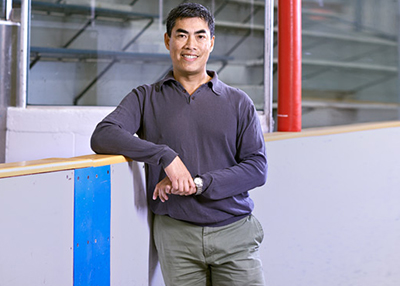
Photo: Richard Ching, Energy Manager, City of Burnaby at the Bill Copeland Sports Centre
That led to a series of projects that have contributed to the City of Burnaby’s energy savings over time.
Ice rink upgrades lead to $80,000 energy savings per year
At the Bill Copeland Sports Centre, Ching and his team installed motion sensors on the twin rinks’ overhead lights at the sports centre, eliminating the need for staff members to manually turn off lights. By redesigning the lighting and changing the fixtures to T5 high output fluorescents, they managed to simultaneously increase the light levels by 50%, while cutting energy consumption in half.
The team also installed a “Low-E” low-emissivity ceiling over one of the ice rink surfaces. The ceiling reflects away radiation from the sun, reducing refrigeration costs. That helped reduce runtime for ice-making compressors by a third, lowering wear and tear and extending the lifespan of the equipment.
“Between the three ice rinks at Bill Copeland Sports Centre and Kensington Arena, the number of kilowatt hours of electricity used dropped by 772,000 [kWh] annually, for an $80,000 savings each year,” says Ching. “We also save $2,500 a year in reduced maintenance costs. Incentives from BC Hydro — under the Power Smart Partner Program — cut the project cost in half.”
Impressive numbers like that are helping Ching and his team make the business case for other projects to improve energy efficiency. As technology improves, they are even able to re-visit ideas that may have been previously shelved because of cost concerns.
Municipal leadership helps local residents and business owners pursue energy efficient upgrades too
Dale Littlejohn, executive director of the Community Energy Association of BC, says the benefits of such projects go beyond simply saving energy and money.
“When municipal governments pursue objectives like that within their own buildings, it also gives them more confidence and credibility to help residents and businesses change over too,” he points out. “The outreach can range from changing guidelines for a new housing development, to distributing information pamphlets right at a counter where someone is coming in to apply for a building permit.”
Littlejohn says if a municipality is familiar with all of the specific details involved in making a building more energy efficient, it is easier to guide an individual resident or a business owner along the same path. Measures can range from the small, such as web-controlled wireless thermostats that ensure heating systems are turned off when a building is empty, to the big, such as sophisticated heat recovery systems.
Ching says researching advances in technology is second nature for someone with his analytical personality. However, he also enjoys the challenge of talking with people one-on-one about the benefits of energy conservation.
Reducing human impact on the environment extends to his personal life, too. He just bought a fuel-efficient scooter to use instead of his car whenever possible, and used salvaged materials in a renovation to upgrade the energy efficiency of his home. On a recent trip to Sri Lanka, he gave an impromptu energy audit to the local hotel where he was staying.
“I never leave the mindset behind,” he says with a laugh. “I’m conditioned!”
Source: BC Hydro, www.bchydro.com/news/conservation/2015/city-of-burnaby-big-energy-savings.html.