Daylight Harvesting Systems for Large Commercial and Industrial Spaces
March 11, 2019
The change to new LED fixtures from older generations of lighting technology has helped reduce energy cost significantly for many different types of consumer, commercial, and industrial applications. Switching to LED fixtures can be a quick win for many companies and deliver a good initial return on investment. In addition to the savings from a general technology swap, there are more savings available. Companies have realized even more savings by adding lighting control systems and implementing a few proven energy saving techniques.
Lights are a major component to a company’s energy bill each month. LED technology has reduced this percentage somewhat, but companies are still looking for ways to reduce the amount of wasted energy used by lighting each month. The next step is to implement lighting control systems to help control and manage lights as an integrated system rather than as isolated components.
In larger commercial and industrial applications, lighting control systems build off the initial LED retrofit savings and allow addition methods to further reduce waste and the cost of running their lighting infrastructure. For new construction, many times the wireless control systems are designed in from the beginning or embedded into the light fixtures.
Lighting control systems enable companies to make changes and put automated policies in place to increase their energy savings. Estimated savings can range from 10-15% with minor adjustments. Implementing multiple strategies and making major adjustments, the savings can add up to 45% or more. Here are a few common lighting control examples used for energy savings.
Occupancy sensors — these types of sensors are commonly used to turn lights on when activity is detected in an area and then turn the lights off when the last person leaves the room.
Control schedules — advanced control systems allow companies to set schedules to turn individual lights or large groups of lights on or off at specific times and days.
Photosensors — commonly used with both indoor and outdoor lights to disable lights during daylight hours and then automatically turn them on when it becomes darker.
High-end trim — lighting control systems allow companies to adjust and set the maximum light level for an area. Changing the maximum light level from 100% to 80% instantly reduces the energy usage by 20%. A more aggressive trim to 70% or below is not uncommon in some areas.
Task tuning — in areas where common tasks or jobs are performed, the light can be dimmed from 100% down to a lower level that is both safe and acceptable for all the people working in that space.
Daylight harvesting — in buildings and structures with many windows or skylights, daylight harvesting systems can be set up to save energy by dimming the lights down significantly during the day to take advantage of the natural light.
Different applications require different daylight harvesting systems
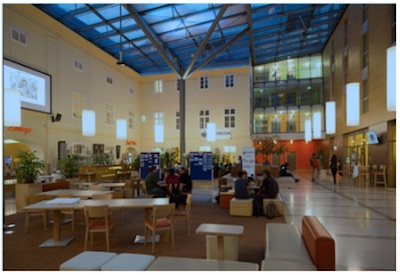
The focus of this document is to take a closer look at Daylight Harvesting systems and the benefits of using this type of lighting intelligence in large interior spaces like atriums, warehouses, and manufacturing environments. First, it is important to define and discuss the two main types of Daylight Harvesting that exist and explain certain types of applications for each.
1. Closed-loop system
The first type of daylight harvesting system is called a closed-loop system. This is widely used in office spaces, hotel rooms, studios, and other smaller areas. A single photosensor measures light from both the natural and artificial light sources and then makes adjustments to the light fixtures to maintain the desired light level. It is called a closed-loop system because the adjustments made to the light are also part of the measurement; it is providing itself feedback, creating a closed loop.
2. Open-loop system
The second type of daylight harvesting system is called an open-loop system. This type of daylight harvesting system is normally used in larger spaces with windows and skylights such as warehouses, atriums, factory floors, distribution centres, and manufacturing plants. A single photosensor measures natural light only, and then makes adjustments to a large group of light fixtures in the area to maintain the desired light level. In this case the sensor should not be installed where it detects or measures the artificial light in the area. In these open loop systems, the sensor is pointed up toward the sky in a skylight installation or pointed to the outside near a large window opening. It is called an open loop system because the adjustments made to the lights are not part of the measurement and therefore there is no feedback loop created, so the system is open
Considerations when implementing a daylight harvesting system
Implementing daylight harvesting or other energy saving controls in small office spaces typically involves a single photosensor measuring light from one window and one to two light fixtures. Each office is a separate system and requires a photosensor to measure and control the light level in that space. The savings from implementing a closed-loop daylight harvesting system are not significant if you just look at the reduction of a single office. Each office uses low power light fixtures and the normal operating hours are from 8:00-5:00 each weekday. Occupancy sensors alone can turn these fixtures off for 12 hours or more each day. The savings from daylight harvesting in these smaller spaces only begins to add up when you measure it across a large number of individual offices in a large campus or building.
Installing a daylight harvesting system in larger commercial or industrial settings requires a different type of implementation. A warehouse, for example, with dozens of forklifts, hundreds of lights, and tall storage racks requires a very different system than a typical office with one window, two lights, and a desk. In larger atriums, warehouses, and in manufacturing facilities the variety of work surfaces and the occurrence of larger items and obstructions are not uncommon. An open-loop system can save significant energy in these applications based on a few core differences found in these larger environments. Here are a few key differences to think about when making a decision about daylight harvesting in these large-scale applications.
1. Sensors performance
Motion sensors are used in larger environments with higher ceilings and work well to detect motion. Basic photosensors have limitations in these environments as they are not designed to accurately measure the reflective light off of a workspace 20 ft. or more from the sensor. A closed loop daylight harvesting system is not recommended for higher ceiling environments for this exact reason. An open loop system uses a single sensor installed and positioned to measure natural light directly from a skylight or large area window. The photosensor range of measurement differs greatly between an open loop and closed loop system. The photosensors used in closed loop systems are normally below 100 foot-candles while the photosensors used in open loop systems measure 1000 foot-candles or more.
2. Operating hours
Typical office spaces operate from 8-5, so natural light changes are minimal and basic photosensors will suffice. Many of these larger environments operate 24/7 and require a much more granular measurement scale than the basic sensors used in a typical office space since the operations occur during sunrise and sunset.
3. Higher fixture input/output
In warehouses, distribution centres, manufacturing facilities, and atriums the light fixtures can be located anywhere from 20 ft. or more from the floor. These higher power fixtures produce more light and also require much more power. That means each high-power fixture that is part of the daylight harvesting system can result in significant energy savings per light compared to lower power fixtures in office environments.
4. Number of fixtures per sensor
In a closed loop system found in most office spaces, the daylight harvesting system is controlled by a single sensor that controls the behaviour of one or two light fixtures. In industrial or larger commercial interior spaces a single sensor is used to control the behaviour of large numbers of lights in a zone. An open loop system can take the measurement of natural light and then easily adjust a large number of lights in an area based on that measurement.
5. Management/configuration
When smaller daylight harvesting systems are installed and configured in office environments the sensors are often delivered with a limited default setting or a handful of general presets. If the sensor is adjustable, it is often changed through manual dials or dip switches or other physical adjustments made directly to buttons on each sensor. This type of manual adjustment is not practical in high bay applications where a scissor lift is necessary to reach each sensor and light fixture. Many systems utilize wireless connectivity as an option in these smaller environments to ease installation time and configuration efforts. In high ceiling applications wireless connectivity is not an option or “nice to have”, it is a requirement.
Summary points
Daylight harvesting systems and other control technologies can save significant energy in offices and other similar applications. These types of rooms and individual work spaces are easily monitored by basic occupancy and photosensors. Measuring the light level and placing a basic occupancy sensor in an office space that has a 10 ft ceiling is relatively straightforward and works best with a closed-loop daylight harvesting system.
In larger environments with ceiling heights of 30 ft. or more, occupancy sensors need to be designed for greater distances and photosensors need to have a foot-candle range to support measuring a wide range of natural light. These shared work environments have a variety of work surfaces and activities. The lights need to be adjusted based on the needs of a particular area. Closed-loop systems in these larger shared areas will not work. Closed-loop systems measure all light sources and they will see too many influences in these large open environments. The result is that each closed-loop sensor sees the activity from other zones and oscillating light levels can occur between zones.
In these applications the lights have a much higher cost, use more power, operate more hours each day, and are typically deployed in very large numbers. Open-loop daylight harvesting systems along with wireless lighting controls can help enable a saving strategy that is designed with all the challenges these large-scale applications bring.
This article was first published online by Synapse Wireless: synapsewireless.com/wp-content/uploads/2018/07/DLH-Whitepaper.pdf