Quebec Study Examines Sector Hazards and Strategies
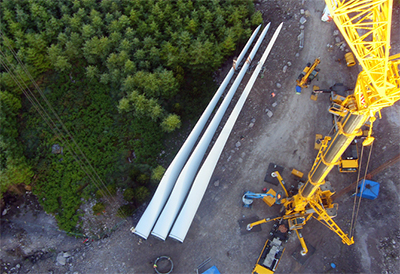
Workers in the wind energy sector face a range of hazards and challenges, according to a new study released by Quebec’s Institut de recherche Robert-Sauvé en santé et en sécurité du travail (IRSST), one of Canada’s leading workplace health and safety research centres. Hazards and challenges include those associated with the mechanical aspects of wind turbines, cardiac risks, and electrical hazards associated with power circuits and control circuits, as well as getting access to company injury prevention plans and timely response from emergency services when performing winter work in isolated locations.
The wind energy sector is an emerging industry across Canada. In Quebec alone, an estimated 1,000 people work full time in the operation and maintenance of Québec wind farms, and another 2,000 are occasionally involved. Work at heights, in confined spaces, isolation, the absence of nearby emergency assistance, the physical requirements to climb towers, work at very low temperatures, and electrocution risks are many of the occupational health and safety challenges in this sector.
This study analyzes the accidents and critical incidents that have occurred in this sector, and injury prevention practices of wind farms located in Quebec and elsewhere in the world. In the process, the researchers created a scientific database on the typical risks to which this sector’s workers are exposed.
To analyze on-site working conditions, the researchers observed technicians performing their operation and maintenance tasks, as well as construction companies and subcontractors during the wind farm construction phase. These observations supplemented the data collection and helped characterize work hazards and procedures.
In many cases, it was noted in the field that only company managers have access toan injury prevention plan.Workers and technicians are aware that a plan exists, and some have read a summary of it, but they have problems getting access to the plan’s detailed guidelines and protocols. In other words, the company can meetgovernment requirements and show that a plan exists, but few workers know its detailed provisions.
The study is believed to be the first to create a health and safety profile of people connected to the industry. Researchers found that injury statistics are fragmentary and injury prevention programs in the industry are “an odd assortment and come in many forms, often simply borrowed from wind turbine manufacturers.” Nor did the researchers find clear, instructive examples of related practices elsewhere in the world. They recommended that companies shift towards implementing adapted prevention plans that comply with Quebec legislation and CSST requirements. In broader terms, the jurisdiction in which the companies are operating.
The project has resulted in a number of changes and advances in workplace accident prevention at several wind energy organizations and companies, the study says.
Find out more: http://www.irsst.qc.ca/en/publications-tools/publication/i/100813/n/wind-sector-safety-risks-prevention-strategies-r-858