The Sun Is Rising on Solar in Canada

Solar Power 1

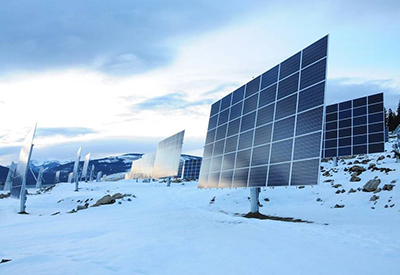
In BC, the site of what once was Canada’s largest lead and zinc mine is now being used to mine sunshine.In June, SunMine, near Kimberley, began feeding energy into BC Hydro’s grid, making it one of BC’s first grid-connected solar photovoltaic (PV) installations and one of Western Canada’s largest solar projects. Using just eight hectares of land, more than 4,000 solar PV modules generate roughly 1 megawatt (MW) of electricity, enough to power about 200 homes, according to Scott Sommerville, Chief Administrative Officer for the City of Kimberley, which now owns the site.

“It’s pretty awe-inspiring when you’re up there, looking at it. It kind of feels like you’re seeing the future,” he says.

The SunMine is built on land used by the former Sullivan Mine, shuttered in 2001, and it is a hotbed of solar potential. The site has one of the highest solar energy intensities in Canada (2,200 hours of annual sunshine, averaging six hours per day), guaranteeing reliable energy production.

Making the site even more attractive for the project is its infrastructure, including roads, high-voltage transmission lines and sub-stations, which were re-fashioned for use by SunMine. Teck, the former mine owner, provided the land as well as $2-million of the $5.3-million cost.

“We like to say we’ve gone from a brownfield to a brightfield. We took land that was dormant and created something,” says Sommerville, who adds that there’s enough land at the SunMine to install up to 200MW worth of modules — enough to power 40,000 homes.

While SunMine is still in the early stages of development, it is a significant project. Not only is it the largest project of its kind in western Canada, it is also one of the largest outside of Ontario, where the lion’s share of Canada’s solar capacity has been installed under the province’s feed-in tariff program.

Established in 2009, the program pays premium rates to businesses and property owners to feed wind- and solar-generated electricity into the grid. Today, the province is up to 19,200 grid-connected PV systems, which generated 1.2 gigawatts (GW) of electricity in 2013.

Noteworthy but much smaller projects also exist further north in the territories, where PV systems work better due to the cool climate.

“There’s way better payback,” says Gordon Howell, a professional engineer and managing principal of Howell Mayhew Engineering in Edmonton.”Electronics like cold and don’t like heat.”

Howell, who has worked in the solar industry for 32 years, has been working on the installation of off-grid PV systems at eight remote telecommunications sites in Yukon and the Northwest Territories, replacing diesel as a fuel source for generating electricity.

When a working solar cell reaches 70 degrees Celsius, the 250-watt PV module will operate at 205 watts, an 18% drop. At a cell temperature of 0 degrees, the 250-watt PV module will operate at 273 watts, 9% better.

Today’s solar PV systems are also long-lasting and adaptable, remaining 80% effective after 25 years. They can be installed on mountaintops, and in windy, humid or salty conditions. They even undergo hail tests, with 25 millimetre steel balls travelling at 80 kilometres per hour used to simulate storms.

“I’m stunningly optimistic about the future,” says Howell.

Internationally, Germany remains the biggest star on the solar stage. According to an annual 2014 International Energy Agency (IEA) report, Germany possessed 38GW of PV capacity. The U.S. has about 16GW of installed capacity. China has made gigantic strides, going from 0.8GW of PV capacity in 2010 to 32GW by March 2015. By the end of 2014, cumulative PV capacity worldwide reached roughly 177GW, enough to supply one percent of the world’s electricity requirements, according to the IEA.


Solar Sun Glass


Related Articles


Latest Articles

  • The Role of Lighting in the AI-Powered Home

    The Role of Lighting in the AI-Powered Home

    January 14, 2026 Elizabeth Parks, President and CMO of Parks Associates, joins Derek Richardson, Founder and CEO of Deako, for a wide-ranging conversation on how lighting is becoming a core layer of the intelligent home. The discussion explores how Deako’s plug-and-play lighting approach is removing long-standing barriers to adoption by simplifying installation, reducing costs, and Read More…

  • What Canada’s Lighting Pulse Means for Contractors and Plant Buyers in 2026

    What Canada’s Lighting Pulse Means for Contractors and Plant Buyers in 2026

    January 14, 2025 By John Kerr From the ground, many contractors and plant teams are experiencing the same thing: jobs are there, but they are smaller, more price‑sensitive, and slower to release compared to past years. The Canadian Pulse of Lighting confirms that impression and offers some clear signals about how contractors and plant electrical Read More…

  • Guide to the Canadian Electrical Code, Part 1 – 26th Edition[i] – A Road Map: Section 54

    Guide to the Canadian Electrical Code, Part 1 – 26th Edition[i] – A Road Map: Section 54

    January 12, 2026 By Bill Burr The Code is a comprehensive document. Sometimes it can seem quite daunting to quickly find the information you need. This series of articles provides a guide to help users find their way through this critical document. This is not intended to replace the notes in Appendix B or the Read More…

  • Tom Penton & Magic Lite: Forty Years of Leadership in Canadian Lighting

    Tom Penton & Magic Lite: Forty Years of Leadership in Canadian Lighting

    January 12, 2026 By John Kerr Sales has always been at the core of Magic Lite’s story, because it was at the core of who its founder Tom Penton was. He genuinely loved sales, loved being independent, and consistently gravitated to roles where he could take personal responsibility for results and build his own customer Read More…


Changing Scene

  • Hammond Manufacturing Expands to Western Canada

    Hammond Manufacturing Expands to Western Canada

    January 13, 2026 Hammond Manufacturing have announced that they are opening a new distribution facility in the Southeast of Calgary, Alberta. The new facility includes over 50,000 sq ft of warehouse space. “This addition will better serve our customers in Western Canada and stock volume and larger products to ensure our distributors have an improve stock Read More…

  • ABB Chosen to Supply Technology for BC Ferries’ New Major Vessels

    ABB Chosen to Supply Technology for BC Ferries’ New Major Vessels

    January 12, 2026 ABB will supply a complete package of power, propulsion and control technology for four new double-ended passenger and car ferries operated by British Columbia Ferry Services (BC Ferries). One of the largest ferry operators in the world, BC Ferries provides year-round vehicle and passenger service on 25 routes to 47 terminals, carrying Read More…

  • Federal Government Invests in Four Ontario Steel Companies

    Federal Government Invests in Four Ontario Steel Companies

    January 12, 2026 Through targeted investments, the Government of Canada is committed to providing support to help businesses in all sectors, including steel and automotive, to respond, adapt and compete amid shifting market conditions. Evan Solomon, Minister of Artificial Intelligence and Digital Innovation and Minister responsible for the Federal Economic Development Agency for Southern Ontario Read More…

  • Craftsman V20 150W Power Inverter Recalled Due to Fire Hazard

    Craftsman V20 150W Power Inverter Recalled Due to Fire Hazard

    January 12, 2026 This recall involves the Craftsman V20 150W Power Inverter (Model number: CMCB1150B). The product has a rectangular prism shape with dimensions of 8.13 x 7.62 x 11.68 cm. It is red and black and weighs 320 grams. It has three charging ports for Type-C, Type-A, and AC connections. It contains an LED Read More…