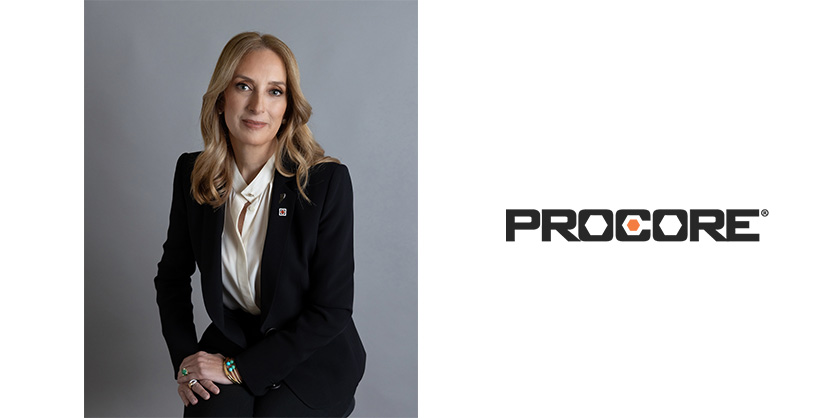
A Discussion with Anna Schlegel, Global VP with Procore on Diversity, Equity, & Inclusion
May 15, 2023
By Elle Bremmer
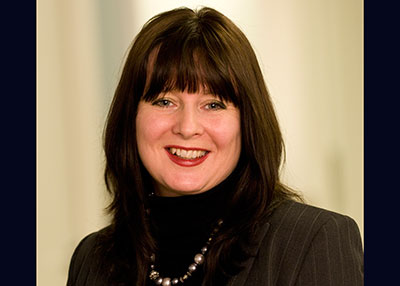
Diversity, equity, and inclusion. These three buzzwords are flying all over our industry right now. I sat down with Procore’s VP of Global, Anna Schlegel, who offered up her unique perspective on what DEI efforts mean to her, to the industry, and how Procore is working hard as a construction industry leader to implement best practices to support these efforts, and tackle other challenges, such as the labour shortage. Plus, what the term means for independent contractors in the industry. She also touches on new developments at Procore, as well as offering her insight and expertise in the industry.
A native of Catalonia, Spain, but based out of California, Schlegel has a truly global and holistic worldview. She is an internationally acclaimed author of the book “Truly Global,” co-founded the non-profit Women in Localization, and has been recognized as the Most Impactful Woman in Technology in December 2020 by Analytics Insight, among many other awards and acclaims. She has worked in global engineering and localization for the past thirty years and is coming up on her second year working with Procore.
Schlegel is proud to work at Procore, and touts company culture as one of the great benefits of being on their team. Citing one of her colleagues as an example, she says, “employees can take time off to give back to their communities. We have an internal channel where you see people posting about their own interests and passions. I have a guy on my team that gave himself a goal of raising $1 million for charity. […] So, there is a lot of employee activity that is very celebrated.”
Also celebrating Procore’s DEI efforts she says, “we [also] have a very strong diversity, equity, inclusion and belonging department that we call DEIBs.” Schlegel explained that DEIB encompasses ‘diversity’ which is accepting and respecting everything that makes us unique, including both seen and unseen characteristics; ‘equity,’ which is eliminating structural barriers and creating fair treatment, access, opportunity and advancement; ‘inclusion’ entails creating space to contribute, participate and amplify everyone’s voices – being respected, supported and valued for who you are; and finally, ’belonging’ means building a community of trust, where all voices are heard and we feel safe bringing our authentic selves to work.
“I come from working at very large companies with 70,000 or 80,000 employees that had smaller departments than we do at Procore. I was very surprised to see how people-centric this company is when I arrived, which speaks volumes about [Procore].”
Procore currently has 3,500+ employees globally.
Schlegel spoke highly about her colleague, Steve Zahm, one of the co-founders of the company, and currently President and Chief Culture Officer of Procore. She emphasized that “he leads an organization within Procore that is completely separate from HR ” which she describes as very important for implementing DEIB efforts effectively.
Procore has also championed the Women in Construction initiative, which strives to provide women in the industry with connections and support that they might need in their work. To date, over 13,000 people have benefitted from this initiative. It is important to keep these efforts up, because as of the most recent figures, the construction industry comprises only around 13 per cent women in Canada, and around 11 per cent in the United States.
Through its social impact arm Procore.org, the company works with colleges and universities across Canada and around the world to attract more young students to the construction industry. For example, the company is partnering with Southern Alberta Institute of Technology (SAIT). In addition to its programs aimed at high school students, SAIT works to reach girls in junior high. Schlegel says, “the Dean of Academic Services at SAIT told us the goal is ‘to expose young women to some of the opportunities that might be available to them, and to also help build their confidence in a space where they might not realize that they’re capable’. We strongly believe the partnerships among the industry, educational institutions and companies/technology service providers are crucial in addressing labour shortages and attracting a more diverse workforce.”
At Procore’s Groundbreak conference last November, I attended a seminar on women in construction and I was taken aback, not only by those figures, but the fact that implementing DEI efforts for marginalized people in the industry makes job sites safer for everybody, including men. They feel more comfortable coming forward reporting incidents of harassment and a culture of jobsite safety is supported as well. I asked Schlegel how we can end the stigma of women and marginalized individuals working in construction, and how we can encourage them to enter the industry, especially when faced with a looming labour shortage.
In response, she said:
“Let’s say [the percentage of women in the industry] is around 10%. That’s very intimidating! I have worked in engineering teams where it was around 6% female, and it can get very masculine, and the energy can be pretty rough. We are talking to 98 universities in the states and 11 in Canada discussing this very topic, which is not that different from women in technology and women in engineering. I have been working for 20 some years where you see women start with a lot of energy and enthusiasm, but over time they get burnt out and then drop out. And when a big concern for the US, Canada, and Europe is a global labour shortage, we want to be accommodating and welcoming as many individuals as possible. So it is not even from the standpoint of just having DEIB, which is great on its own, but for practical reasons too. We just need more workers in this industry.”
In fact, workplace stress and burnout is a big problem for everyone in the industry, not just for men. The construction industry has the highest suicide rate of any industry, along with incredibly high levels of self-reported workplace stress, which is a major safety risk in the industry. However, when more women and marginalized individuals enter the industry, they also bring new perspectives and new needs that can lead to broader organizational changes. For example, if a woman starts a job in the construction industry and has a baby, she may ask for more maternity leave or a flexible schedule, which in turn may encourage men to ask for paternity leave and flexible schedules for childcare. They start to have more important discussions that weren’t had before and increase employee retention, satisfaction, and well-being. This example of equity leads to more mentally healthy organizational cultures, reducing risk of burnout and employee turnover.
On how to attract more marginalized individuals to the construction industry and how to break the stigma that can accompany these individuals working in the trades, Schlegel said, “Technology and training play a key role in how firms compete, win work and build a pipeline of repeat business. Yet, providing marginalized communities easy access to tech and construction education is one of the biggest hurdles faced by the industry. At Procore, we work on removing that obstacle by ensuring marginalized individuals have what they need to enter the construction workforce successfully.”
Helping to get more workers into the industry is vital. In a recent survey commissioned by Procore, 92 per cent of Canadians agreed there is an urgent need to build more or update current infrastructure in Canada over the next two years.
In addition to the women in construction initiative mentioned before, Schlegel said they also give non-profit builders in Canada and the U.S. free access to Procore’s full platform and support services as well as the training and certification necessary to optimize their projects. She added, “In 2021, we partnered with the National Association of Minority Contractors (NAMC), the oldest minority construction trade association in the U.S. We’ve provided free Procore product training to NAMC National Members, NAMC Regional Chapter Members, and NAMC historically Black colleges and universities partners.”
Schlegel also emphasizes the importance of recognizing globalization in DEI efforts, stating:
“We are dealing with such a global and distributed workforce in all industries. Folks are coming in from many different countries to make a living. There are so many geopolitical dynamics right now, and we are seeing our GCs and owners talking about where they themselves must employ in the world of construction. We see European companies, American companies, Canadian companies go and build elsewhere. So, who do they bring? They bring in the workforce from Eastern Europe, North Africa, from Asia. Now they must think about new sets of languages and cultures.”
While executives and owners may not be opening an office in all of these new locations, software like Procore can aid by offering itself in many different languages, such as simplified Chinese, which is in beta right now as Schlegel says. Many new workers can begin to understand the platform and the projects that they are working on, helping them connect to their global counterparts across different countries.
“They need to understand each other [linguistically and culturally]. So I think that this diversity and inclusion is not just about men and women, it is also cultural.”
I asked her where she saw the industry headed, and what her personal forecast was for its direction. Touching on digitization and globalization, she discusses how Procore fits into this vision of the future of the industry.
Schlegel tells me, “As the construction industry continues to build sophisticated technology, this will present more opportunities for women in software development, project management, business development, financing and payment tools specific to the industry, marketing and more. A 2022 Construction Talent Retention Survey suggests that the main successful retention driver for women in construction is career development, followed by work-life balance and a sense of belonging.”
She adds, “It’s all in the power of the network.”
“A lot of these companies are becoming more efficient as they digitize, and they don’t want 10, 20 vendors. I think there will be a large reduction of who these vendors are. That’s why at Procore, we are one multiservice platform where you can do anything, you can find your subcontractors and all of your files in one place. In the future, you will see a lot more global collaboration, which comes through digitization. One thing that we are working on now is the Procore Construction Network, or PCN. We are about to start testing it in Canada.”
She describes the PCN and how it can be used further, “If you are an electrician, you are able to place your business onto the PCN and anybody can start hiring you for your services. You will be able to give them thumbs up or thumbs down [for their work]. You will also be able to keep track and record all of the finances for this project. You retain all of the documentation for the subcontractors and the projects.”
Overall, she says, “With PCN, we hope to be able to help you.”
A challenge she notes in globalization efforts in the construction industry is dealing with standards and codes that can vary greatly by region, which is again something Procore construction management software is looking to tackle.
“We’re seeing an elevated number of standards and compliances and codes needed per region. So projects can become lengthier because of all these compliance hurdles, and it can be a pretty high bar to be able to build something. If I am from Spain and I want to build something in Canada, with PCN I can start looking for local subcontractors.”
Finally, a personal change Schlegel would like to see in the industry is a bigger push towards sustainability. She says that all companies big and small can do their part by tackling the little things first. She emphasizes things such as not ordering material twice, avoiding rework, and properly disposing of materials as solutions that people can start implementing immediately. For larger companies, she throws out the idea of having a Chief Sustainability Officer.
“A leader, an individual dedicated solely to sustainability,” she says.
Schlegel’s insightful comments remind us that DEI efforts are more global than what might appear on the surface, and that many other angles of organizational management and organizational wellness ought to be considered to successfully implement DEI initiatives in our industry. As construction continues to digitize and globalize, DEI and sustainability efforts will continue to come with it to foster a thriving, successful, and diverse industry for all.