Sustainable Tourism with ABB Technology
Sustainability

Sept 11, 2019

ABB’s innovative technology is helping people explore the world in environmentally friendly ways, and it’s just in time. International tourist arrivals are expected to reach a staggering 1.8 billion in 2030. This is a jump of about 29% from 2018, according to the World Tourism Organization, the United Nations agency responsible for the promotion of responsible, sustainable and universally accessible tourism.

ABB is a leader in developing sustainable technologies. Here’s a brief look at some of ABB’s sustainability achievements in the tourism industry:

• ABB is a global leader in fast-charging solutions for electric vehicles (EV) with more than 11,000 DC fast chargers sold across 76 countries worldwide. For example, IONITY, which aims to build a charging net-work of approximately 400 fast charging stations across 24 European countries, has selected ABB as its main technology partner. Together they aim to make sustainable European road trips a reality, with ABB’s advanced high-power chargers capable of providing 200 km of range in just eight minutes.

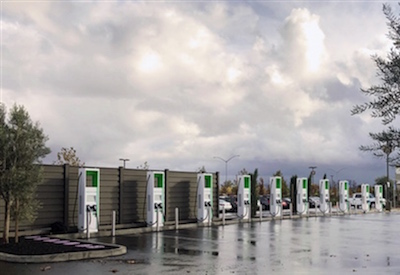
• ABB is also providing its Terra HP fast-charging stations in the United States [IT](shown in photo)[IT]. ABB chargers are used by EVgo as part of the largest public fast-charging network in the country and Electrify America, a project that plans to deploy hundreds of charging stations within and around 17 metropolitan areas and along multiple nationwide highway corridors in the U.S.

ABB’s innovative technologies for sustainable marine transportation are being used around the world. In one of its most iconic electric marine projects, ABB powers a futuristic hybrid ferry on Norwegian fjords. The ferry carries up to 400 tourists between Flåm and Gudvangen along the Nærøyfjord in the west of Norway, a distance of around 32 km. Once it has arrived in the most scenic part of the fjord the ferry switches to battery power, allowing sightseers to enjoy the nature in almost complete silence at around 8 knots (approx. 15 km/h). The fjord is on UNESCO’s World Heritage List because it remains largely unspoiled by human development and the ferry is designed with the surroundings in mind.

Sustainable Boating


In September, visitors to the iconic Niagara Falls will experience one of the U.S.’s top landmarks emission free. Two new Maid of the Mist passenger vessels will be powered entirely by high-capacity battery packs, becoming the first all-electric vessels ever built in the US. These boats carry an estimated 1.6 million guests annually to the base of Niagara Falls.

Adding to this, ABB has powered two vessels run by ForSea, which will utilize battery power to cover the 4 km stretch between Helsingør, Denmark, and Helsingborg, Sweden. The vessels — Tycho Brahe and Aurora — have become the world’s largest emission-free electric ferries, and operate on a high-intensity route that carries more than 7.4 million passengers and 1.9 million vehicles annually. The battery solution will reduce emissions across the fleet substantially. 

Another key aspect of ensuring sustainable tourism is to enable effective energy savings. ABB drives and high-efficiency motors help to reduce energy usage of the InterContinental Hotel Madrid by 40%. Energy usage has been reduced by 445,000 kWh a year — enough to boil two million kettles of water.

ABB is also helping conserve energy with Europe’s top-rated thrill ride, at the Liseberg amusement park in Gothenburg, Sweden. The Loke Gyro Swing, a giant pendulum ride that reaches thrilling speeds of up to 100 km per hour, is controlled by an ABB regenerative drive. The drive utilizes the braking energy as the ride slows down and stops to generate electricity that feeds back to the grid. Each ride cycle captures 1.4 kWh, or enough energy to power a large air conditioner for an hour.

This article was first published online by ABB.

Related Articles


Latest Articles

  • Industrial Construction Intentions Drive Increase in Non-Residential Sector in January

    Industrial Construction Intentions Drive Increase in Non-Residential Sector in January

    March 13, 2026 In January, the total value of building permits issued in Canada increased $607.0 million (+4.8%) to $13.3 billion. The increase was led by the non-residential sector (+$464.0 million) and supported by the residential sector (+$143.0 million). On a constant dollar basis (2023=100), the total value of building permits issued in January rose 4.3% from the previous month Read More…

  • Multi-Unit Construction Drives Growth in December Residential Construction Investment, 2025 Review

    Multi-Unit Construction Drives Growth in December Residential Construction Investment, 2025 Review

    March 13, 2026 The total value of investment in building construction increased $442.9 million (+1.9%) to $23.7 billion in December. The residential sector grew 2.4%, while the non-residential sector edged up 0.6%. Year over year, investment in building construction grew 12.2% in December. On a constant dollar basis (2023=100), the total value of investment in building construction in December rose 1.7% Read More…

  • 5 Strategic Reasons to Attend the Lumen Exhibition

    5 Strategic Reasons to Attend the Lumen Exhibition

    March 13, 2026 In a market where deadlines are tight and projects are increasingly complex, staying competitive is no longer just about technical skills. It also depends on having the right tools, the right information, and the right partners by your side. The Lumen Exhibition is more than just an event—it’s a strategic lever designed to Read More…

  • BCCA Official Statement on Construction Projects Procurement Act

    BCCA Official Statement on Construction Projects Procurement Act

    March 13, 2026 On March 5, 2026, Kiel Giddens, MLA for Prince George – Mackenzie and Critic for Labour, introduced the Construction Projects Procurement Act, a Private Member’s Bill aimed at restoring fair and open procurement on public construction projects in British Columbia. BCCA has a long history of advocating for fair and open public procurement. Read More…


Changing Scene

  • Nova Scotia Strengthens Housing Legislation to Accelerate Supply

    Nova Scotia Strengthens Housing Legislation to Accelerate Supply

    March 13, 2026 Amendments to existing legislation will mean more housing, improved efficiency in the sector and better alignment of related agencies. The changes extend the Executive Panel on Housing in the Halifax Regional Municipality and give the Minister of Housing new authority to ensure housing projects aren’t delayed. “We are strengthening how we plan, Read More…

  • Sonepar Company Opens a New Automated Distribution Center in Las Vegas

    Sonepar Company Opens a New Automated Distribution Center in Las Vegas

    March 13, 2026 Codale Electric Supply, a Sonepar company, is transforming electrical distribution with the launch of its central distribution center located just off the Las Vegas Strip, in October 2025. The site features a highly automated setup designed to improve speed, accuracy, and customer convenience. At the heart of the facility is an advanced Read More…

  • BC Introduces Public Sector Construction Projects Procurement Act

    BC Introduces Public Sector Construction Projects Procurement Act

    March 13, 2026 Kiel Giddens, MLA for Prince George-Mackenzie and Critic for Labour, has introduced the Public Sector Construction Projects Procurement Act, legislation aimed at ensuring publicly funded construction contracts are awarded through labour-neutral, merit-based procurement. “Here’s the simple question: if labour shortages are driving cost overruns, why would government limit who can work on public projects?” Read More…

  • KPMG Establishes Major Products Delivery Office

    KPMG Establishes Major Products Delivery Office

    March 13, 2026 KMPG: Complex projects require well-structured teams, appropriate delivery models tailored to the project’s needs, robust governance frameworks, and stable execution environments: KPMG Canada Canada is entering a defining era of major project development that has significant implications for the nation’s economic future, as the country works to establish new trade partnerships, develop its resources, reinforce Read More…