Determine the Right Arc Flash Protective Clothing for Each Application
Safety SPI

May 6, 2020

The risk of electric explosion and arc flash injuries is high, from superficial burns to fatalities. The leading causes of occupational accidents are deficient maintenance and inspection of installations as well as unsafe practices due to inadequate training.

It is essential to wear AF clothing when there are arc flash risks. Wearing AF and fire-resistant clothing will protect the workers from injuries generally caused by momentary and continuous ignition of non-flammable clothing. As AF clothing is self-extinguishing, it limits possible injuries.

To select the right work gear, incident energies must first be estimated. Only after estimating how many calories per square centimeter is performed that the worker is able to make an informed choice.

AF clothing is divided into four different categories: category 1, category 2, category 3 and category 4. The right clothing category for a particular application must be determined by the estimated incident energy that is calculated and according to the requirements of the standard CSA Z462-2018.

• Category 1: clothing with minimum arc index of 4 cal/cm2
• Category 2: clothing with minimum arc index of 8 cal/cm2
• Category 3: arc-rated clothing of at least 25 cal/cm2
• Category 4: arc-rated clothing of at least 40 cal/cm2

At Bulwark, most monolayer clothing used for low and high-voltage power line work provides a minimum protection of 8 calories per cm2. If all estimates are fewer than 8 calories per cm2, category 2 clothing is sufficient. For installations with risks higher than 8 cal/cm2, simply increase the distance between the work and the arc (until obtaining an estimated 8 cal/cm2 or lower) or add additional clothing layers until reaching the right protection level for incident energy.

Multi-layer system

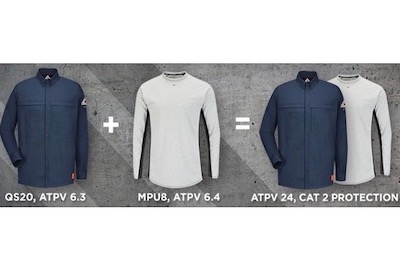
The multi-layer system proposes putting on two layers or more of AF clothing in order to reach a higher protection level. It is mandatory that the outer layer is AF approved and the inner layer is made of natural fibres. Sometimes, two lighter layers of lesser categories may offer a better protection than a single layer of a higher category. However, it is not simply a matter of adding up layers to increase the protection level. The efficiency of all layers together must be tested in order to assess the overall protection. It is with this in mind that the Bulwark Arc Rating Calculator becomes an important tool. This calculator proposes the best AF clothing combination according to a pre-selected clothing item and the arc flash protection needed.

In the example shown below, there are 35 possible combinations with the item MPU8 for an estimated arc of 20. It is also possible to refine the search by specifying the desired category and fabric type. A valuable tool to make safe choices.

This article was first published online by SPI Health and Safety; www.spi-s.com/en/blog/electrical-safety/the-right-arc-flash-protective-clothing-for-each-application. The company’s mission is to be the single most valuable partner for companies that value health and safety in their work environment.


Related Articles


Latest Articles

  • Ottawa Day 2026: EFC Members Engage with Parliamentarians on Canada’s Electricity Future

    Ottawa Day 2026: EFC Members Engage with Parliamentarians on Canada’s Electricity Future

    March 16, 2026 By Electro-Federation Canada Following EFC’s recent update on our 2026 Ottawa Day, we are pleased to share photo highlights from two days of engagement on Parliament Hill, where members met with federal decision-makers to discuss the future of Canada’s electricity system. More than 40 EFC member leaders and Government Relations representatives travelled Read More…

  • Industrial Construction Intentions Drive Increase in Non-Residential Sector in January

    Industrial Construction Intentions Drive Increase in Non-Residential Sector in January

    March 13, 2026 In January, the total value of building permits issued in Canada increased $607.0 million (+4.8%) to $13.3 billion. The increase was led by the non-residential sector (+$464.0 million) and supported by the residential sector (+$143.0 million). On a constant dollar basis (2023=100), the total value of building permits issued in January rose 4.3% from the previous month Read More…

  • Multi-Unit Construction Drives Growth in December Residential Construction Investment, 2025 Review

    Multi-Unit Construction Drives Growth in December Residential Construction Investment, 2025 Review

    March 13, 2026 The total value of investment in building construction increased $442.9 million (+1.9%) to $23.7 billion in December. The residential sector grew 2.4%, while the non-residential sector edged up 0.6%. Year over year, investment in building construction grew 12.2% in December. On a constant dollar basis (2023=100), the total value of investment in building construction in December rose 1.7% Read More…

  • 5 Strategic Reasons to Attend the Lumen Exhibition

    5 Strategic Reasons to Attend the Lumen Exhibition

    March 13, 2026 In a market where deadlines are tight and projects are increasingly complex, staying competitive is no longer just about technical skills. It also depends on having the right tools, the right information, and the right partners by your side. The Lumen Exhibition is more than just an event—it’s a strategic lever designed to Read More…


Changing Scene

  • A New Guillevin.com, Designed to Simplify Your Purchasing Experience

    A New Guillevin.com, Designed to Simplify Your Purchasing Experience

    March 16, 2026 Guillevin.com was built as a digital working tool, designed to support the way their customers plan, search for, and purchase products today. The goal is simple: to offer a fast, reliable, and intuitive online platform capable of supporting real-world operations; both on the job site and in the office. A platform built around Read More…

  • Nova Scotia Strengthens Housing Legislation to Accelerate Supply

    Nova Scotia Strengthens Housing Legislation to Accelerate Supply

    March 13, 2026 Amendments to existing legislation will mean more housing, improved efficiency in the sector and better alignment of related agencies. The changes extend the Executive Panel on Housing in the Halifax Regional Municipality and give the Minister of Housing new authority to ensure housing projects aren’t delayed. “We are strengthening how we plan, Read More…

  • BC Introduces Public Sector Construction Projects Procurement Act

    BC Introduces Public Sector Construction Projects Procurement Act

    March 13, 2026 Kiel Giddens, MLA for Prince George-Mackenzie and Critic for Labour, has introduced the Public Sector Construction Projects Procurement Act, legislation aimed at ensuring publicly funded construction contracts are awarded through labour-neutral, merit-based procurement. “Here’s the simple question: if labour shortages are driving cost overruns, why would government limit who can work on public projects?” Read More…

  • KPMG Establishes Major Products Delivery Office

    KPMG Establishes Major Products Delivery Office

    March 13, 2026 KMPG: Complex projects require well-structured teams, appropriate delivery models tailored to the project’s needs, robust governance frameworks, and stable execution environments KPMG Canada is entering a defining era of major project development that has significant implications for the nation’s economic future, as the country works to establish new trade partnerships, develop its resources, reinforce self-reliance Read More…