CanREA: Canada’s Wind, Solar, and Energy Storage Sector Grew by 10.5% in 2022

February 23, 2023
The Canadian Renewable Energy Association (CanREA) has announced the industry’s year-end data, reporting that Canada’s wind and solar energy sectors grew significantly in 2022.
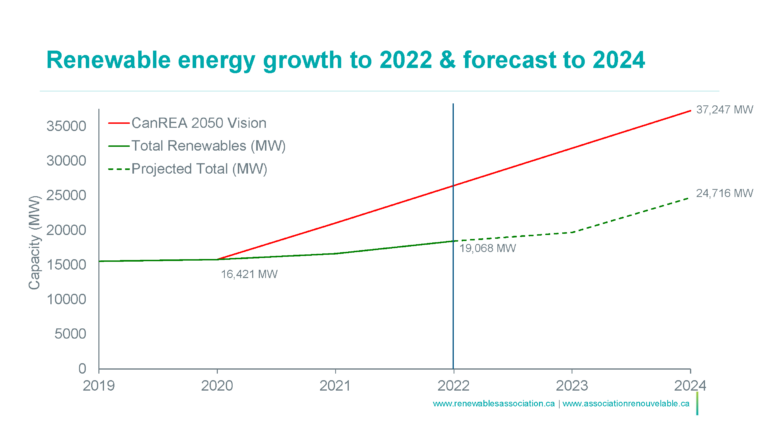
“I am happy to see that, across Canada, the sector grew by an impressive 10.5% this year,” said Phil McKay, CanREA’s Senior Director, Technical and Utility Affairs. “Canada now has an installed capacity of more than 19 GW of utility-scale wind and solar energy, having added more than 1.8 GW of new generation capacity in 2022.”
Of note: Solar is growing particularly quickly—more than one quarter of all the installed capacity in Canada was added this year alone.
Western Canada accounted for 98% of Canada’s total growth in 2022, with Alberta adding 1,391 MW and Saskatchewan adding 387 MW of installed capacity this year. Quebec contributed 24 MW to the total growth for 2022, Ontario 10 MW, and Nova Scotia 2 MW.
As it grows, the renewables sector is emerging as an important force for job creation, primarily in the construction of new facilities, but also in the ongoing operations and maintenance of these sites. Canada’s wind and solar industry accounted for approximately 4,462 person-years of employment in 2022, having grown by an impressive 86% this year (it was 2,400 in 2021).
“Growth in the renewables sector means job growth for Canadians,” said McKay, “and we are anticipating these employment opportunities to keep expanding exponentially as the renewables industry continues to grow.”
While this year’s growth of 1.8 GW was significantly larger than last year’s (less than 1 GW in 2021), it does not meet the growth rate called for in CanREA’s 2050 Vision, Powering Canada’s Journey to Net-Zero, which states that Canada needs to deploy more than 5 GW of new wind and solar energy every year to meet its commitment to net-zero GHG emissions by 2050.
“Canada is just starting to take advantage of its wind and solar energy potential,” said Vittoria Bellissimo, CanREA’s President and CEO. “The country needs to do more to unlock the benefits of the enormous opportunities offered by renewable energy. We have massive, untapped wind and solar resources, the lowest-cost sources of new decarbonized electricity generation available today.”
Significantly more growth in the deployment of wind and solar energy can be expected in the near future. CanREA’s data team is tracking more than 2 GW of projects that are currently under construction across Canada, plus another 6 GW of projects in advanced stages of development, for a total forecast of more than 5 GW of wind, 2 GW of major solar and 1 GW of energy storage expected in the next few years.
At the same time, CanREA is working with federal and provincial governments to unlock many more GWs of additional opportunities in their jurisdictions.
“CanREA is working hard to dramatically accelerate and expand the deployment of wind, solar and energy-storage technologies—there are several policy, regulatory and infrastructure barriers that we think need to be addressed,” said Bellissimo.
To download a summary of the latest industry data for Canada, visit CanREA’s “By the Numbers” webpage. CanREA members have access to a more detailed report on the members-only side of the website.
Facts at a Glance
Current state of the industry, growth & forecasts
- Overall, the wind, solar and energy storage sector grew by 10.5% this year.
- As of December 31, 2022, Canada had an installed capacity of more than 19 GW of utility-scale wind and solar energy.
- Canada added more than 1.8 GW of new generation capacity in 2022, significantly larger than last year’s growth (1 GW in 2021).
- CanREA is forecasting the addition of more than 5 GW of wind, 2 GW of major solar and 1 GW of energy storage capacity in the short term (2023-5).
- CanREA is working hard to unlock massive opportunities for renewable energy in the coming years.
Turning the spotlight on solar energy
- Solar energy grew by 25.9% (810 MW) in 2022, to a new total installed capacity of nearly 4 GW.
- More than a quarter of Canada’s current solar capacity was installed in 2022.
- Alberta accounts for almost all this growth, with 759 MW of 771 MW. Saskatchewan installed 10 MW, Nova Scotia 2 MW, and Yukon 0.1 MW this year.
- As of December 31, 2022, Ontario had more than 1.9 GW of installed solar PV capacity, powering nearly 517,000 homes.
- This year’s growth was not on par with CanREA’s 2050 Vision, which calls for the addition of 1.6 GW of utility-scale solar annually.
From coast to coast to coast, wind is a winner
- Wind energy grew by 7.1% (1 GW) this year, to a new total of more than 15 GW of installed capacity.
- Western Canada blew ahead of the pack in 2022, thanks to significant growth in Alberta (nearly 605 MW) and Saskatchewan (377 MW), as well as some (24 MW) new wind in Quebec.
- This year’s growth was not on par with CanREA’s 2050 Vision, which calls for the addition of 3.8 GW of wind annually.
- Across Canada: As of December 31, 2022, Ontario had more than 5.5 GW in total installed wind capacity, powering nearly 1.5 million homes. Quebec had nearly 4 GW. Alberta had a new total of 2.6 GW, Saskatchewan had 804 MW of installed wind capacity, and Nova Scotia had 616.
Recharging the grid with energy storage
- Across Canada, energy storage increased by 30.5% or 50 MW this year, now accounting for nearly 214 MW of energy storage capacity (347 MWh duration), up from 164 MW/ 277 MWh in 2021.
- This increase was led by Alberta (40 MW/ 40 MWh). Alberta doubled its energy storage capacity this year.
- Across Canada: As of December 31, 2022, Ontario had the most installed energy storage capacity, with 126 MW/ 240 MWh, having added 10 MW/ 30 MWh in 2022, while Alberta had 82 MW/ 92 MWh. In addition, BC, Quebec, NB, SK, PEI also had some energy storage capacity.
![Guide to the Canadian Electrical Code, Part 1[i], 26th Edition– A Road Map: Section 76 — Temporary Wiring](https://electricalindustry.ca/wp-content/uploads/2026/05/EIN-Stock-Guide-Code-Canada-Map-1200-768x403.png)



![Guide to the Canadian Electrical Code, Part 1[i], 26th Edition– A Road Map: Section 76 — Temporary Wiring](https://electricalindustry.ca/wp-content/uploads/2026/05/EIN-Stock-Guide-Code-Canada-Map-1200.png)