BC Hydro Completes Major Upgrade at George Tripp Substation
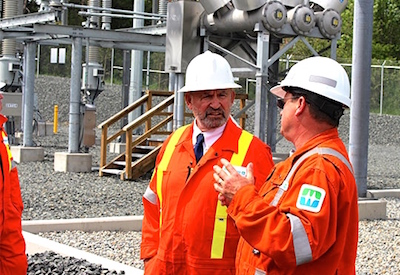
BC Hydro has completed a $47 million expansion of the George Tripp substation to help meet the growing needs of the Greater Victoria area for a reliable supply of power.
“The demand for electricity in Victoria will increase by about 2% per year over the next 10 years and this important investment at George Tripp will help us meet that demand,” says Energy and Mines Minister Bill Bennett, shown in the photo at the George Tripp substation. “We are making investments like this all over Vancouver Island. In fact, BC Hydro will spend about $2 billion over the next decade on the island to upgrade existing assets and build new infrastructure to support the growing population and economy. These capital projects will create 9,300 person-years of employment.”
Construction on the George Tripp project began in 2013. Project work involved adding a new step-up transformer and switchgear breaker equipment, and installing a new 230 kilovolt underground transmission cable that connects to nearby Horsey substation.
“Between the upgrades at George Tripp substation and the ones nearing completion at Horsey substation, this represents a $95 million investment to upgrade Victoria’s two major substations,” says Greg Reimer, Executive Vice President, Transmission, Distribution & Customer Service, BC Hydro. “Most of our infrastructure in the area was built decades ago and is in need of reinvestment so that we can continue providing reliable power to our customers when they need it.”
About 75 jobs were created over two and a half years of construction between the George Tripp and Horsey projects. Nanaimo-based F&M Installations provided cable installation for the new underground transmission cable. BC Hydro is in the midst of a major capital plan that is investing, on average, $2.4 billion a year, over the next 10 years in the system. Examples of capital projects on Vancouver Island currently under way or nearing completion include:
- John Hart generating station replacement project in Campbell River ($1 billion)
- South Wellington substation project in Nanaimo ($29 million)
- Buckley Bay substation project in the Comox Valley ($28 million)
- Campbell River substation project ($25 million)
About 400 Vancouver Island companies currently help BC Hydro with capital project work across the province.
Photo courtesy of BC Hydro.






![Guide to the Canadian Electrical Code, Part 1[i], 26th Edition– A Road Map: Section 76 — Temporary Wiring](https://electricalindustry.ca/wp-content/uploads/2026/05/EIN-Stock-Guide-Code-Canada-Map-1200.png)