Power Utility in Sarnia-Lambton Fined in Electrocution Death of Worker
Bluewater Power


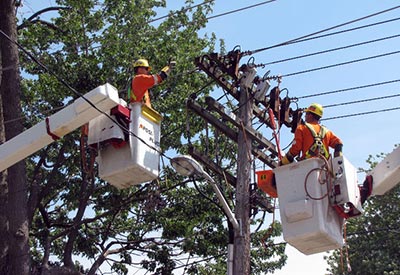
Bluewater Power Distribution Corporation, the utility providing electricity distribution and related services in the Sarnia-Lambton area, has been fined $120,000 in the 2012 death of a worker who was performing repair work following the aftermath of Hurricane Sandy.

The worker was one of two who had been assigned post-storm repair work on Passingham Drive in Sarnia, where trees had downed power lines. On October 31, 2012, the two workers cleared tree limbs and began to repair the electrical lines. One worker was working from an aerial bucket while the other was working from the ground, and they began working on the downed primary neutral line.

Up until that point, the worker in the aerial bucket had been working with leather gauntlet gloves and was preparing to make the final connection by fastening the neutral end to a connector that completes the circuit path. That worker called down to the other to bring rubber gloves from the cab of their truck. While the worker was heading to the truck cab to retrieve the rubber gloves, the truck shook and the boom of the bucket dropped.

The supervisor was immediately called and both ambulance and the fire department were summoned. The worker in the bucket was taken to hospital and could not be revived. Cause of death was determined to be electrocution.
An investigation revealed that no job plan or tailboard was in place prior to the commencement of work. A job plan is typically prepared by a power line technician when the technician arrives at the job site in order to assess the work that needs to be carried out. A tailboard conference – or job site planning meeting – is used to review the job plan, identify hazards and determine how to best mitigate these hazards before work begins.

Job planning and documentation of a tailboard is a requirement under the Electrical Utility Safety (EUSR) Book, Rule 107. These rules have been established as a minimum standard for safety precautions to be followed by employers and workplaces that do not fall under the jurisdiction of Ontario Regulation 851/91 (the Industrial Establishments Regulation) or Ontario Regulation 213/91 (the Construction Projects Regulation).

In this instance, a properlyestablished job plan and tailboard conference would have addressed some of the key hazards and safety failings present at the site. In a statement, the worker who was on site indicated that a job plan was normally completed prior to the project; it was not completed in this instance because they were anxious to bring the power back to the community.

Although both workers had over 20 years of experience each and had been trained on the importance of wearing rubber gloves at all times upon stepping into the aerial bucket on a boom truck, the job plan and tailboard conference would have reiterated the need for using rubber gloves at all times when working on any pole or structure carrying energized conductors. The worker had been wearing leather gloves, which have a reduced electrical resistance compared to rubber gloves. Following the incident, the worker’s gloves were found to contain some dampness, which would have further weakened their resistance to electricity.

The workers should have taken the measure of treating the neutral conductor as energized (“live”) as indicated in Rule 116 of the EUSR Book.

Bluewater Power Distribution Corporation pleaded guilty to failing as an employer to ensure that workers performed a documented job plan before performing work on or in proximity to energized electrical equipment in accordance with Rule 107 of the EUSR.

 

Related Articles


Latest Articles

  • Mastering Advanced Bidding Strategies in Electrical Contracting

    Mastering Advanced Bidding Strategies in Electrical Contracting

    December 1, 2025 By Melvin Newman, Patabid CEO & Ian Paterson, Patabid Client Success Manager and journeyman electrician with 30+ years of experience In the competitive world of electrical contracting, knowing how to estimate electrical jobs effectively can make the difference between winning profitable projects and watching opportunities slip away. For electrical contractors, mastering advanced… Read More…

  • Why Choosing the Right USB Charger Matters

    Why Choosing the Right USB Charger Matters

    December 1, 2025 Not all USB Chargers are Created Equal As the number of devices used daily increases, so does the need for a charger that delivers safe speeds and maximum charging potential. A high-quality USB charger delivers efficient charging without risk of damage, but the sea of USB chargers and outlets available on online… Read More…

  • How Homebuilding Incentives Can Pay Off for Cities, Homeowners and Local Economies: New Concordia Study

    December 1, 2025 A new study from Concordia University’s John Molson School of Business finds that improving housing affordability isn’t just a social good — it’s an economic growth opportunity. Build and Benefit: How Homebuilding Incentives Can Pay Off for Cities, Homeowners and Local Economies reframes housing policy reform as a sustainable fiscal growth strategy, demonstrating meaningful… Read More…

  • The Importance of HazLoc LED Lighting for Safe Workplaces

    The Importance of HazLoc LED Lighting for Safe Workplaces

    November 30, 2025 By CSC LED In Canada’s industrial lighting sector, one of the most critical yet often overlooked safety components is lighting designed specifically for hazardous locations, otherwise known as HazLoc (hazardous location) LED lighting. For workplaces dealing with flammable gases, vapours, combustible dust, or ignitable fibres, standard LED fixtures simply don’t cut it…. Read More…


Changing Scene

  • Skills Ontario Celebrates the Expansion of Trades & Tech Truck Program

    Skills Ontario Celebrates the Expansion of Trades & Tech Truck Program

    December 1, 2025 Skills Ontario is expanding its fleet of Trades & Tech mobile unit thanks to support from the Ontario Government. The government announced this morning it’s investment in Skills Ontario to expand experiential opportunities for Ontario’s future workforce.    “Ontario’s future relies on a strong, skilled workforce,” said David Piccini, Minister of Labour, Immigration,… Read More…

  • BC’s Canadian Mutual Recognition Agreement aims to Facilitate Interprovincial Trade

    BC’s Canadian Mutual Recognition Agreement aims to Facilitate Interprovincial Trade

    December 1, 2025 A new agreement signed by all provinces, territories, and the federal government will break down interprovincial trade barriers, making it easier for B.C. businesses to sell products across Canada, and for people to buy Canadian-made goods.   “When threats to Canada’s economic security land at our doorstep, we’re at our best when we work together as… Read More…

  • EB Horsman’s Commitment to Giving Back – A Year in Recap 2024/2025

    EB Horsman’s Commitment to Giving Back – A Year in Recap 2024/2025

    December 1, 2025 EB Horsman Cares is the company’s community engagement program that supports local children’s hospitals, communities, and non-profit initiatives with donations, fundraising, volunteering, and scholarships.  Since 1993, BC Children’s Hospital has been the primary recipient of EB Horsman & Son’s fundraising. However, as EB Horsman has continued to expand its businesses across Western… Read More…

  • Build Canada Homes Introduces Policy Framework to Guide its Investments in Affordable Housing

    Build Canada Homes Introduces Policy Framework to Guide its Investments in Affordable Housing

    December 1, 2025 Central to that work, the Government of Canada is stepping up with the recently launched Build Canada Homes, new federal agency with a mandate to scale up the supply of affordable housing across Canada. Build Canada Homes will also help fight homelessness by building transitional and supportive housing – working with provinces,… Read More…