Electricity Demand Drops 5.6% in May Year over Year
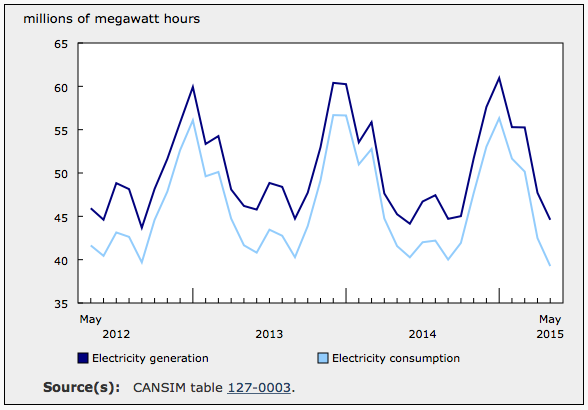
Demand for electricity totalled 39.3 million megawatt hours (MWh) in May, down 5.6% from the same month a year earlier. Demand for electricity has fallen on a year-over-year basis in 12 of the past 13 months.Like demand, electric power generation declined in May, down 1.4% to 44.6 million MWh, largely as a result of lower generation levels in Alberta and Quebec.
Exports of electricity rose 37.2% to 4.8 million MWh, buoyed by strong demand from the United States. Imports fell 49.1% to 0.6 million MWh with the decline mainly in British Columbia.
Chart 1: Electricity generation and consumption
Electricity generation levels in Alberta were down for a fifth consecutive month, falling 10.8% to 4.6 million MWh in May. The decline was part of a larger downturn in demand for electricity in the province, which has posted year-over-year declines every month since September 2014. Demand in Alberta totalled 4.6 million MWh in May, down 13.2% from the same month a year earlier.
Quebec’s demand for electricity declined 7.0% to 13.8 million MWh in May, continuing a year-over-year downward trend that began in April 2014. Electric power generation levels within Quebec declined 7.8% from the same month a year earlier to 13.3 million MWh. In contrast to the rise in exports at the national level, Quebec’s exports to the United States fell 16.4% to 1.3 million MWh.
Generation levels in British Columbia increased 17.6% to 5.2 million MWh in May. Demand within the province decreased 8.6% to 4.1 million MWh. The gains in generation translated to higher exports to the United States to meet demand south of the border. Exports from the province nearly doubled in May to 1.5 million MWh compared with May 2014.
Source: Statistics Canada, http://www.statcan.gc.ca/daily-quotidien/150727/cg-b001-eng.htm.

![Guide to the Canadian Electrical Code, Part 1[i], 26th Edition– A Road Map: Section 74 — Airport installations](https://electricalindustry.ca/wp-content/uploads/2026/05/EIN-Stock-Guide-Code-Canada-Map-1200-768x403.png)




![Guide to the Canadian Electrical Code, Part 1[i], 26th Edition– A Road Map: Section 74 — Airport installations](https://electricalindustry.ca/wp-content/uploads/2026/05/EIN-Stock-Guide-Code-Canada-Map-1200.png)