The Impact of Arc Flash Events on Photocontrol Longevity in LED Lighting
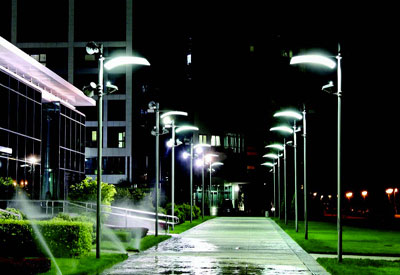
The adoption of LED lighting continues at a rapid pace.Although the extended life of LEDs is beneficial, it also presents a compatibility challenge with older technology controls, especially with outdoor photocontrols. This rapid change to LED fixtures andluminaires can leave contractors, designers and distributors facing questions they cannot answer.
LED and other new lightingtechnologies exclusively useelectronic drivers and ballasts for operation. Their designshave different electrical start-up characteristics than older,magnetic models. In the case of photocontrols, matching theextended lifespan of LED fixtures requires a more complexcontrol unit for a reliable, turn-on/off.
Design considerations for electronic ballasts
A more complex control unit is required because some electronic ballasts produce inrush currents at turn-on that can cause premature relay contact failures. Intermatic has completed simulations in our UL-certified laboratory and has videotaped the phenomena of this spike of energy. This energy spike can and has caused control failures in the field.These inrush currents can be much higher than thoseexperienced with traditional tungsten or magnetic ballastloads because many electronic ballasts employ large energystorage capacitors. Such capacitors can charge up to 400Vfor a 277 V line voltage, and will briefly draw high currentfrom the line to achieve this voltage.
As mentioned above, these typically short inrush currentscan climb as high as 100-times the nominal operating levels.(See table below for typical inrush value comparisons.)

An overlooked source of photocontrol failure
Inrush currents have not always been recognized as a source of failure for controls. Some contractors may mistakenly believe that a switch has failed because it’s a“bad” switch or a power surge has occurred. Jay Hoch, Lighting Specialist for Wyandotte Electric Supply, Wyandotte, Michigan, noticed photocontrol failures on a large, exterior LED lighting project in Detroit. “We had multiple fixtures on one circuit fail, but not all of the fixtures failed. That didn’t make any sense. If one failed, they all should.” Hoch was looking for an explanation and wondering how best to advise the contractor coming to him.Information on inrush currents supplied by Intermatic made sense of the performance of the controls that Hoch andthe contractor had noticed. After reviewing the information,Hoch realized that in rush currents were adversely impacting the controls. “The failure wasn’t in the circuit,” Hoch says.“Intermatic’s research solidified the fact that the in rushcurrent affects photo cells.”
Variances in inrush current
The inrush current magnitude and duration depends upon the value of the capacitance (measured inμF), along with circuit and power distribution network impedances.This current may weld relay contacts and other switching devices or possibly fuse semiconductors. Overall, these high-current transients can negatively impact the lifespan of traditional photo controls,negating the reduced maintenance cost associated with LED luminaires.
Therefore, the actual performance of electronic ballasts can’t be determined by a straight watt-to-watt comparison of incandescent bulbs to LED bulbs. At first glance, it may make sense to assume that ten 15 W LED bulbs could be substituted for a single 100 W incandescent bulb. However,an inrush current in the LEDs can negatively impact the control, causing failures over time.
If contractors don’t look at the specs for the controls, they may believe when a switch failsit’s a bad switch. However,providing proper control specifications would enable contractors to avoid failures that are caused by very highinrush currents.
New electronic ballast designs can provide low or zero in rush currents, but they are more costly to implement and have not been universally adopted by lighting manufacturers in the marketplace. This created a challenge for control suppliers. Hearing questions from distributors and contractors, Intermatic chose to design electronic photo controls for worst case in rush currents, as characterized bythe National Electrical Manufacturers Association (NEMA)’s survey of electronic ballast technologies.
Read the Rest of the Series:
– The Impact of Arc Flash Events on Photocontrol Longevity in LED Lighting – Part 2
– The Impact of Arc Flash Events on Photocontrol Longevity in LED Lighting – Part 3
Source: Intermatic Incorporated, 7777 Winn Road, Spring Grove, IL 60081; 815-675-2321; www.intermatic.com/zerocross. Intermatic’s new line of electronic photocontrols for LED applications successfully utilizes zero crossing techniques to suppress inrush current impact and deliver on the extended lifespan of LED luminaires. As a result, Intermatic offers costeffective, 8 to 12 year warrantied electronic photocontrols, while providing large inrush current carrying capacities. Lab testing shows the visible reduction of inrush current, which Intermatic has captured on video.
![Guide to the Canadian Electrical Code, Part 1[i], 26th Edition– A Road Map: Section 74 — Airport installations](https://electricalindustry.ca/wp-content/uploads/2026/05/EIN-Stock-Guide-Code-Canada-Map-1200-768x403.png)




![Guide to the Canadian Electrical Code, Part 1[i], 26th Edition– A Road Map: Section 74 — Airport installations](https://electricalindustry.ca/wp-content/uploads/2026/05/EIN-Stock-Guide-Code-Canada-Map-1200.png)