Inline Circulation Heaters Can Simplify Many Liquid Applications in Business
 March 21 2016

Ilan Toledano

Companies that rely on flowing liquids such as oils, water or natural gas often rely on overly-complicated systems to keep everything functioning properly. These companies don’t worry about the systems being too complex until something goes wrong. Then the issue is a big deal, but it’s often too late for the system to be modified, or the company is committed to their current solution. To help set up that simple setup originally, your company should consider relying on inline circulation heaters for oils, natural gas, water or any other solution that has to be kept at a constant temperature. The heaters are flexible and can heat liquids up to 1500 degrees Fahrenheit or much less depending on heating needs.

How inline circulation heaters work

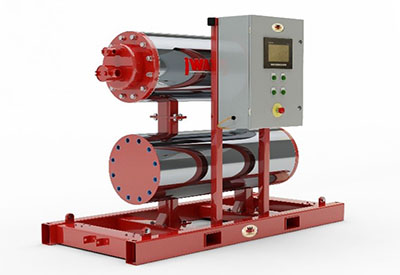
Inline circulation heaters are pretty simple in how they work. They have an inlet and an outlet that connects right up to your standard lines that the liquid is already flowing through. The liquid goes through the inlet, gets heated by the interior element, and then flows through the outlet back into the standard loop. These heaters typically come with insulation to help prevent heat loss, and some also come with filters to clean up the fluid flowing through and to protect the heat elements as well.

The heaters are designed with a thermostat so that you can adjust the final temperature of the fluid up or down until it’s exactly where you want it to be in the end.

Simple service and maintenance

When relying on an inline heater to warm liquids you won’t have to work nearly as hard to maintain the system and make sure that it functions properly. Often making a repair to the system is as simple as closing a valve and replacing a part on the heater or replacing the entire unit for a new one. There are less individual parts than there are in a tank heater, and the parts are typically more accessible as well.

Cut down on tank heat losses

If your application demands a nearly constant level of heat in oil, natural gas or water, you can rely on an inline circulation heater rather than a tank heater to achieve those temperatures more efficiently. When using a tank to keep constant temperatures, your system will suffer from more heat loss out the walls of the tank. When heating the system right in the line that needs the heat itself you’ll benefit from less heat loss overall and a more efficient system, not to mention that you’ll have one container less to maintain and replace when the time comes.

While it might not be worth the switch to move from a tank heater setup to an inline one if all your equipment is brand new, companies that are about to install new heaters, or a company that hasn’t yet put together a heated system should strongly consider using inline circulation heaters rather than tank-based systems. They are often more affordable and more efficient and they are certainly simpler and easier to maintain.


Ilan Toledano, is the President of Wattco. With over 20 years of experience in the electric heating industry, Ilan Toledano has been involved in sales and marketing, product development, and expansion of the industrial immersion heaters in the chemical and oil and gas industry for the past 15 years. Mr. Toledano has a B.Comm from Concordia University in Finance and Business Law; www.wattco.com

 

Related Articles


Latest Articles

  • ESA 2025 Annual Licence Holder Meeting

    ESA 2025 Annual Licence Holder Meeting

    December 8, 2025 This year marked ESA’s 20th Annual Licence Holder Meeting — a milestone celebrating two decades of collaboration, innovation and safety leadership made possible by Ontario’s licence holder community. The meeting was held on Wednesday, November 26, 2025 Agenda Highlights Watch a recording of the 2025 Licence Holder Meeting. Read More…

  • BC Hydro’s Updated Business Energy-Saving Incentives, Limited Time Bonus Offer

    BC Hydro’s Updated Business Energy-Saving Incentives, Limited Time Bonus Offer

    December 8, 2025 Get funding from BC Hydro for businesses upgrading eligible equipment with energy-efficient models. Funding rates vary depending on the equipment being upgraded, with past participants receiving an average of 30% for upfront costs. Incentives are available for: Bonus offer BC Hydro is currently offering a 30% bonus incentive on all business energy-saving incentives projects… Read More…

  • Mastering Advanced Bidding Strategies in Electrical Contracting

    Mastering Advanced Bidding Strategies in Electrical Contracting

    December 1, 2025 By Melvin Newman, Patabid CEO & Ian Paterson, Patabid Client Success Manager and journeyman electrician with 30+ years of experience In the competitive world of electrical contracting, knowing how to estimate electrical jobs effectively can make the difference between winning profitable projects and watching opportunities slip away. For electrical contractors, mastering advanced… Read More…

  • Why Choosing the Right USB Charger Matters

    Why Choosing the Right USB Charger Matters

    December 1, 2025 Not all USB Chargers are Created Equal As the number of devices used daily increases, so does the need for a charger that delivers safe speeds and maximum charging potential. A high-quality USB charger delivers efficient charging without risk of damage, but the sea of USB chargers and outlets available on online… Read More…


Changing Scene

  • BC’s Bill 20 – The Construction Prompt Payment Act Receives Royal Assent

    BC’s Bill 20 – The Construction Prompt Payment Act Receives Royal Assent

    December 8, 2025 As the BC Legislature wraps up the final week of the Fall session, BCCA is very pleased to see Bill 20 receive Royal Assent and officially become the Construction Prompt Payment Act, SBC 2025, c 24. This marks a significant milestone for BC’s construction sector. This achievement reflects decades of consistent, principled… Read More…

  • Federal Government Announces New Measures to Support Steel and Lumber

    Federal Government Announces New Measures to Support Steel and Lumber

    December 8, 2025 The world is changing rapidly. The United States, the world’s largest economy, is fundamentally reshaping all its trade relationships, causing major disruption and upheaval for Canadians. It is time to transform our economy from one that is reliant on a single trade partner to one that is stronger, more self-sufficient, and resilient… Read More…

  • Skills Ontario Celebrates the Expansion of Trades & Tech Truck Program

    Skills Ontario Celebrates the Expansion of Trades & Tech Truck Program

    December 1, 2025 Skills Ontario is expanding its fleet of Trades & Tech mobile unit thanks to support from the Ontario Government. The government announced this morning it’s investment in Skills Ontario to expand experiential opportunities for Ontario’s future workforce.    “Ontario’s future relies on a strong, skilled workforce,” said David Piccini, Minister of Labour, Immigration,… Read More…

  • BC’s Canadian Mutual Recognition Agreement aims to Facilitate Interprovincial Trade

    BC’s Canadian Mutual Recognition Agreement aims to Facilitate Interprovincial Trade

    December 1, 2025 A new agreement signed by all provinces, territories, and the federal government will break down interprovincial trade barriers, making it easier for B.C. businesses to sell products across Canada, and for people to buy Canadian-made goods.   “When threats to Canada’s economic security land at our doorstep, we’re at our best when we work together as… Read More…