October Building Permits Jump 9.1% Nationally
December 10, 2015
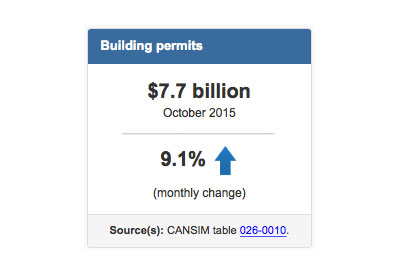
Municipalities issued $7.7 billion worth of building permits in October, up 9.1% from a month earlier. This was the first increase in three months. The value of residential building permits rose 15.5% to $4.8 billion, following two months of declines. Higher construction intentions for multi-family dwellings and institutional buildings in Alberta were responsible for much of the gain, as builders filed permits in advance of the changes in the Building Code.
Chart 1: Total value of permits

The value of residential building permits rose 15.5% from September to $4.8 billion in October. The advance followed an 11.4% drop in September and a 5.4% decline in August. Increases were posted in five provinces, led by Alberta, followed by Ontario and British Columbia. The largest declines were reported in Manitoba and Quebec.
Construction intentions for non-residential buildings edged down 0.2% to $2.9 billion in October. Declines were registered in five provinces, with Saskatchewan and Ontario posting the largest decreases. Alberta posted the largest gain, followed by Quebec, a distant second.
Residential sector: Higher construction intentions for multi-family dwellings
The value of building permits for multi-family dwellings increased 35.4% to $2.5 billion in October. The advance followed two consecutive monthly declines. Gains were reported in six provinces, led by Alberta, followed by Ontario and British Columbia. Manitoba posted the largest decline.
Construction intentions for single-family dwellings edged down 0.3% to $2.3 billion in October, marking a third consecutive monthly decline. Increases in Ontario partly offset decreases in seven provinces, with Quebec registering the largest decline.
Municipalities approved the construction of 19,781 new dwellings in October, up 17.1% from the previous month. The gain was mainly attributable to multi-family dwellings, which increased 25.4% to 14,078 units. The number of single-family dwellings edged up 0.7% to 5,703 units.
Chart 2: Residential and non-residential sectors

Non-residential: Lower construction intentions for commercial and industrial buildings
The value of permits issued for commercial buildings declined for a second consecutive month, down 9.9% to $1.4 billion in October. The decline at the national level was mainly the result of lower construction intentions for warehouses, office buildings and hotels and restaurants. Saskatchewan and Ontario registered the largest declines in commercial building construction intentions. Alberta saw the largest increase, which partly offset the decline in the component.
In the industrial component, the value of building permits fell 22.4% to $430 million in October, following a 17.1% increase in September. The decline was mainly attributable to lower construction intentions for utilities buildings and manufacturing plants. Lower industrial building construction intentions were reported in every province except Nova Scotia and New Brunswick. Ontario, Quebec and Saskatchewan registered the largest declines.
The value of institutional building permits rose 36.4% to $1.0 billion in October, following a large increase in September. The gain at the national level was attributable to higher construction intentions for retirement homes, continuing care facilities and government buildings. Advances were reported in eight provinces, led by Alberta, Quebec and Ontario. Saskatchewan and New Brunswick registered declines.
Provinces: Alberta posts the largest increase
The total value of permits was up in six provinces, with Alberta posting the largest increase, followed by Ontario, a distant second. Saskatchewan and Manitoba registered the largest declines.
In Alberta, the value of building permits increased 53.0% in October to a record high of $2.2 billion. The gain was the result of increased construction intentions for multi-family dwellings, institutional structures and commercial buildings. The increase in building permits in October was largely attributable to contractors applying for permits prior to November 1, 2015, when the transition period for the implementation of the 2014 Alberta Building Code ended.
In Ontario, municipalities issued building permits valued at $2.6 billion in October, up 3.3% from the previous month. The gain was mainly attributable to higher construction intentions for multi-family dwellings, institutional buildings and single-family dwellings. Declines in the value of building permits for commercial and industrial buildings partly offset the overall provincial increase.
After posting a notable gain in September, Saskatchewan issued building permits worth $326 million in October, down 30.6% from the previous month. The decrease was mainly attributable to lower demand for building permits in all three non-residential components, led by commercial structures.
Manitoba registered a 16.1% decline in the value of building permits, following a 27.6% increase in September. Lower construction intentions for residential buildings, led by multi-family dwellings, were responsible for much of the provincial decrease.
Higher construction intentions in half of the census metropolitan areas
The value of building permits was up in 17 of the 34 census metropolitan areas in October. The largest increase was reported in Calgary, followed by Toronto and Saskatoon.
The value of permits in Calgary was up for both residential and non-residential buildings, led by multi-family dwellings, followed by commercial and institutional buildings.
In Toronto, the increase stemmed from higher construction intentions for institutional buildings, multi-family dwellings and, to a lesser extent, single-family homes.
In contrast, the largest decrease was recorded in Edmonton, which had a notable increase the previous month. Commercial buildings, multi-family dwellings and single-family houses explained much of the decline.
Source: Statistics Canada, www.statcan.gc.ca/daily-quotidien/151208/dq151208a-eng.htm?cmp=mstatcan.
![Guide to the Canadian Electrical Code, Part 1[i], 26th Edition– A Road Map: Section 74 — Airport installations](https://electricalindustry.ca/wp-content/uploads/2026/05/EIN-Stock-Guide-Code-Canada-Map-1200-768x403.png)



![Guide to the Canadian Electrical Code, Part 1[i], 26th Edition– A Road Map: Section 74 — Airport installations](https://electricalindustry.ca/wp-content/uploads/2026/05/EIN-Stock-Guide-Code-Canada-Map-1200.png)