How Welcoming Is Your Workplace for Those with Disabilities?
Disabilities Workplace


Feb 12, 2016

Michelle Branigan

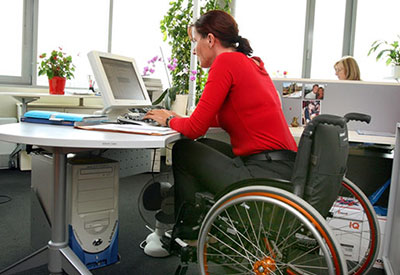
Did you know that both provincial and federal governments have enacted legislation that requires organization to remove barriers for persons with disabilities (PWD) to participate fully in Canadian society, be that in employment or access to services?

While this has been a stimulus for some organizations to develop employment equity strategies, employers should, as a best practice, attempt to foster a culture of equal respect, adaptation and understanding to recognize the strengths that all cohorts bring to the workplace.

Photo courtesy: http://gogovernment.org
In addition to those who enter the workplace with a disability (visible or hidden), there are also those who have a disability as a result of illness or injury while in employment. We know that the barriers for people with disabilities take a number of different forms, from lack of awareness, inaccurate assumptions, inappropriate behaviour and attitudes on the job as well as the need to exceed expectations to prove oneself on a continual basis. Breaking down the assumptions that exist in many workplaces, be they conscious or unconsciously biased, will take a coordinated effort by employers and employees, including those with disabilities.

Many electricity employers are not aware of research that shows, for example, that in the areas of punctuality, attendance, work quality, task consistency, and overall proficiency, the performance of people with disabilities has been rated as the same as or even better than their co-workers.

Many accommodation options available to you as an employer can be low cost or no cost. While you may have to make some changes to workstations or provide an assistive device or assistive technology, many changes are simple. The employee being accommodated will be an important source of information about accommodation needs and sources of information, and potentially, sources of funding for making the accommodations.

In Ontario, the Accessibility for Ontarians with Disabilities Act (AODA) 2005 is a law that sets out a process for developing accessibility standards. In addition to the AODA requirements already in place, the act’s Employment Standard came into effective January 1st 2016 for large organisations with 50+ employees. The Employment Standard makes accessibility in organizations a regular part of finding, hiring, supporting and communicating with employees who have disabilities. Smaller organizations (>50 employees) have until January 1, 2017 to comply. Different jurisdictions may have different interpretations about the duty to accommodate, so it is worth reviewing the requirements that are relevant to your place of business.

EHRC research and consultations to date indicate that there is a recognition, interest and willingness among employers to be more inclusive of talent from under-represented and minority groups. Hiring people with disabilities is not only socially responsible but good for business, increasing employer morale, productivity, innovation, profitability and the ability to retain talent.


Michelle Branigan is CEO, Electricity Human Resources Canada.

More from Michelle Branigan:
Michelle Branigan: Profile
It’s Not Just the Technical Stuff That’s Important
– Call for Mentors to Support Recruitment and Retention of Women in the Electricity Industry
Retention: You’ve Hired. Now What Are You Doing to Keep Your Staff?
– What are the Benefits of Effective Coaching?
– Multigenerational Workforces
– Mentoring

 

Related Articles


Latest Articles

  • Stephanie Medeiros on EV Infrastructure in Canada, Innovative Technologies, Well-Planned Charging Networks, & Commercial Fleets

    Stephanie Medeiros on EV Infrastructure in Canada, Innovative Technologies, Well-Planned Charging Networks, & Commercial Fleets

    September 3, 2026 By Blake Marchand In this Q&A with Stephanie Medeiros, the Head of Mobility at Schneider Electric Canada provides insight into her perspective on EV charging infrastructure in Canada, factors that will contribute to growing EV adoption, grid modernization for commercial fleets, the role of Vehicle-to-Grid and other innovative approaches to electrification. The focus of… Read More…

  • LEDVANCE: Understanding Light Beam Angles

    LEDVANCE: Understanding Light Beam Angles

    September 3, 2026 Light Beam Angles: How It Affects Different Types of Lighting, Where It Is Applied & What to Consider When Choosing the Right One Beam angle is important in lighting design. It determines how light spreads within a space and influences both functionality and atmosphere. By understanding beam angles, you can achieve both… Read More…

  • ITC 101 Series: Why Certifications (UL, CSA) Matter in Industrial Components

    ITC 101 Series: Why Certifications (UL, CSA) Matter in Industrial Components

    September 2, 2026 By ITC Electrical Components When selecting industrial electrical components, certification is more than a logo on a datasheet. A certification mark indicates that a product or component has been independently evaluated against specified requirements for its intended market. In North America, selecting products with the appropriate certification can affect regulatory acceptance, equipment… Read More…

  • Project Spotlight: Leigh Square Fountain

    Project Spotlight: Leigh Square Fountain

    September 2, 2026 In spring 2025, the City of Port Coquitlam unveiled a transformed Leigh Square, reimagined as a vibrant, accessible, and welcoming gathering place in the heart of downtown. At the heart of the renewed plaza, a Bellagio-style programmable dancing fountain is integrated directly into the paving—three interlocking rings where jets rise, fall, and… Read More…


Changing Scene

  • 2026 Ontario Apprenticeship Awards Call for Nominations

    2026 Ontario Apprenticeship Awards Call for Nominations

    September 3, 2026 Skilled Trades Ontario is proud to open nominations for the 2026 Ontario Apprenticeship Awards, recognizing outstanding apprentices, journeypersons, organizations and skilled trades leaders who are helping strengthen Ontario’s apprenticeship system. Award recipients will be announced at the Ontario Apprenticeship Summit on November 4, 2026, at the Toronto Congress Centre. Nominations must be submitted… Read More…

  • Bartle & Gibson Announces New Partnership with Hubbell Canada

    Bartle & Gibson Announces New Partnership with Hubbell Canada

    September 3, 2026 Bartle & Gibson Co. Ltd., an Alberta-based premier plumbing, heating and electrical distributor and Hubbell Canada have announced a new regional partnership enabling increased access to Hubbell Canada’s end-to-end electrical product portfolio across Western Canada. “With our strong presence in the west through 31 branches and counting located in Alberta, Saskatchewan, British… Read More…

  • Bartle & Gibson Opens Salmon Arm Location

    Bartle & Gibson Opens Salmon Arm Location

    September 3, 2026 Bartle & Gibson opened their new Salmon Arm location on July 20th. The Salmon Arm location features: This site is strategically positioned in the city of Salmon Arm, located near to the busy Picadilly Mall.  Salmon Arm branch is located at: 621- 10 Street SW Salmon ARM, BC V1E 1T1 Photo Source Read More…

  • MacKinnon Magnetics Announces Partnership with Resilient Sales Corporation in Northeastern Ontario

    MacKinnon Magnetics Announces Partnership with Resilient Sales Corporation in Northeastern Ontario

    September 3, 2026 MacKinnon Magnetics is pleased to welcome Resilient Sales Corporation as their newest sales agency partner. Resilient Sales will represent MacKinnon Magnetics across Northeastern Ontario, including the Districts of Muskoka and Parry Sound. Key markets include Sudbury, North Bay, Timmins, Kirkland Lake, Sault Ste. Marie, Huntsville, Bracebridge and Parry Sound. “This partnership expands… Read More…