Inline Circulation Heaters Can Simplify Many Liquid Applications in Business
 March 21 2016

Ilan Toledano

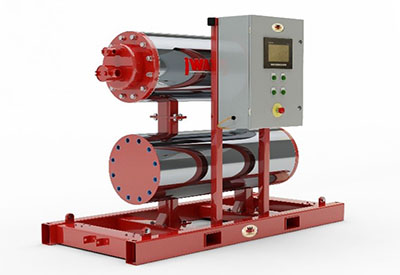
Companies that rely on flowing liquids such as oils, water or natural gas often rely on overly-complicated systems to keep everything functioning properly. These companies don’t worry about the systems being too complex until something goes wrong. Then the issue is a big deal, but it’s often too late for the system to be modified, or the company is committed to their current solution. To help set up that simple setup originally, your company should consider relying on inline circulation heaters for oils, natural gas, water or any other solution that has to be kept at a constant temperature. The heaters are flexible and can heat liquids up to 1500 degrees Fahrenheit or much less depending on heating needs.

How inline circulation heaters work

Inline circulation heaters are pretty simple in how they work. They have an inlet and an outlet that connects right up to your standard lines that the liquid is already flowing through. The liquid goes through the inlet, gets heated by the interior element, and then flows through the outlet back into the standard loop. These heaters typically come with insulation to help prevent heat loss, and some also come with filters to clean up the fluid flowing through and to protect the heat elements as well.

The heaters are designed with a thermostat so that you can adjust the final temperature of the fluid up or down until it’s exactly where you want it to be in the end.

Simple service and maintenance

When relying on an inline heater to warm liquids you won’t have to work nearly as hard to maintain the system and make sure that it functions properly. Often making a repair to the system is as simple as closing a valve and replacing a part on the heater or replacing the entire unit for a new one. There are less individual parts than there are in a tank heater, and the parts are typically more accessible as well.

Cut down on tank heat losses

If your application demands a nearly constant level of heat in oil, natural gas or water, you can rely on an inline circulation heater rather than a tank heater to achieve those temperatures more efficiently. When using a tank to keep constant temperatures, your system will suffer from more heat loss out the walls of the tank. When heating the system right in the line that needs the heat itself you’ll benefit from less heat loss overall and a more efficient system, not to mention that you’ll have one container less to maintain and replace when the time comes.

While it might not be worth the switch to move from a tank heater setup to an inline one if all your equipment is brand new, companies that are about to install new heaters, or a company that hasn’t yet put together a heated system should strongly consider using inline circulation heaters rather than tank-based systems. They are often more affordable and more efficient and they are certainly simpler and easier to maintain.


Ilan Toledano, is the President of Wattco. With over 20 years of experience in the electric heating industry, Ilan Toledano has been involved in sales and marketing, product development, and expansion of the industrial immersion heaters in the chemical and oil and gas industry for the past 15 years. Mr. Toledano has a B.Comm from Concordia University in Finance and Business Law; www.wattco.com

 

Related Articles


Latest Articles

  • Stephanie Medeiros on EV Infrastructure in Canada, Innovative Technologies, Well-Planned Charging Networks, & Commercial Fleets

    Stephanie Medeiros on EV Infrastructure in Canada, Innovative Technologies, Well-Planned Charging Networks, & Commercial Fleets

    September 3, 2026 By Blake Marchand In this Q&A with Stephanie Medeiros, the Head of Mobility at Schneider Electric Canada provides insight into her perspective on EV charging infrastructure in Canada, factors that will contribute to growing EV adoption, grid modernization for commercial fleets, the role of Vehicle-to-Grid and other innovative approaches to electrification. The focus of… Read More…

  • LEDVANCE: Understanding Light Beam Angles

    LEDVANCE: Understanding Light Beam Angles

    September 3, 2026 Light Beam Angles: How It Affects Different Types of Lighting, Where It Is Applied & What to Consider When Choosing the Right One Beam angle is important in lighting design. It determines how light spreads within a space and influences both functionality and atmosphere. By understanding beam angles, you can achieve both… Read More…

  • ITC 101 Series: Why Certifications (UL, CSA) Matter in Industrial Components

    ITC 101 Series: Why Certifications (UL, CSA) Matter in Industrial Components

    September 2, 2026 By ITC Electrical Components When selecting industrial electrical components, certification is more than a logo on a datasheet. A certification mark indicates that a product or component has been independently evaluated against specified requirements for its intended market. In North America, selecting products with the appropriate certification can affect regulatory acceptance, equipment… Read More…

  • Project Spotlight: Leigh Square Fountain

    Project Spotlight: Leigh Square Fountain

    September 2, 2026 In spring 2025, the City of Port Coquitlam unveiled a transformed Leigh Square, reimagined as a vibrant, accessible, and welcoming gathering place in the heart of downtown. At the heart of the renewed plaza, a Bellagio-style programmable dancing fountain is integrated directly into the paving—three interlocking rings where jets rise, fall, and… Read More…


Changing Scene

  • 2026 Ontario Apprenticeship Awards Call for Nominations

    2026 Ontario Apprenticeship Awards Call for Nominations

    September 3, 2026 Skilled Trades Ontario is proud to open nominations for the 2026 Ontario Apprenticeship Awards, recognizing outstanding apprentices, journeypersons, organizations and skilled trades leaders who are helping strengthen Ontario’s apprenticeship system. Award recipients will be announced at the Ontario Apprenticeship Summit on November 4, 2026, at the Toronto Congress Centre. Nominations must be submitted… Read More…

  • Bartle & Gibson Announces New Partnership with Hubbell Canada

    Bartle & Gibson Announces New Partnership with Hubbell Canada

    September 3, 2026 Bartle & Gibson Co. Ltd., an Alberta-based premier plumbing, heating and electrical distributor and Hubbell Canada have announced a new regional partnership enabling increased access to Hubbell Canada’s end-to-end electrical product portfolio across Western Canada. “With our strong presence in the west through 31 branches and counting located in Alberta, Saskatchewan, British… Read More…

  • Bartle & Gibson Opens Salmon Arm Location

    Bartle & Gibson Opens Salmon Arm Location

    September 3, 2026 Bartle & Gibson opened their new Salmon Arm location on July 20th. The Salmon Arm location features: This site is strategically positioned in the city of Salmon Arm, located near to the busy Picadilly Mall.  Salmon Arm branch is located at: 621- 10 Street SW Salmon ARM, BC V1E 1T1 Photo Source Read More…

  • MacKinnon Magnetics Announces Partnership with Resilient Sales Corporation in Northeastern Ontario

    MacKinnon Magnetics Announces Partnership with Resilient Sales Corporation in Northeastern Ontario

    September 3, 2026 MacKinnon Magnetics is pleased to welcome Resilient Sales Corporation as their newest sales agency partner. Resilient Sales will represent MacKinnon Magnetics across Northeastern Ontario, including the Districts of Muskoka and Parry Sound. Key markets include Sudbury, North Bay, Timmins, Kirkland Lake, Sault Ste. Marie, Huntsville, Bracebridge and Parry Sound. “This partnership expands… Read More…