How Welcoming Is Your Workplace for Those with Disabilities?
Disabilities Workplace


Feb 12, 2016

Michelle Branigan

Did you know that both provincial and federal governments have enacted legislation that requires organization to remove barriers for persons with disabilities (PWD) to participate fully in Canadian society, be that in employment or access to services?

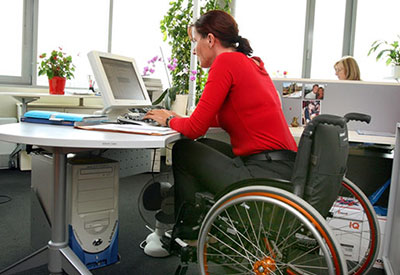
While this has been a stimulus for some organizations to develop employment equity strategies, employers should, as a best practice, attempt to foster a culture of equal respect, adaptation and understanding to recognize the strengths that all cohorts bring to the workplace.

Photo courtesy: http://gogovernment.org
In addition to those who enter the workplace with a disability (visible or hidden), there are also those who have a disability as a result of illness or injury while in employment. We know that the barriers for people with disabilities take a number of different forms, from lack of awareness, inaccurate assumptions, inappropriate behaviour and attitudes on the job as well as the need to exceed expectations to prove oneself on a continual basis. Breaking down the assumptions that exist in many workplaces, be they conscious or unconsciously biased, will take a coordinated effort by employers and employees, including those with disabilities.

Many electricity employers are not aware of research that shows, for example, that in the areas of punctuality, attendance, work quality, task consistency, and overall proficiency, the performance of people with disabilities has been rated as the same as or even better than their co-workers.

Many accommodation options available to you as an employer can be low cost or no cost. While you may have to make some changes to workstations or provide an assistive device or assistive technology, many changes are simple. The employee being accommodated will be an important source of information about accommodation needs and sources of information, and potentially, sources of funding for making the accommodations.

In Ontario, the Accessibility for Ontarians with Disabilities Act (AODA) 2005 is a law that sets out a process for developing accessibility standards. In addition to the AODA requirements already in place, the act’s Employment Standard came into effective January 1st 2016 for large organisations with 50+ employees. The Employment Standard makes accessibility in organizations a regular part of finding, hiring, supporting and communicating with employees who have disabilities. Smaller organizations (>50 employees) have until January 1, 2017 to comply. Different jurisdictions may have different interpretations about the duty to accommodate, so it is worth reviewing the requirements that are relevant to your place of business.

EHRC research and consultations to date indicate that there is a recognition, interest and willingness among employers to be more inclusive of talent from under-represented and minority groups. Hiring people with disabilities is not only socially responsible but good for business, increasing employer morale, productivity, innovation, profitability and the ability to retain talent.


Michelle Branigan is CEO, Electricity Human Resources Canada.

More from Michelle Branigan:
– Michelle Branigan: Profile
– It’s Not Just the Technical Stuff That’s Important
– Call for Mentors to Support Recruitment and Retention of Women in the Electricity Industry
– Retention: You’ve Hired. Now What Are You Doing to Keep Your Staff?
– What are the Benefits of Effective Coaching?
– Multigenerational Workforces
– Mentoring

 

Related Articles


Latest Articles

  • Winnipeg Information Bulletin: Low-Risk Voice, Data, Video & Security System Installations

    Winnipeg Information Bulletin: Low-Risk Voice, Data, Video & Security System Installations

    September 17, 2026 Certain types of installations may qualify for a low-risk voice, data, video (VDV) and security system electrical permit. For information related to regular VDV/security system installations, see winnipeg.ca/vdvsystems. Applications must be submitted through Permits Online. Electrical permits and inspections are needed for certain installations of security and similar alarm systems. This makes… Read More…

  • What Type of Outdoor Light Do I Need for My Application?

    What Type of Outdoor Light Do I Need for My Application?

    September 17, 2026 By Stanpro The right outdoor light starts with the space you need to illuminate and how that space is used. For commercial projects, parking lots and large exterior areas point toward area lights; entrances and building perimeters toward wall-mounted or security lighting; signs, facades and targeted areas toward flood lights; pathways toward… Read More…

  • Alberta Employers and Tradespeople Share their Perspectives

    Alberta Employers and Tradespeople Share their Perspectives

    September 16, 2026 In Alberta’s skilled trades labour market employers and tradespeople are facing growing pressure from tariffs, rising costs, hiring challenges and labour mobility barriers. CAF-FCA’s new report, Hiring, Mobility and Needed Supports: Alberta Employers and Tradespeople Share Their Perspectives, takes a closer look at what’s happening on the ground. Based on surveys of… Read More…

  • Goal Zero YETI 3000X Power Stations Recalled due to Fire and Burn Hazards

    Goal Zero YETI 3000X Power Stations Recalled due to Fire and Burn Hazards

    September 16, 2026 This recall involves Goal Zero YETI 3000X power stations. The silver and black portable power stations measure about 62 centimetres (24.4 inches) high, 47 centimetres (18.5 inches) wide, 57 centimetres (22.3 inches) deep and weigh approximately 42 kilograms (92 pounds). The power stations have yellow handles and a digital display at the… Read More…


Changing Scene

  • LEDVANCE Canada Marks 10 Years of Innovation and Growth and Looks Ahead to Its Next Chapter in the Canadian Market

    LEDVANCE Canada Marks 10 Years of Innovation and Growth and Looks Ahead to Its Next Chapter in the Canadian Market

    September 25, 2026 From legacy lighting leader to solutions partner, LEDVANCE is entering its next decade with a clear focus on Canadian customers, communities, and market needs LEDVANCE Canada is marking the 10th anniversary of LEDVANCE as an independent brand by celebrating a decade of growth, customer partnerships, and continued investment in solutions designed around… Read More…

  • EFC Welcomes Patrick McManus as Incoming President & CEO

    EFC Welcomes Patrick McManus as Incoming President & CEO

    September 25, 2026 Electro-Federation Canada (EFC) is pleased to announce the appointment of Patrick McManus as President & CEO, effective October 13, 2026. McManus will succeed Carol McGlogan, who is retiring following 10 years with EFC. McGlogan will remain with the organization through the end of 2026 to support a smooth leadership transition. McManus is… Read More…

  • Innovair Solutions Acquires TRM Heating Cables

    Innovair Solutions Acquires TRM Heating Cables

    September 18, 2026 Innovair Solutions has announced the acquisition of TRM Heating Cables, a Toronto-based Canadian company specializing in heating cables for commercial and industrial applications. Founded in 2001, TRM has built strong technical expertise in the sale and installation of specialized products, including self-regulating cables, mineral-insulated cables and electric floor heating systems. The company… Read More…

  • Electrical Safety Authority Honours Leaders Helping Build a Safer, More Electrified Future

    Electrical Safety Authority Honours Leaders Helping Build a Safer, More Electrified Future

    September 17, 2026 From preparing the next generation of skilled workers to supporting one of the world’s largest sporting events, this year’s recipients demonstrate how electrical safety supports Ontario’s future As Ontario electrifies homes, transportation and industry, the Electrical Safety Authority (ESA) has recognized the organizations and individuals helping ensure safety keeps pace with that… Read More…