IoT and Its Application in Electrical Power Systems, Part 1
December 2, 2016
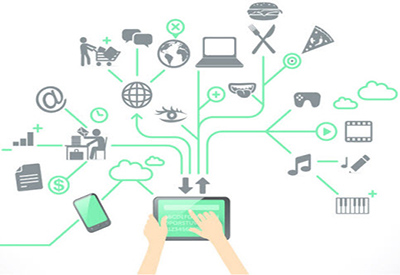
Several recent digital and smart manufacturing technologies, as well as design innovations in internet connectivity are leading the Internet of Things (IoT) to become a revolutionary technology in transforming modern day living.
Though the inception of IoT began in the context of supply chain management, it is evolving into a wide range of applications such as transport, utilities, industrial automation, healthcare, building and home automation, etc. The smart connectivity with existing networks through IoT results in ubiquitous computing without the aid of human intervention.
What is the Internet of Things (IOT)?
IoT is an emerging paradigm of Internet connected things that allow the physical objects or things to connect, interact and communicate with one another similar to the way humans talk through the web in today’s environment. It connects systems, sensors and actuator instruments to the broader Internet.
The applications of IoT are not limited to particular fields, but span a wide range of applications such as energy systems, homes, industries, cities, logistics, health, agriculture, and so on.
The goal of IoT is not only just connecting things such as machines, devices and appliances, but also allowing the things to communicate, exchanging control data and other necessary information while executing applications.
It consists of IoT devices that have unique identities and are capable of performing remote sensing, monitoring and actuating tasks. These devices are capable of interacting with one another directly or indirectly. Data collection is performed locally or remotely via centralized servers or cloud based applications. These devices may be data collection devices to which various sensors are attached such as temperature, humidity, light, etc., or they may be data actuating devices to which actuators are connected, such as relays.
It is a global network in which computers, sensors and actuators are interconnected through internet protocols. For example, consider the figure below in which a computer communicates with a device consisting of sensor, over the Internet. The TCP/IP protocol is used as internet protocol in such cases.

The Internet of Things is also affecting the industrial sector, especially for industrial automation systems in which internet infrastructure provides extensive access to sensors, controls and actuators, with a goal of increasing efficiency.
Industrial Internet of Things (IIoT) collects data from connected devices (i.e., smart connected devices and machines) in the field or plant and then processes this data using sophisticated software and networking tools. The entire IIoT requires a collection of hardware, software, communications and networking technologies.
IoT applications
There will be 26 billion devices connected to the Internet of Things by 2020, according to Gartner Inc. IoT applications are not restricted to specific group of areas, but can be applied to a wide variety of domains whether individual, industry or infrastructure. IoT products are classified based on the type of application. These can be smart wearable, smart city, smart home, smart enterprise, or smart environment. Some of the application areas of IoT are discussed below.
Home and building automation
IOT devices are used to monitor and control electronic, electrical and mechanical systems in homes and buildings in order to improve convenience and safety. The tasks of IoT in this domain include:
- smart lighting by adapting ambient conditions based switching
- web application and mobile apps enabled wireless and Internet connected lights
- smart appliances management and control
- intrusion detection systems, alarm systems and surveillance systems
- safety systems such as smoke and gas detection
- home entertainment management such as video, audio and projectors
Industries
IoT deals with real-time optimization of production and supply chain networks in a manufacturing industry by networking sensors, actuators, control systems and machinery together. In the case of process industries, it automates the process controls, service information systems and operator tools using digital controllers, all in order to achieve enhanced productivity and a safe distribution system.
The tasks of Industrial Internet of Things (IIoT) are
- real-time monitoring and control of processes
- deploying smart machines, smart sensors, and smart controllers with proprietary communication and internet technologies
- maximize safety, security and reliability through high precision automation and control
Energy
The major area where IoT deals with energy management systems is the smart grid. IoT extends smart grid benefits beyond the automation, distribution and monitoring being done by the utilities. IoT tasks in the field of electrical energy include:
- advanced metering infrastructure (AMI)
- SCADA (supervisory control and data acquisition)
- smart inverters
- remote control operation of energy consuming devices
Medical and healthcare systems
Internet of Things technology has caused a certain degree of development in mobile digital medical systems. This enables us to send human body multiple physiological parameters to medical service centres through a wearable multi-parameter sensor network. The tasks of IoT in this field include:
- remote health monitoring
- emergency notification systems
- wearable IoT devices
- medication remainder
- real-time infant monitoring
Transportation
IoT can integrate control, information processing and communications across various transportation systems by establishing an interconnection between drivers or users and vehicles. IoT tasks in transportation include:
- smart traffic control
- unmanned autonomous navigation
- inter and intra vehicular communication
- automatic transmission for emergency rescue
- electronic toll collection system
- safety and road assistance
- smart parking
Environment
IoT in the field of environmental monitoring consists of aligning various environmental parameter sensors with cloud based applications so that weather monitoring, pollution check and early warning systems (such as fire, earthquake and tsunami) can be achieved effectively. IoT duties in this field include:
- cloud-based weather monitoring
- noise and air pollution monitoring
- fire detection systems
- earthquake and tsunami early warning systems
- soil condition monitoring
Watch for Part 2, “Examples of IoT usage in the electrical power industry,” in the January 10, 2017 issue of EIN.
Wasim Khan is an electrical engineer and Advertisement & Content Management Team Manager at Electrical Technology, www.electricaltechnology.org/. This article was first published online at Electrical Technology and has been lightly edited.

![Guide to the Canadian Electrical Code, Part 1[i], 26th Edition– A Road Map: Section 74 — Airport installations](https://electricalindustry.ca/wp-content/uploads/2026/05/EIN-Stock-Guide-Code-Canada-Map-1200-768x403.png)




![Guide to the Canadian Electrical Code, Part 1[i], 26th Edition– A Road Map: Section 74 — Airport installations](https://electricalindustry.ca/wp-content/uploads/2026/05/EIN-Stock-Guide-Code-Canada-Map-1200.png)