Single Family Homes Lead 2.5% Decline in February’s Building Permits
Apr 9, 2017
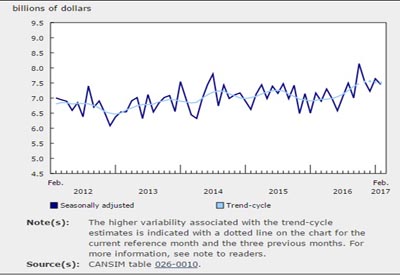
Canadian municipalities issued $7.5 billion worth of building permits in February, down 2.5% from January. Ontario and Alberta led the five provinces that reported declines in February. The national decrease resulted mainly from lower construction intentions for single-family dwellings and institutional structures.
Residential sector: fewer single-family dwellings; more multi-family buildings
The value of residential building permits fell 1.5% from January to $5.0 billion in February, but remained just above the $5.0 billion mark for a second consecutive month. The decline in single-family construction intentions was moderated by an increase in the multi-family component. Four provinces posted decreases in the residential sector in February, led by Ontario.
Construction intentions for single-family dwellings declined 5.4% to $2.6 billion. Ontario registered the greatest decrease in this component, more than offsetting the six provinces that reported gains.
Conversely, multi-family construction intentions increased 3.0% to $2.4 billion, a second consecutive monthly gain. The increase was mainly attributable to apartment buildings in both British Columbia and Alberta.
In February, Canadian municipalities approved the construction of 19,903 new dwellings (+2.9%), consisting of 13,445 multi-family units (+9.3%) and 6,458 single units (-8.3%).
Non-residential sector: declines in institutional and industrial components
Municipalities issued $2.4 billion worth of building permits for non-residential structures in February, down 4.5% from January. Five provinces registered decreases, led by Alberta and followed by Ontario and British Columbia. Nationally, the institutional component contributed the most to the decline.
The institutional component decreased 16.2% to $609 million in February, mainly due to lower construction intentions for government buildings and elementary schools. Alberta and Quebec posted the largest declines among the provinces and territories. A hospital revitalization project in the Northwest Territories moderated the drop in the national value of institutional building permits in February.
In February, the value of building permits issued for industrial structures fell 2.7% to $395 million, following a 9.9% increase in the previous month. Higher construction intentions for utility buildings in Saskatchewan and Ontario could not offset the widespread decreases reported across several types of industrial buildings in multiple provinces.
The commercial component rose 1.0% to $1.4 billion in February, marking a second consecutive monthly increase. The gain was mainly attributable to higher construction intentions for office buildings in Quebec and Manitoba.
Provinces: Ontario posts declines in every component, while British Columbia registers gains on strength of multi-family dwellings
The total value of building permits decreased in five provinces in February, led by Ontario and Alberta. Saskatchewan and British Columbia reported the largest increases.
Ontario posted a second consecutive monthly decline in the value of building permits in February. Every building component registered decreases, particularly single-family dwellings.
In Alberta, following growth in every building component in January, the decrease in the value of building permits in February originated mostly in the non-residential sector. The decline was led by the institutional component.
Conversely, residential construction intentions in Alberta increased for a second consecutive month in February, on the strength of apartment buildings and single-family dwellings.
Saskatchewan reported an increase in every building component in February except commercial structures. Utility buildings, notably a new natural gas power generation facility, contributed the most to the overall advance. For a second month in a row, Saskatchewan reported gains in both single-family and multi-family buildings in February.
In British Columbia, multi-family dwellings led the increase in building permit values in February, more than offsetting declines registered in every other building component. This marks a second consecutive monthly increase in multi-family construction intentions for British Columbia.
Census metropolitan areas: notable decrease in Edmonton, while Vancouver posts the largest increase
In February, the value of building permits declined in 22 out of the 36 census metropolitan areas (CMAs). Edmonton registered the biggest decline, followed distantly by Montréal, Toronto and Hamilton.
The decrease in the value of building permits in Edmonton was largely the result of institutional structures, led by government buildings. This followed a strong month in January when Edmonton reported its second-highest value on record in institutional building permits.
Lower construction intentions for institutional structures and multi-family buildings were mainly responsible for the declines in both Montréal and Hamilton in February. In Toronto, the decrease was mostly attributable to multi-family dwellings.
In contrast, Vancouver reported the highest growth in the value of building permits among the CMAs in February. Increased construction intentions for both rental apartments and apartment-condominiums were mainly responsible for the advance. The multi-family dwelling component rose for a second consecutive month in Vancouver in February.
Source: Statistics Canada, www.statcan.gc.ca/daily-quotidien/170406/dq170406a-eng.htm?HPA=1.
![Guide to the Canadian Electrical Code, Part 1[i], 26th Edition– A Road Map: Section 74 — Airport installations](https://electricalindustry.ca/wp-content/uploads/2026/05/EIN-Stock-Guide-Code-Canada-Map-1200-768x403.png)



![Guide to the Canadian Electrical Code, Part 1[i], 26th Edition– A Road Map: Section 74 — Airport installations](https://electricalindustry.ca/wp-content/uploads/2026/05/EIN-Stock-Guide-Code-Canada-Map-1200.png)