Workplace Lighting as a Dynamic Design Element
July 9, 2017
By Erin Hawley
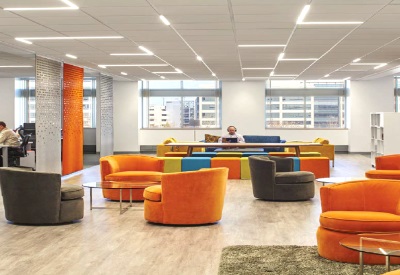
The modern office is seeing a major design shift as work styles change, mobile device use continues to grow, Millennials enter the workforce, and businesses embrace green, energy efficient technologies. Today’s workplaces are being redefined as dynamic, reconfigurable environments that can easily evolve with the changing needs of a company and its workers. With flexible floorplans and adaptable, multi-purpose furniture systems, a private office today can become a meeting room tomorrow. A common area can be converted to client showroom or training space overnight. Individual workspaces can be moved, modified, and reimagined in response to short and long-term business needs.
Despite the versatility that reconfigurable floorplans and furnishings bring, lighting has historically been more difficult and expensive to change, due to its electrical infrastructure and the typically complicated and invasive process to make modifications. One system, however, has found a way to make light fixtures as easy to move as furniture. The innovative DC Flexzone – from Armstrong Ceiling Systems and IDEAL Industries’ Audacy Advanced Wireless Controls – allows businesses to adapt their lighting to any situation using simple plug-and-play components. The DC Flexzone is modular, energy efficient, and can be integrated with wireless lighting controls made by Audacy AWS to monitor and help reduce energy consumption even further.
The DC Flexzone ceiling grid is itself energized with low-voltage DC power, delivering electricity directly to LED luminaires. Rather than being individually wired, each light fixture is simply connected to the ceiling grid by a clip, allowing it to be moved to a different location quickly and easily. A wide variety of fixtures are available for the system including troffers, pendants, T-Bars, and can-lights. So as office interiors are reconfigured, the lighting can also be easily modified to enhance the function of the space. Workplace Lighting
Besides the architectural design benefits of using the DC Flexzone grid, another advantage of the system is found in improved energy efficiency. While today’s low-energy LED fixtures run on DC power, our electricity is provided in AC format. In a typical set-up, power in each LED fixture is converted from AC to DC current, and that conversion results in energy loss. In an office with dozens of fixtures, the wasted energy quickly begins to add up. When using DC Flexzone however, the entire grid is connected to a power supply that converts current from AC to DC once, so there is no conversion needed for individual fixtures.
In a report by published in the scientific journal Energy Policy, researchers from Carnegie Mellon University examined the economic feasibility of using dedicated DC circuits to operate lighting in commercial buildings. Their research found that using LED lighting powered by DC current had the potential to save $24,000 (USD) a year versus traditional AC electricity in a 48,000-square-foot commercial building*.
Using DC Flexzone in conjunction with Audacy advanced wireless controls can further optimize energy use while providing users with precise control over their lighting. Audacy employs several strategies for increasing energy efficiency including daylight harvesting, occupancy sensors, and scheduling. Fixtures can be automatically dimmed or turned off when daylight illuminates the space, when the room is empty, or outside of office hours. And being wireless, the sensors and controllers are as simple to reconfigure as other flexible components in the office.
 Using Audacy controls, lighting levels for individual luminaires or a set group of fixtures are easily adjusted and programmed in real-time based on the needs of people working in a space. Occupants have the option to manage their lighting through the use of the intuitive Audacy mobile app, online interface, or simple wall Workplace Lightingswitches and remote controls. Monitoring and reporting functions allow uncomplicated management of energy use, allowing businesses to find efficiencies, thereby reducing overall lighting costs.
Incorporating the DC Flexzone ceiling grid with Audacy wireless controls into the modern workplace provides incredible flexibility to customize the way spaces are used on an ongoing basis. Essential elements in the office including lighting can be reimagined in response to changing business needs. The right lighting is available where you want it, when you want it – all while contributing to the environmental and economic stability of your business.
Erin Hawley is Marketing Manager, IDEAL Industries (Canada) Corp.