Lamp Bases in All Shapes and Sizes

EIN Lighting


Aug 7, 2017

On an incandescent light bulb, the component that supplies electrical current is called a “base.” There are several types of foot lamp, and each has a specific application. It is therefore vital to select the light bulb that corresponds to your needs. In point of fact, many lamps have their own unique base; this prevents their use in a luminaire that may have a higher wattage, distribute intense heat, and even become a fire hazard.

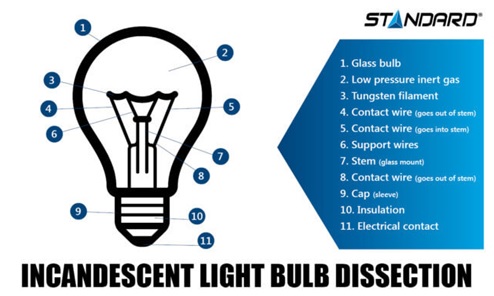
The following infographic dissects various components of a light bulb.

Size code

The size code is straightforward: it is made up of a letter that identifies the shape or type of base followed by a digit that refers to the diameter of the cap.

The letter “E” means Edison, the inventor of this type of base in the early part of the 20th century. These lamps have a screw base; they can therefore be screwed in.

EIN Lighting 2

The letter “B” stands for bayonet. From an historic standpoint, the shape of this foot lamp resembles the long knife that was once attached to the end of a rifle, thus the name “bayonet.”

EIN Lighting 3

The letters “G” and “GU” mean pin cap. The letters “GU” suggest that this specific lamp is equipped with a component that is supported by the luminaire. Initially, these lamps were made of glass, which is why the letter “G” has been kept.

EIN Lighting 4

LED equivalency guide

After many years of refinement, LED lamps have finally achieved their objective: offering an economical and efficient substitute for the conventional light bulb. LED lamps have a longer life span (over 20 years), they produce a fine quality light, and are quite solid (in many cases, these lamps are made of plastic as opposed to glass).

Marketplace competition has brought about a significant drop in the price of LED lamps, and by the same token a serious improvement in this lamp’s design. This trend has led to the development of LED-based alternate solutions that encompass a whole range of multiple use luminaires.

To facilitate the transition to LED lighting, the screw base size codes and the size of light bulbs remains the same.

This article was first published by Standard in its online journal” http://www.standardpro.com/category/our-online-journal/


 

Related Articles


Latest Articles

  • What 2025 Revealed About Canada’s Electrical Industry

    What 2025 Revealed About Canada’s Electrical Industry

    December 16, 2025 By Carol McGlogan, President & CEO, Electro-Federation Canada The past year required Canada’s electrical industry to adapt to a rapidly changing environment. In 2025, businesses across the value chain navigated shifting trade conditions, evolving policy landscapes, and growing expectations tied to electrification and infrastructure expansion. Trade uncertainty introduced new complexity. Organizations reassessed Read More…

  • Considerations for EV Charging Installation and Site Preparation

    Considerations for EV Charging Installation and Site Preparation

    December 15, 2025 By Blake Marchand As part of our recent discussion with LEDVANCE EVSE Product Manager, Erich Bockley, he emphasized the importance of site preparation Site preparation can be the most complicated part of the project, Bockley emphasized, a lot needs to be considered before the installation work begins. Many public charging applications will Read More…

  • Ontario’s Multi-Family Component Leads Residential Sector Increases in October Building Permits

    Ontario’s Multi-Family Component Leads Residential Sector Increases in October Building Permits

    December 15, 2025 In October, the total value of building permits issued in Canada rose $1.8 billion (+14.9%) to $13.8 billion. The increase in construction intentions was led by the residential sector (+$1.1 billion). An increase was also observed in the non-residential sector (+$702.8 million). On a constant dollar basis (2023=100), the total value of building permits issued in Read More…

  • Residential Investment in Building Construction Declines in September

    Residential Investment in Building Construction Declines in September

    December 15, 2025 Overall, investment in building construction decreased 1.1% to $22.4 billion in September. Investment in the residential sector declined 1.7%, while that in the non-residential sector was virtually unchanged. Year over year, investment in building construction grew 6.0% in September. On a constant dollar basis (2023=100), the total value of investment in building construction in September decreased 1.4% Read More…


Changing Scene