EFC Ottawa Day 2024: The Business Case for Accelerating Canada’s Net-Zero Transition
March 21, 2024
By Blake Marchand
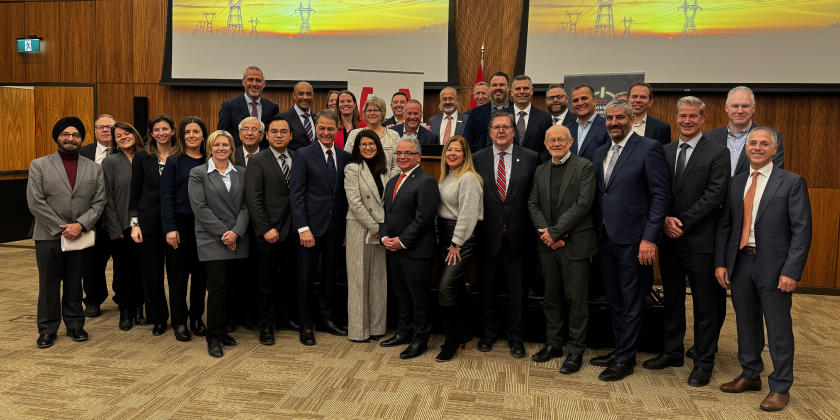
On February 26th and 27th Electro-Federation Canada (EFC) executives and members returned to Parliament Hill for their second ‘Ottawa Day’ to advocate on behalf of their members and the electrical and automation industry as the country continues to progress toward net-zero.
The main objective of the delegation is to involve key industry members in the planning and implementation of decarbonization efforts to lessen the impacts of climate change through electrification. With their collective expertise, and building off last year’s delegation, EFC and its members wanted to focus their discussions this year on the urgency of implementing positive policies signals to attract investment.
In recent years, supply chain issues have impacted every part of our economy. Given the aggressive timelines for net-zero implementation, consulting with the full supply chain is critical for understanding what technologies exist and how to implement solutions efficiently. As EFC supports Canada’s industry of electrical manufacturers, distributors, agents and field service providers – who design, develop, distribute and install electrical and automation products that impact everything from the electrical grid to intelligent buildings, smart homes, industrial automation and the electrification of transportation, heating and more – they are uniquely positioned to provide practical and logistical expertise in the development, implementation, and distribution of the technologies required to facilitate a net-zero economy.
This year’s delegation included 26 EFC member executives, 4 EFC staff, with 24 member companies represented. The group held meetings with Transportation Canada, Natural Resource Canada (NRCAN), Environment and Climate Change Canada (ECCC), and Innovation, Science and Economic Development Canada (ISED). While also meeting with MPs and Senators who have vested interests in energy and natural resources, environment and climate change, transportation, trade, and economic development.
“What I find so refreshing and so surprising,” noted EFC President and CEO, Carol McGlogan, “even the first time we did it, was how much fun the board has, how enthusiastic and engaged they are with the subject, and how proud they are being part of the industry.” Which really speaks to the motivation within EFC’s membership to impact Canada’s progression toward a sustainable, electricity-based economy.
“It’s really nice to be around a group of leaders within the industry that feel so good and so proud.”
The meetings in 2023 and 2024 are intended to give EFC the opportunity to further their relationship with key lawmakers. In meeting with decision makers, EFC strengthens their position to advise on policies related to supply chains, energy efficiency, fuel switching in buildings, grid modernization, electric vehicle charging infrastructure – while promoting the necessity of energy-efficient solutions, emphasizing their member’s potential to contribute to emissions reductions, and stimulate economic growth in the process. The latter was key to their messaging this time around. They wanted to promote the business case surrounding net-zero, because there is a massive opportunity to stimulate the economy, create jobs, and attract investment.
There is a global push towards an electricity based, net-zero economy, increasing the competitive landscape for investment, as well as supply and demand of the products and technologies required for that transition. This puts increased importance on industry and government to invest in local capacity and global supply.
The federal government has issued several positive policy signals with their Draft Clean Electricity Regulations, Electric Vehicle Availability Standard, Investment Tax Credits, as well as funding programs like SREPs (Smart Renewables and Electrification Pathways Program), Canada Greener Homes, ZEVIP (Zero Emission Vehicle Infrastructure Program), Energy Innovation Program, CIB’s Commercial Building Retrofit Program.
However, additional policy signals like these are necessary for Canada’s success in meeting its electrification goals in the current landscape with respect to the grid, building efficiency, and EV infrastructure. This includes, expanding Infrastructure tax credits (ITCs), finalizing clean electricity regulations and strategy, a commitment to deep building retrofits and fuel switching, as well as aligning the National Energy and Building Codes with electrification goals.
Expanding electrification and energy transition related funding programs and enhancing supply chain resilience with respect to critical minerals/metals required for electrification will remove barriers to Canada’s ability to meet net-zero goals.
“This year our tone was about accelerating the effort and indicating that we needed positive policy signals,” explains McGlogan. “If you are a domestic manufacturer, if you do not have those positive policy signals, you are going to be hesitant to expand your business. And if you are a global manufacturer, you need those positive policy signals so that you can draw inventory from other parts of the world.”
A good example of the business case for a net-zero grid is the Volkswagen EV battery manufacturing plant, VW picked Ontario over Oklahoma because Ontario has a cleaner grid.
Increasingly, companies are implementing decarbonization mandates into their operations and corporate governance, which include net-zero pledges. A net-zero grid is critical to meeting those goals and attracting investment from those companies. This is why it is so important for federal and provincial governments to signal to the industry that they are serious about net-zero goals by establishing policy frameworks that encourage investment.
As part of EFC’s first Ottawa Day, the focus was introducing the organization to government officials and explaining what EFC does and how they represent manufacturers, distributors, and the electrical industry supply chain in Canada. This year, the focus was the business case for electrification. With a federal election not far off, it was important to speak to the economic benefits of electrification in a by-partisan manner.
The meetings were strategic in pairing EFC members that operate in the same jurisdictions as the MPs, Senators, and government officials they were meeting with. An example McGlogan provided was a Saskatchewan MP that was supportive of coal, but also a proponent of bringing business to Saskatchewan. So, the focus for that meeting was to frame electrification as a driver of investment by an EFC member with manufacturing operations in Saskatchewan and a professional stake in the success of the provincial economy.
The Ottawa Day delegation allows EFC to participate in the consultation process beyond the two-day event. McGlogan explained that following the official meeting they are added to a formal consultation list that allows them to consult the government on policy, regulation, and strategy. EFC has taken part in several consultations in the past year, in which the government will issue formal questions and a formal response is provided by EFC. To help facilitate this process, EFC formed the Greener Electrified Canada Network that consist of a Grid Committee, a Building Committee, and an EV Committee, comprised of industry leaders in those respective areas.
“The job of those three committees is for them to provide ongoing content so that when we are asked for a submission, we have the answers at the tip of our fingers.”
Going forward, EFC will continue to consult the federal government, while also engaging with provincial governments on similar initiatives as ‘Ottawa Day’. So far, they are in the process of establishing delegations with British Columbia, Ontario, and Quebec. They are also making an increased effort to collaborate with Canadian electricity associations and utility stakeholders because, ultimately, the net-zero transition requires a collective effort.

![Guide to the Canadian Electrical Code, Part 1[i], 26th Edition– A Road Map: Section 74 — Airport installations](https://electricalindustry.ca/wp-content/uploads/2026/05/EIN-Stock-Guide-Code-Canada-Map-1200-768x403.png)





![Guide to the Canadian Electrical Code, Part 1[i], 26th Edition– A Road Map: Section 74 — Airport installations](https://electricalindustry.ca/wp-content/uploads/2026/05/EIN-Stock-Guide-Code-Canada-Map-1200.png)