Value of Building Permits Rose 3.5% in October
Dec 19, 2017
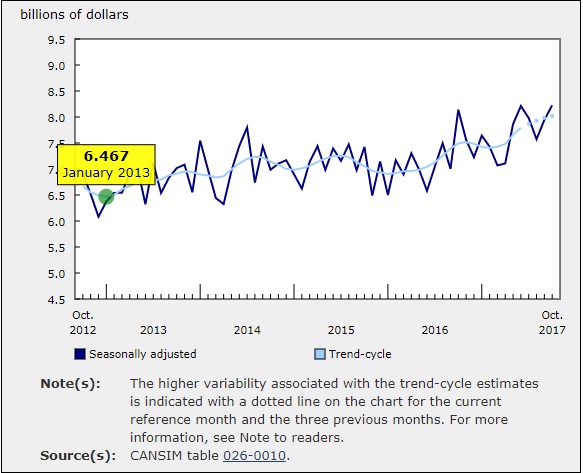
The value of building permits rose for a second straight month, up 3.5% to $8.2 billion in October. All building components increased with the exception of the institutional component, which declined 14.3%, offsetting much of the gain from the previous month.
Commercial and industrial components push the non-residential sector higher
The value of permits for non-residential buildings increased $171.7 million to $3.3 billion in October, the second consecutive monthly gain.
The commercial component, which refers to buildings used in the trade or distribution of goods and services, was the main contributor to the 5.5% increase in the non-residential sector. Permits in Quebec for warehouses, as well as permits in Ontario for office buildings, warehouses, and recreation buildings, contributed to the rise in the value of commercial building permits in October.
Nationally, the value of permits for the industrial component passed the $700 million-mark for the first time in five years. The gain stemmed primarily from higher construction intentions for factories and plants in Alberta. Nationally, the year-to-date value of permits for the industrial component totalled $5.3 billion, $1.0 billion higher than the same period in 2016.
Ontario and Quebec up in all building components
The value of building permits was up for all components in Ontario and Quebec in October.
Ontario municipalities issued $3.5 billion in building permits in October, up 15.3% from the previous month. Just over one-third of the monthly increase stemmed from the higher value of multi-family dwelling permits (+23.1%), which saw its first rise following three consecutive monthly declines.
Ontario’s construction intentions for single-family dwellings also rose in October, up 3.3% from September. Despite this increase in the value of permits, the number of single-family dwelling units approved for construction fell 0.4%.
In Ontario’s non-residential sector, the value of permits increased 21.2% to $1.5 billion. The commercial component reached $733.5 million, the highest level since September 2014, while the industrial sector rose to $373.4 million, the highest value since May 2010.
Quebec municipalities issued $1.7 billion worth of building permits in October, up 21.4% from the previous month. The value of permits for multi-family dwellings led the residential increase (+$127.5 million), while the commercial component (+$127.3 million) pushed the non-residential sector higher.
In Quebec, the value of multi-family dwelling permits was $686.6 million in October, with 78.4% of the value coming from the census metropolitan area (CMA) of Montréal. The value of permits for multi-family dwellings has increased every month since February. This eight-month streak is the longest on record for the province. Multiple high-value permits for apartment condominiums in the Montréal CMA were mainly responsible for the provincial increase in October.
Construction intentions for multi-family dwellings in Montréal continue to climb
In October, the value of permits for both single-family and multi-family dwellings increased in the CMAs of Montréal and Toronto. However, in the Vancouver CMA, both residential components fell, offsetting the gains in September.
Municipalities in the CMA of Montréal issued $538.1 million in permits for multi-family dwellings in October, higher than in Toronto ($409.2 million) and Vancouver ($330.6 million). In regards to single-family homes, Toronto registered $451.3 million in permits, followed by Vancouver ($148.1 million) and Montréal ($122.4 million).
The Montreal CMA issued permits approving the construction of 2,956 new units, stemming mainly from multi-family dwellings (2,720). October marked the fifth consecutive month where the number of units approved for multi-family dwellings exceeded 2,000. Vancouver approved the construction of 1,860 new units for multi-family homes, while Toronto (1,691) approved fewer despite having a higher value for the component.
Source: Statistics Canada, http://www.statcan.gc.ca/daily-quotidien/171207/dq171207a-eng.htm?CMP=mstatcan
![Guide to the Canadian Electrical Code, Part 1[i], 26th Edition– A Road Map: Section 74 — Airport installations](https://electricalindustry.ca/wp-content/uploads/2026/05/EIN-Stock-Guide-Code-Canada-Map-1200-768x403.png)




![Guide to the Canadian Electrical Code, Part 1[i], 26th Edition– A Road Map: Section 74 — Airport installations](https://electricalindustry.ca/wp-content/uploads/2026/05/EIN-Stock-Guide-Code-Canada-Map-1200.png)