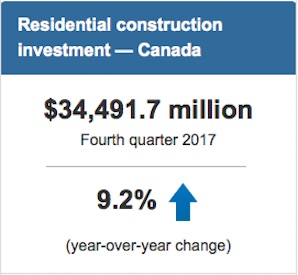
Q4 2017 Residential Construction Investment Up 9.2%
Mar 12, 2018
Investment in residential construction totalled $34.5 billion in the fourth quarter, up 9.2% (+$2.9 billion) compared with the same period in 2016.
Every component except cottages and mobile homes contributed to the year-over-year increase in spending on residential construction. The gain was led by spending on renovations, up $862.6 million (+6.4%) compared with the same quarter a year earlier. In this quarter, renovation spending accounted for 41.8% of the total residential construction investment.
Residential construction investment increased in eight provinces in the fourth quarter, led by Ontario (+$1.1 billion or 8.8%). Saskatchewan (-$28.3 million) and Newfoundland and Labrador (-$5.9 million) were the only provinces posting declines.
Construction spending on renovations rose in every province except Alberta, where it declined by $224.0 million. Renovations in Alberta peaked in the fourth quarter of 2016, when total investment for this component reached $2.3 billion, compared with $2.1 billion in the fourth quarter of 2017. This decline can be partially explained by the completion of renovation projects following the Fort McMurray wild fires in 2016.
Investment in apartment building construction rose in every province except Alberta (-$7.3 million), with Quebec leading the gains, up $451.4 million compared with the fourth quarter of 2016.
Acquisitions costs rose 12.4% (+$437.9 million) in the fourth quarter compared with the same period in 2016 and accounted for 11.5% ($4.0 billion) of the total investment in residential construction. Over the last 10 years, acquisition costs ranged from 9.5% (first quarter of 2009) to 13.5% (first quarter of 2015) of the total investment in residential construction. Acquisitions costs refer to the value of services relating to the acquisition of new dwellings, including sales taxes, land development and service charges, as well as record-processing fees for mortgage insurance and the associated premiums.
Source: Statistics Canada, www.statcan.gc.ca/daily-quotidien/180302/dq180302c-eng.htm
![Guide to the Canadian Electrical Code, Part 1[i], 26th Edition– A Road Map: Section 74 — Airport installations](https://electricalindustry.ca/wp-content/uploads/2026/05/EIN-Stock-Guide-Code-Canada-Map-1200-768x403.png)




![Guide to the Canadian Electrical Code, Part 1[i], 26th Edition– A Road Map: Section 74 — Airport installations](https://electricalindustry.ca/wp-content/uploads/2026/05/EIN-Stock-Guide-Code-Canada-Map-1200.png)