May’s Rise in Value of Building Permits Recaptures April’s Decline
July 16, 2018
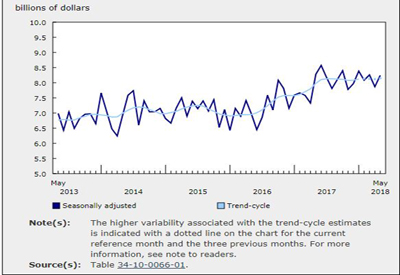
The value of permits issued by Canadian municipalities increased 4.7% to $8.2 billion in May. This followed a 4.7% drop in April, the only month this year where municipalities reported a total value below the $8.0 billion mark.
Residential sector: Multi-family dwellings reach record high
In the residential sector, municipalities issued $5.5 billion worth of permits in May, up 7.7% from April. This was the second-highest value on record, following the $5.7 billion worth of permits issued in October 2016. Five provinces posted increases, with Ontario and British Columbia reporting the largest gains.
The multi-family dwelling component reached a record high in May, with municipalities issuing $3.1 billion worth of building permits. The increase was the result of higher construction intentions in British Columbia, Ontario and Alberta.
The value of single-family dwelling permits also rose in May, up 6.2% from the previous month to $2.5 billion. This was the first increase following four consecutive monthly declines. Ontario led the seven provinces that registered increases.
Municipalities approved the construction of 21,344 new dwellings in May, up 6.6% from April. The rise was mainly attributable to multi-family dwellings, up 7.4% to 15,983 new units. Single-family dwellings increased 4.3% to 5,361 new units.
Non-residential sector: Commercial buildings post the largest decrease
The value of non-residential building permits declined 0.7% in May to $2.7 billion. Four provinces reported lower intentions, led by Alberta and Quebec.
In the commercial component, the value of building permits decreased 3.1% in May to $1.6 billion. Six provinces posted declines, with Quebec and Saskatchewan reporting the largest drops.
The value of institutional permits was down 3.9% in May to $522 million. This was the lowest reported value since July 2015, and continues an overall general decrease that began in October 2017. The decline began following the issuance of multiple permits for educational structures via the Post-Secondary Institutions Strategic Investment Fund and the construction of two new hospitals.
In contrast, the value of industrial permits increased 10.6% in May to $557 million. Seven provinces posted gains, led by Manitoba and New Brunswick.
Provinces and census metropolitan areas: Ontario and British Columbia register largest increases
The total value of building permits was up in five provinces in May, led by Ontario and British Columbia. Yukon also posted a notable gain. The value of building permits grew in 16 of 36 census metropolitan areas (CMAs), with the Toronto CMA reporting the largest increase (+$473 million).
The value of permits in Ontario rose 12.0% in May to $3.3 billion. Increases were reported in every component except industrial buildings. The value of building permits in the CMA of Toronto rose 37.9% to $1.7 billion, following three monthly declines. The gain was the result of higher construction intentions for residential dwellings. Toronto approved the construction of 3,562 multi-family dwelling units, the largest monthly total since August 2015.
British Columbia issued $1.5 billion worth of building permits in May (+18.4%). The increase was the result of higher construction intentions for multi-family dwellings in the CMA of Vancouver.
Yukon reported a large increase in May (+$17 million). Municipalities issued $19 million worth of building permits, with over 90% of the value stemming from residential construction. The gain was mainly attributable to the issuance of multiple permits for a large apartment-condominium project.
In contrast, Quebec posted an 11.4% decline in May to $1.6 billion. The decrease stemmed from lower construction intentions for multi-family dwellings and commercial buildings. The value of permits issued in the CMA of Montréal was down 20.1% in May, following a strong April where $1.1 billion worth of permits were issued.
Source: Statistics Canada, www150.statcan.gc.ca/n1/daily-quotidien/180710/dq180710a-eng.htm
![Guide to the Canadian Electrical Code, Part 1[i], 26th Edition– A Road Map: Section 74 — Airport installations](https://electricalindustry.ca/wp-content/uploads/2026/05/EIN-Stock-Guide-Code-Canada-Map-1200-768x403.png)




![Guide to the Canadian Electrical Code, Part 1[i], 26th Edition– A Road Map: Section 74 — Airport installations](https://electricalindustry.ca/wp-content/uploads/2026/05/EIN-Stock-Guide-Code-Canada-Map-1200.png)