Faulty Wiring Energizes Houseboat, Exposes Swimmers to Electric Shock
Sept 24, 2018
Two young swimmers became incapacitated due to electric shock while swimming in BC’s Lake Cowichan, but were saved by bystanders.
According to an alert published by Technical Safety BC, it appears that the houseboat became energized due to faulty wiring, a situation exacerbated by a lack of GFCI protection. This in turn energized the water and leaked current to a steel cable situated on a nearby dock. When the swimmers jumped into the lake from the houseboat, they inadvertently jumped directly into the path of the leaking current and sustained a debilitating shock.
The houseboat wiring had been altered and an alternating current (AC) circuit was added. Non-metallic sheathed cable (NMD90) fed receptacles and fridge. The fridge was capable of running on either 12V DC or 120V AC.
Testing revealed damaged non-metallic sheathed cable shorted out to a metal device box that housed a receptacle located at the forward part of the cabin. The short to ground was able to make a path back to its source through a 12V/120V fridge that was bonded to the aluminum hull of the boat via the 12V system.
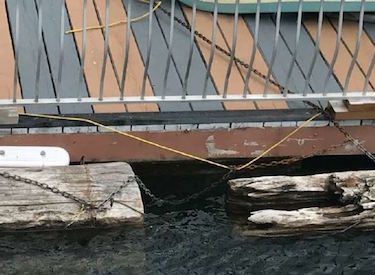
The neighbour’s dock had a galvanized steel cable run along it, the cable ran up the bank between the two properties to where it was connected to a power pole guy line. The guy line anchor was located approximately seven feet from the neighbour’s service ground electrode. The steel cable was in the water directly across from where the swimmers jumped into the water. The steel cable through the guy line anchor and the neighbours service ground electrode was a good return path to the common transformer feeding both properties.
The facts and evidence strongly suggest that the houseboat became energized by faulty wiring. This was exacerbated by the lack of GFCI protection and possibly a poor bonding connection and or voltage drop that prevented the breaker from tripping. This in turn energized the water and leaked current to the steel cable on the neighbour’s dock. The swimmers jumped directly into the path of the leaking current.
The Canadian Electrical Code requires that all 15- and 20-amp receptacles feeding marinas, wharfs and similar structures be protected by Class A ground fault circuit interrupters (GFCI) which trip at 4-6 amps.
Photo source: Technical Safety BC. See more photos at www.technicalsafetybc.ca/alerts/faulty-wiring-energizes-houseboat-exposes-swimmers-electric-shock





![Guide to the Canadian Electrical Code, Part 1[i], 26th Edition– A Road Map: Section 74 — Airport installations](https://electricalindustry.ca/wp-content/uploads/2026/05/EIN-Stock-Guide-Code-Canada-Map-1200-768x403.png)