Residential Sector Drives September Gains in Building Construction
Residential Sector


Nov 29, 2018

Total investment in building construction increased 0.3% from August to $14.5 billion in September. Gains for the month were driven by growth in investment in the residential sector (+0.4% to $10.0 billion), while investment in non-residential building construction remained unchanged at $4.5 billion. 

Investment in residential building construction

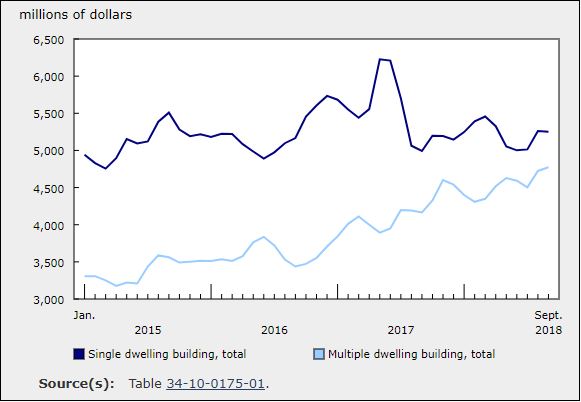
In the residential sector, the increase in investments was led by a gain of 1.0% within the multi-unit category (which includes doubles, row homes, and apartments) to $4.8 billion, while investment in the single-unit category edged down 0.2% to $5.3 billion. 

Investment in single-unit dwellings increased 5.2% compared with September 2017, while investment in multi-unit dwellings rose 14.6% over the same period.

Investment in non-residential building construction

Investment in non-residential building construction was unchanged at $4.5 billion in September, as gains in the commercial (+0.5% to $2.5 billion) and industrial (+2.0% to $0.9 billion) sectors were offset by a 2.7% decline in the institutional sector. 

Investment in non-residential building construction rose 4.1% in the 12 months to September, led by strength in the commercial (+$213 million) and industrial (+$137 million) sectors. In contrast, investment in the institutional and government sectors declined $172 million (-13.5%) compared with September 2017.

Source: Statistics Canada, www150.statcan.gc.ca/n1/daily-quotidien/181123/dq181123c-info-eng.htm.

Related Articles


Latest Articles


Changing Scene

  • Ontario Introduces Draft Regulation to Unlock Free Trade Within Canada

    Ontario Introduces Draft Regulation to Unlock Free Trade Within Canada

    December 15, 2025 The province is taking the next steps to implement mutual recognition of goods and services from other reciprocating Canadian jurisdictions by publishing a draft regulation under the Ontario Free Trade and Mobility Act, 2025 (OFTMA). The mutual recognition of goods and services will play a substantial role in supporting economic integration across Canada and… Read More…

  • New Study Reveals Opportunity for Industrial Companies to Boost Competitiveness by Modernizing Closed Automation Systems

    New Study Reveals Opportunity for Industrial Companies to Boost Competitiveness by Modernizing Closed Automation Systems

    December 8. 2025 Schneider Electric unveiled new global research titled “Open vs. Closed: The $11.28 million Question for Industrial Leaders.” The report reveals that closed industrial automation systems are quietly eroding competitiveness, costing mid-sized organizations an average of 7.5 per cent of their revenue. The research, conducted by Global Analysts firm Omdia, highlights how these costs… Read More…

  • Modernizing Canada’s Energy Efficiency Act to Improve Affordability and Competitiveness

    Modernizing Canada’s Energy Efficiency Act to Improve Affordability and Competitiveness

    December 8, 2025 Amendments to modernize the Energy Efficiency Act have been introduced in the Senate. First passed in 1992, the Act aims to reduce the overall energy consumption of energy-using products and allow consumers to make informed purchasing decisions. Since 1995, Canadian households, businesses and industries have saved over $110 billion as a result of regulations… Read More…

  • B.C.’s Economy Shows Resilience Despite Global Trade Volatility

    B.C.’s Economy Shows Resilience Despite Global Trade Volatility

    December 8, 2025 B.C.’s economy is expected to grow at a measured pace despite instability and uncertainty in the global economy. “Unjust and unpredictable trade policies have upended global relationships and shaken investor confidence across the world,” said Brenda Bailey, Minister of Finance. “We’re leaning into our strengths, like our natural resources and our skilled… Read More…