Multi-Unit Construction Drives Growth in December Residential Construction Investment, 2025 Review
March 13, 2026
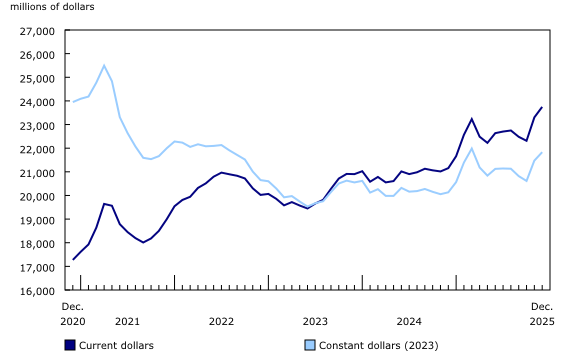
The total value of investment in building construction increased $442.9 million (+1.9%) to $23.7 billion in December. The residential sector grew 2.4%, while the non-residential sector edged up 0.6%. Year over year, investment in building construction grew 12.2% in December.
On a constant dollar basis (2023=100), the total value of investment in building construction in December rose 1.7% from the previous month to $21.8 billion and was up 8.4% year over year.
Multi-unit construction drives growth in residential investment
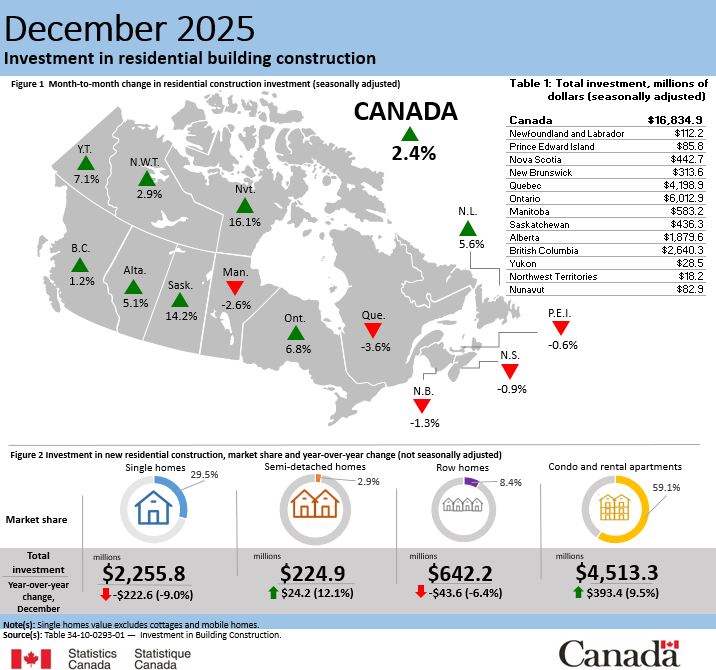
In December, investment in residential building construction was up $401.0 million to $16.8 billion. This growth was driven by the multi-unit component (+2.6%), followed by the single-family component (+2.3%).
Investment in multi-unit construction rose $234.1 million to $9.3 billion in December, led by Ontario (+$266.9 million) and Alberta (+$97.3 million). The increase was partially offset by declines in Quebec (-$111.8 million) and Manitoba (-$25.2 million). In total, three provinces and two territories contributed to the growth in this component.
Meanwhile, investment in single-family home construction increased $166.9 million to $7.5 billion. The increase was driven by Ontario (+$116.3 million) and British Columbia (+$45.6 million).
Commercial component leads non-residential sector
Investment in non-residential construction edged up $41.9 million to $6.9 billion in December. Growth in the commercial (+1.3%) and institutional (+0.2%) components were moderated by a slight decline in the industrial component (-0.4%).
Commercial construction investment rose $43.8 million to $3.5 billion in December. This growth was driven by Alberta (+$20.6 million), followed by Ontario (+$15.7 million) and British Columbia (+$6.4 million). In total, eight provinces and one territory contributed to the increase in commercial construction investment. Investment in office building construction led the increase in the commercial component, driven by major projects in the Toronto and Vancouver census metropolitan areas.
Investment in the institutional component edged up $3.8 million to $2.1 billion in December, led by British Columbia (+$21.1 million) and Alberta (+$7.6 million). The slight gains in these two provinces were moderated by declines across four provinces and two territories, driven by Ontario (-$21.4 million).
Investment in the industrial component edged down $5.8 million to $1.3 billion in December, marking the 11th consecutive monthly decrease. Quebec (-$3.9 million), British Columbia (-$2.5 million) and Manitoba (-$1.1 million) were the primary contributors to the decline, while Ontario (+$1.9 million) partially offset it.
Investment in building construction increases in the fourth quarter
The value of investment in building construction was up 2.1% (+$1.4 billion) to $69.4 billion in the fourth quarter. On a constant dollar basis (2023=100), the total value of investment in building construction grew 1.3% from the previous quarter to $63.9 billion in the fourth quarter.
Investment in residential building construction rose $1.1 billion to $48.8 billion in the fourth quarter. This increase was primarily attributed to the multi-unit component (+$895.9 million), followed by the single-family component (+$243.2 million). Additionally, the increase in investment was broad-based with seven provinces and two territories reporting gains.
Meanwhile, investment in non-residential building construction recorded a new high, rising $289.7 million to $20.6 billion in the fourth quarter. The commercial (+$314.2 million) and institutional (+$57.7 million) components contributed to the increase, while the industrial component (-$82.2 million) declined.
Annual review, 2025
In 2025, the total value of investment in building construction increased 8.5% (+$21.3 billion) to $272.1 billion. On a constant dollar basis (2023=100), the total value of investment in building construction grew 4.8% to $254.0 billion. The remainder of this release will use constant dollars (2023=100).
Investment in residential building construction rose $12.5 billion to $178.0 billion in 2025. The multi-unit component (+$11.2 billion to $98.4 billion) drove the increase, followed by the single-family component (+$1.3 billion to $79.6 billion).
Declines in the non-residential sector (-$738.6 million to $76.0 billion) tempered the increase of the investment in building construction in 2025. Losses in the industrial (-$1.2 billion) and commercial (-$787.2 million) components were moderated by gains in the institutional component (+$1.3 billion).
Investment in the industrial component decreased 7.3% to $15.3 billion in 2025, led by Quebec (-$705.0 million), followed by Ontario (-$397.1 million) and, to a lesser extent, British Columbia (-$98.3 million). In total, eight provinces and two territories contributed to the decline.
Commercial construction investment was down 2.1% to $37.6 billion in 2025, driven by Quebec (-$506.9 million), Alberta (-$464.2 million) and British Columbia (-$437.2 million). The decrease was tempered by increases in Ontario (+$464.3 million) and New Brunswick (+$102.4 million).
Investment in the institutional component rose 5.7% to $23.1 billion in 2025. Alberta (+$1.1 billion) led the overall growth, supported by broad gains across seven other provinces and the three territories.
![Guide to the Canadian Electrical Code, Part 1[i], 26th Edition– A Road Map: Section 74 — Airport installations](https://electricalindustry.ca/wp-content/uploads/2026/05/EIN-Stock-Guide-Code-Canada-Map-1200-768x403.png)



![Guide to the Canadian Electrical Code, Part 1[i], 26th Edition– A Road Map: Section 74 — Airport installations](https://electricalindustry.ca/wp-content/uploads/2026/05/EIN-Stock-Guide-Code-Canada-Map-1200.png)