Challenges and Opportunities in ICI Construction in 2026 as OCS Poll Reveals Quiet Contractor Confidence
March 9, 2026
Annual OCS poll reveals quiet contractor confidence amid trade uncertainty, escalating material costs, financing concerns and continued labour market imbalances
Ontario’s non-residential building contractors remain resilient in the face of a turbulent and uncertain marketplace, according to the Ontario Construction Secretariat’s annual Contractor Survey.
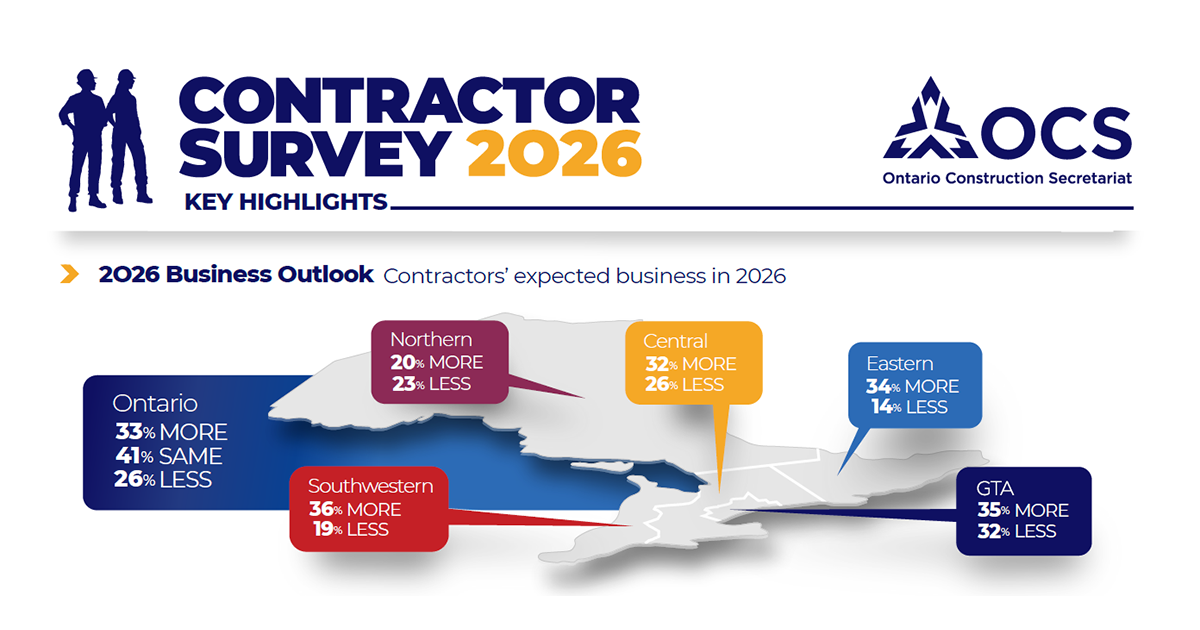
Two-thirds of the contractors who participated in the OCS poll reported that they were running at or above capacity in 2025, and a similar number are expecting 2026 to be the same — this despite data that indicates a near split on the outlook for Ontario’s construction market in the coming year. Nearly half of contractors are expecting the overall market to be either stable (35 percent) or grow (14 per cent), while the number of contractors who are expecting a decline is not far off, coming in at 46 per cent.
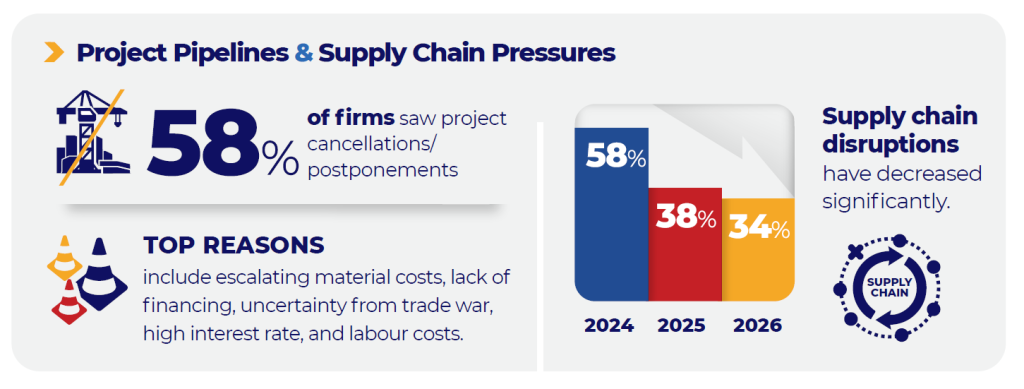
The survey, which was released today at the OCS’s 26th Annual State of the Industry & Outlook Conference in Toronto, also found that project cancellations and postponements are widespread with more than half (58 per cent) of contractors reporting that one or more of their projects have been either delayed or cancelled. Contractors cite escalating material costs (66% per cent), lack of financing (59 per cent), uncertainty from the trade war (45 per cent) and high interest rates (45 per cent) as the primary drivers leading to project deferment.
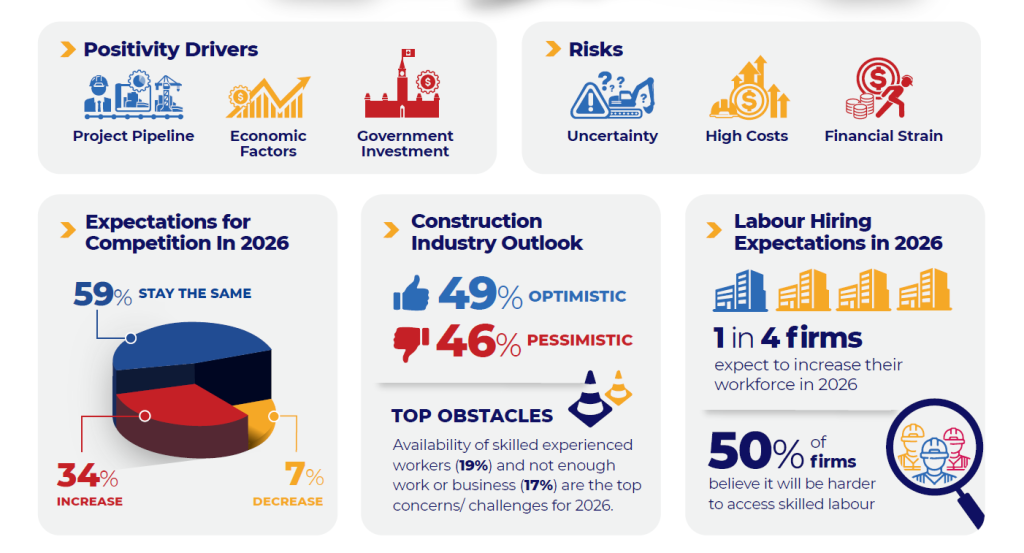
While contractors are reporting strong competition, they have witnessed some relief as supply chains have shown more stability. Only a third of contractors experienced supply chain disruptions in the past year — compared to 58 per cent in 2024.
“Ontario’s Industrial, Commercial and Institutional contractors continue to show remarkable strength and adaptability in a time that is dominated by uncertainty,” says Brian Barron, Chief Executive Officer of the Ontario Construction Secretariat. “Economic and political uncertainty, the availability of skilled experienced labour and material costs remain major challenges, especially for smaller firms, but our industry’s ability to navigate supply chain disruptions and policy uncertainties, and to work collaboratively is a testament to the dedication and professionalism of the sector.”
Despite broad concerns about Ontario’s construction market, contractors are generally bullish about their own firm’s outlook for 2026, with roughly a third of businesses in the Southwest (36 per cent), Central (32 per cent), East (34 per cent) and Greater Toronto Area (35 per cent) expecting growth in 2026. The outlook in the North is more cautious, where only 20 per cent of businesses are forecasting growth.
Labour market imbalances remain a significant concern in the sector, with one-in-five contractors noting it as their top challenge. Although down by half from previous years, ensuring contractors have access to a highly skilled and experienced workforce is a priority for the industry — especially as many Baby Boomers continue to retire. This is even more urgent in smaller markets such as Northern Ontario, when one or two large projects can have a significant impact on labour requirements.
To build a highly skilled workforce, contractors continue to invest in workforce development by hiring apprentices. Currently, 70 per cent of contractors employ apprentices – a steady increase from 58 per cent in 2024 and 64 per cent in 2025.
“With 82 per cent of unionized contractors employing apprentices, it is clear that our labour and management partners are committed to training the next generation of skilled tradespeople,” says Mr. Barron. “But there remains a cautious undertone. While we are making progress, there is a need for stability in the sector, project certainty and policy support that ensures apprenticeship pathways remain strong across Ontario.”
The OCS Contractor Survey, conducted by Ipsos, polls a representative sample of the province’s institutional, commercial and industrial construction sector to gauge business expectations and perspectives on salient issues impacting the industry. The survey was conducted via phone interview with 400 contractors between December 23rd, 2025, and January 26th, 2026, including union and non-union companies. The margin of error for this sample is +/-4.9%, 19 times out of 20.
Read the full survey at iciconstruction.com. For more information on the OCS, please visit www.iciconstruction.com.

![Guide to the Canadian Electrical Code, Part 1[i], 26th Edition– A Road Map: Section 74 — Airport installations](https://electricalindustry.ca/wp-content/uploads/2026/05/EIN-Stock-Guide-Code-Canada-Map-1200-768x403.png)




![Guide to the Canadian Electrical Code, Part 1[i], 26th Edition– A Road Map: Section 74 — Airport installations](https://electricalindustry.ca/wp-content/uploads/2026/05/EIN-Stock-Guide-Code-Canada-Map-1200.png)