Value of Building Permits Rose 2.6% in November
Jan 12, 2020
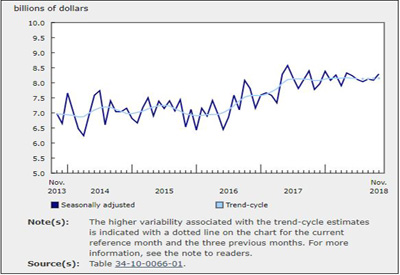
Canadian municipalities issued $8.3 billion worth of building permits in November, up 2.6% from October. Higher construction intentions for commercial buildings drove most of the gain.
Non-residential sector: commercial permits drive the increase
The value of non-residential building permits rose 11.6% to $3.3 billion in November. Construction intentions rose in five provinces, with British Columbia accounting for most of the gain.
In the commercial component, the value of building permits was up 16.8% to $2.1 billion, the highest level since May 2007. The increase was led by higher construction intentions for office buildings in the census metropolitan areas (CMAs) of Vancouver and Quebec.
Following three consecutive monthly declines, the value of industrial building permits rose 21.9% to $527 million in November. The increase was mainly attributable to permits for new agricultural buildings.
In the institutional component, the value of permits was down 7.2% to $682 million in November, with Quebec and Newfoundland and Labrador reporting the largest decreases. The decline in the institutional component was largely attributable to fewer high value permits issued for nursing homes compared with the previous month.
Residential sector: single-family dwellings post the largest decline
In the residential sector, the value of building permits decreased 2.5% to $5.0 billion in November. There were declines in five provinces, most notably Ontario. Meanwhile, the largest gain was in Quebec.
The value of single-family permits fell 5.5% to $2.2 billion in November, after increasing 4.7% the previous month. Ontario reported the largest decline (-8.1% to $930 million)—the lowest reported value since January 2016.
In the multi-family dwelling component, municipalities issued $2.9 billion worth of building permits in November, edging down 0.1% from October. Ontario reported the largest decrease (-$232 million), which was largely offset by a $204 million gain in Quebec.
In November, municipalities approved the construction of 19,378 new dwellings (-3.1%), consisting of 4,725 single-family units (-7.0%) and 14,653 multi-family units (-1.8%).
Provinces and census metropolitan areas: British Columbia and Quebec register largest increases
The value of building permits increased in six provinces in November, led by British Columbia and Quebec. Meanwhile, the value of permits rose in 14 of the 36 CMAs, led by Montréal, Vancouver and Calgary.
In British Columbia, the value of permits rose 14.3% to $1.7 billion. The commercial component posted the highest value on record, driven by a $240 million permit for an office building in the CMA of Vancouver.
The value of building permits in Quebec was up 13.9% to $1.8 billion in November, following a decrease of 14.9% the previous month. The increase was largely the result of the issuance of high-value permits for large apartment buildings in the CMA of Montréal and a record high for commercial permits in the CMA of Québec.
In Alberta, the value of building permits increased 10.4% to $1.1 billion. The gain was largely driven by the CMA of Calgary (+$131 million), where every component, except for industrial buildings, reported an increase.
In contrast, the value of building permits in Ontario was down 10.3% to $3.0 billion, following an increase of 9.0% in October. The value of permits in the CMA of Toronto dropped 17.4% to $1.5 billion in November. The decrease in multi-family dwellings (-$225 million) was the main contributor to the decline. Despite the decrease in November, the year-to-date value in the Toronto CMA for multi-family permits ($6.8 billion) has surpassed the total value for 2017 by 20.2%.
Source: Statistics Canada, www150.statcan.gc.ca/n1/daily-quotidien/190110/dq190110a-eng.htm