The Smart Grid Atlantic Project: Developing the Electrical Grid of the Future
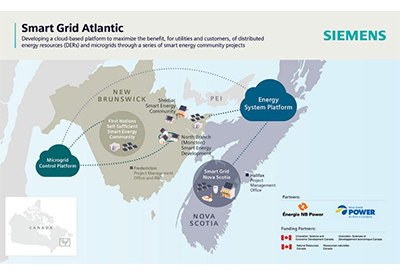
PB 43 Siemens SmartGridAtlantic 400

March 25, 2021

Smart Grid Atlantic: a living lab

The Smart Grid Atlantic initiative will determine how energy technologies of the future can provide customer, community, and provincial benefits such as cleaner local power, more renewable energy, new energy solutions and more reliable electricity.

Creating Smart Energy Communities in Atlantic Canada

Announced in 2019, Siemens Canada, New Brunswick Power (NB Power) and Nova Scotia Power (NSP) received federal funding for a joint pilot project aimed at analyzing challenges and opportunities posed by Canada’s energy transition. The partners are researching and testing how the grid of the future can optimize the integration of renewable sources of energy, ensure the stability of the grid and manage decentralized distribution. The aim is to better manage the provinces’ electricity, potentially reduce consumers’ future electricity costs and reduce greenhouse gas emissions.

The Smart Grid Atlantic project deploys Siemens Energy System Platform (ESP) in both provinces (New Brunswick and Nova Scotia). The benefits of distributed energy resources (DERs) and entire microgrids for utilities and customers will be maximized through a series of smart energy community projects. A wide array of grid-edge devices and community and utility-scale assets will be connected. This includes: 

  •    –   Residential solar, storage, water heaters, heat pumps, etc.
  •    –   Fleet and residential electrical vehicle charging
  •    –   Building automation systems
  •    –   Commercial solar, storage and loads
  •    –   Community solar and utility-scale storage

This project is a living lab for utilities to understand how customers engage with new offerings. It is demonstrating how to design new business models, create value, and analyze how incentive structures can influence behaviour. With all stakeholders involved, it is providing a critical roadmap for an efficient and cost-effective energy transition, leading to a more resilient and sustainable future.

Go HERE to download a whitepaper on the project
Related Articles


Latest Articles


Changing Scene

  • CAF-FCA Welcomes Federal Apprenticeship Investments, Urges Focus on Implementation

    CAF-FCA Welcomes Federal Apprenticeship Investments, Urges Focus on Implementation

    May 1, 2026 CAF-FCA welcomes the federal government’s strong focus on skilled trades in the 2026 Spring Economic Update, including new investments in apprenticeship pathways, financial supports, and employer incentives. These measures reflect long standing priorities advanced by employers and partners across the country. The Canadian Apprenticeship Forum (CAF-FCA) welcomes the Government of Canada’s renewed Read More…

  • ECABC Announces 2026 Hall of Fame Inductees

    ECABC Announces 2026 Hall of Fame Inductees

    April 30, 2026 ECABC is proud to announce that Bill Strain and Rob Tate will be inducted into the ECABC Electrical Hall of Fame this June. Bill and Rob have devoted their careers to the electrical contracting industry in British Columbia. Induction into the Electrical Hall of Fame is the highest honour the Association can Read More…

  • Nexans Initiates Copper Mark Recertification for Montreal Site

    Nexans Initiates Copper Mark Recertification for Montreal Site

    April 27, 2026 Nexans Canada Inc. has initiated the Copper Mark recertification process for its site located at 460 Durocher Avenue in Montreal. As part of this process, an independent external assessment of the site is scheduled for April 22–24, 2026. Copper Mark is an independent assurance framework designed to assess the responsible practices of industrial sites against recognized Read More…

  • Fort Frances Memorial Sports Centre Adding Solar as Part of GICB Program

    Fort Frances Memorial Sports Centre Adding Solar as Part of GICB Program

    April 27, 2026 The Fort Frances Memorial Sports Centre will generate solar energy following an investment of $589,762 from the federal government through the Green and Inclusive Community Buildings (GICB) program. This funding will reduce greenhouse gas emissions and annual electricity costs for the facility. A rooftop solar generation system will convert solar energy into Read More…