Smartflower Microgrid Project Enhances Provincial Curriculum Resources and Showcases Saskatchewan Tech
EIN Sunflower Solar 400

November 3, 2022

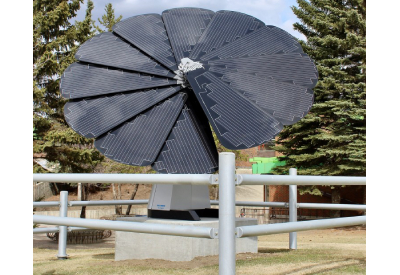
The official launch of the Smartflower Microgrid (MG) marked another milestone for the future of green technology in Saskatchewan.

The Saskatoon Industry Education Council (SIEC) and Siemens Canada welcomed dignitaries and guests to a launch event at Bishop James Mahoney High School in Saskatoon.

The Smartflower MG is now powering classrooms and providing real-time data on electricity production and energy absorption. Students were on hand to provide classroom tours and discuss the solar-powered microgrid solution, co-created by Siemens Canada. 

New curriculum resources will be available to students across the province, providing a deeper understanding of green technology and the applications of solar power, data analytics and grid management. Students will learn how microgrids generate, distribute, and control power in a campus setting such as a school, a small community, in critical infrastructures, military institutions, commercial and industrial areas, remote locations, and on islands.

“SIEC is pleased to be able to provide opportunities to students in K-12 to learn about career pathways in the green energy sector. Access to the Smartflower technology and connecting it to STEM education is a great way to showcase what careers are available now and in the future in Saskatchewan,” said Janet Uchacz-Hart, Executive Director, SIEC.

Siemens Canada is responsible for the innovative technology behind the Smartflower MG, the first educational microgrid of its kind in Canada. The resounding success of the pilot project in Saskatoon has paved the way for subsequent Smartflower MG installations across Canada.

We are excited to offer students the opportunity to learn about renewable microgrid installations. It is very rewarding to see young people excited about working with these technologies in the classroom and using the knowledge to make their own homes and communities sustainable,” said Faisal Kazi, President and CEO, Siemens Canada. “Projects like this enable a more sustainable future – a future that is in their hands.”


Source

Related Articles


Latest Articles

  • What 2025 Revealed About Canada’s Electrical Industry

    What 2025 Revealed About Canada’s Electrical Industry

    December 16, 2025 By Carol McGlogan, President & CEO, Electro-Federation Canada The past year required Canada’s electrical industry to adapt to a rapidly changing environment. In 2025, businesses across the value chain navigated shifting trade conditions, evolving policy landscapes, and growing expectations tied to electrification and infrastructure expansion. Trade uncertainty introduced new complexity. Organizations reassessed Read More…

  • Considerations for EV Charging Installation and Site Preparation

    Considerations for EV Charging Installation and Site Preparation

    December 15, 2025 By Blake Marchand As part of our recent discussion with LEDVANCE EVSE Product Manager, Erich Bockley, he emphasized the importance of site preparation Site preparation can be the most complicated part of the project, Bockley emphasized, a lot needs to be considered before the installation work begins. Many public charging applications will Read More…

  • Ontario’s Multi-Family Component Leads Residential Sector Increases in October Building Permits

    Ontario’s Multi-Family Component Leads Residential Sector Increases in October Building Permits

    December 15, 2025 In October, the total value of building permits issued in Canada rose $1.8 billion (+14.9%) to $13.8 billion. The increase in construction intentions was led by the residential sector (+$1.1 billion). An increase was also observed in the non-residential sector (+$702.8 million). On a constant dollar basis (2023=100), the total value of building permits issued in Read More…

  • Residential Investment in Building Construction Declines in September

    Residential Investment in Building Construction Declines in September

    December 15, 2025 Overall, investment in building construction decreased 1.1% to $22.4 billion in September. Investment in the residential sector declined 1.7%, while that in the non-residential sector was virtually unchanged. Year over year, investment in building construction grew 6.0% in September. On a constant dollar basis (2023=100), the total value of investment in building construction in September decreased 1.4% Read More…


Changing Scene