AI-Powered Retrofits: A Smarter Path to Efficiency and Sustainability

September 5, 2025
By Richard Henzie, Director, Smart Buildings Division, Schneider Electric Canada
Canada’s buildings are aging—and so is the infrastructure that powers them. With more than half of today’s buildings expected to still be in use by 2050, the path to net-zero must run through the systems we already have. For Smart Building Technology professionals—including those in electrical, mechanical, HVAC, and building automation—this presents a pivotal opportunity: to lead the transformation of legacy buildings into high-performing, energy-efficient assets using the power of artificial intelligence (AI).
Why Now?
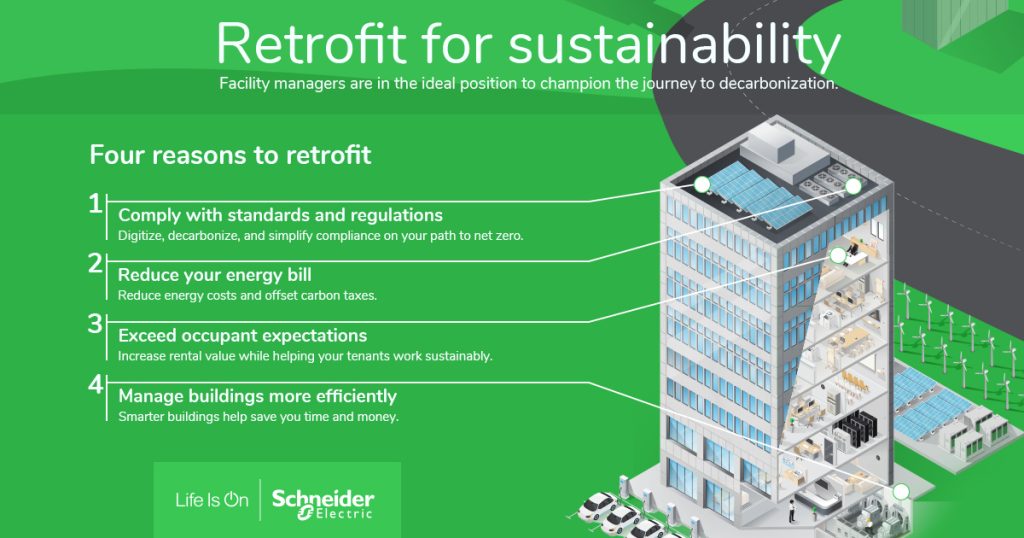
The urgency is clear. Escalating costs, tightening emissions regulations, and growing ESG expectations are converging to make building performance a national priority. In cities like Toronto, bylaws now require energy and water benchmarking, while provinces are introducing stricter building codes and carbon reporting frameworks. At the same time, the embodied carbon in existing structures makes retrofitting a more sustainable—and often more economical—alternative to demolition and rebuilds.
Another critical driver is the risk of stranded assets. Buildings that fail to transition toward efficiency and sustainability risk becoming financial liabilities—harder to lease, more expensive to maintain, and less attractive to buyers. Retrofitting with intelligent technologies is not just a climate imperative; it’s a business one.

From Dashboards to Decisions: The AI Shift
A few years ago, the focus was on connected assets feeding dashboards and reports to help operators understand building performance. But this still required human interpretation and manual action. Today, AI has shifted the paradigm. These models can now analyze, interpret, and act on data autonomously—delivering optimized performance with less human intervention.
In retrofit applications, AI is not just about automation—it’s about intelligence. These systems can:
- Analyze historical energy usage to identify inefficiencies.
- Recommend cost-effective, high-impact upgrades.
- Model building performance under various retrofit scenarios.
- Predict emissions reductions and ROI from targeted improvements.
This is already delivering measurable results. In Stockholm, AI-powered HVAC optimization across educational buildings led to a 3.12% reduction in district heating and an 8.93% drop in electricity consumption between 2019 and 2023. That translated to an annual carbon reduction of 64.8 tonnes of CO₂ equivalent per building. Meanwhile, edge AI—processing data locally at the device level—has demonstrated up to 15% energy savings in commercial HVAC systems.
These aren’t theoretical gains. They’re real-world examples of how AI is helping building operators make smarter, faster decisions that drive both environmental and operational performance.
Bridging the Workforce Gap
As skilled professionals retire and fewer replacements enter the field, building operations face a growing talent gap. Technology is stepping in to fill it. AI-enabled platforms allow operators to manage more square footage per person, improving efficiency without compromising performance.
One major Canadian bank, for example, avoided hundreds of costly technician dispatches across dozens of branches by using remote diagnostics and AI-driven fault detection—saving hundreds of thousands in operational costs over just a few months. These kinds of efficiencies are increasingly vital as portfolios grow and staffing remains constrained.
The Role of Smart Building Technology Professionals
Retrofitting a building for AI integration requires more than just installing sensors or upgrading controls. It demands a deep understanding of how electrical systems are integrated with HVAC, lighting, and automation platforms—and how to design for interoperability, scalability, and resilience.
This is where the expertise of Smart Building Technology professionals becomes indispensable. From specifying smart panels and IoT-enabled devices to building automation systems (BAS) and ensuring cybersecurity, these professionals are the enablers of intelligent infrastructure.
A Canadian Perspective
In Canada, the retrofit opportunity is massive. According to Natural Resources Canada, buildings account for approximately 13% of the country’s direct GHG emissions—rising to 18% when electricity use is included. Much of this stems from outdated systems and inefficient operations. Retrofitting with AI-enabled technologies offers a practical, scalable way to reduce emissions while improving building performance.
And it’s not just about large commercial towers. Mid-sized residential buildings, schools, healthcare facilities, and municipal & retail infrastructure all stand to benefit. With modular, cloud-connected platforms, AI retrofits can be tailored to different building types, budgets, and performance goals.
From Ambition to Action
Solutions like Schneider Electric Canada’s EcoStruxure Building Operation and EcoStruxure Building Advisor exemplify how AI can be applied in retrofit scenarios. These platforms use real-time data to continuously assess system performance, detect anomalies, and recommend prioritized actions based on cost, carbon impact, and ROI. They don’t just flag issues—they help solve them.
This kind of intelligent automation accelerates decision-making and ensures that retrofits are not only effective but aligned with broader business and sustainability strategies. It also supports compliance with evolving regulations and helps future-proof assets against rising energy costs and climate risks.

Looking Ahead
As Canada moves toward its 2050 net-zero targets, the role of Smart Building Technology professionals will only grow in importance. Retrofitting legacy buildings with AI-powered systems is one of the most impactful ways to reduce emissions, improve resilience, and unlock long-term value.
But it requires a shift in mindset—from reactive maintenance to predictive optimization, from siloed systems to integrated intelligence. It also requires collaboration across disciplines: electrical, mechanical, digital, and operational.
The good news? The tools are here. The expertise exists. And the momentum is building.
Author Bio

Richard Henzie – Director of the Smart Buildings Division, Schneider Electric Canada
Richard Henzie is a global business leader specializing in energy management and automation. Based in Victoria, Canada, he directs the Digital Energy Division at Schneider Electric, focusing on advanced building systems and sustainability. With 21 years at the company, he has held leadership roles in digital solutions, business development, and marketing, overseeing operations across Canada, Europe, and the USA.
A graduate of the University of British Columbia, Richard combines his expertise in commerce and technology to drive innovation and growth. Richard is extremely passionate about Smart Building design and operation, focusing on how digitization of systems and processes can help building owners and operators achieve more sustainable, resilient, hyper-efficient, and people-centric buildings.

![Guide to the Canadian Electrical Code, Part 1[i], 26th Edition– A Road Map: Section 74 — Airport installations](https://electricalindustry.ca/wp-content/uploads/2026/05/EIN-Stock-Guide-Code-Canada-Map-1200-768x403.png)



![Guide to the Canadian Electrical Code, Part 1[i], 26th Edition– A Road Map: Section 74 — Airport installations](https://electricalindustry.ca/wp-content/uploads/2026/05/EIN-Stock-Guide-Code-Canada-Map-1200.png)