Using Electrical Estimating Software as Preconstruction Risk Mitigation

February 15, 2024
By Melvin Newman, Co-Founder, President and CTO of PataBid
In the intricate landscape of preconstruction, where uncertainties often lurk, leveraging the power of electrical estimating software emerges as a strategic cornerstone for effective risk mitigation. As construction projects become increasingly complex, the need for a comprehensive approach to preconstruction risk reduction becomes imperative. This blog delves into the instrumental role of electrical estimating software as a proactive tool in identifying, analyzing, and mitigating potential risks before they evolve into challenges. Explore how harnessing technology can optimize your preconstruction processes, protect your projects against uncertainties and future proof your contracting business.
Centralized estimate data storage
In the realm of preconstruction risk mitigation, the significance of utilizing electrical estimating software extends to centralized data storage. The period between submission and job award, which can span many weeks, often poses the risk of misplacing crucial estimate documents. Addressing this challenge, estimating software provides a solution by consolidating all preconstruction-related documents in a singular, accessible location. PataBid Quantify allows contractors to store project drawings, user-drafted PDFs, pricing quotes, specification documents, and shop drawings in one central platform. By streamlining preconstruction document storage, estimating software guarantees that contractors can swiftly access essential information, safeguarding against the loss of critical project documents. If the project lifecycle changes, estimating software is also useful to create change orders, modify scope and save addenda documentation. Stay organized and bid with confidence, knowing that no project documents will be misplaced again!
Know what’s in your bid
An essential aspect of risk mitigation in electrical estimating software lies in the ability to trace the origins of every numerical value within your estimate. Being able to reference the estimate drawings to confirm how the final bid number was produced. Take, for instance, the use of estimating software such as Quantify for electrical projects. With this platform, you can be confident that each figure in your estimate is intricately connected to a source document specific to the project. By removing uncertainties and ensuring a clear link between every estimate value and its source, software allows contractors to bid electrical work with confidence, eliminating guesswork and contributing to more accurate and informed decision-making in the bidding process.
Automated features
Artificial intelligence is gaining more dominance within construction, especially within estimating software. A key application of AI in estimation is evident in the automation of quantity takeoff. Advancements in AI development have now reached a stage where an estimator can simply select an item on a drawing and direct the AI to count all similar items on the page. This automation significantly accelerates the tedious task of takeoff, typically resulting in a 30% faster completion time with substantially fewer errors compared to manual methods. Estimating software, enriched with AI, extends its capabilities to include additional automated features such as pricing integrations and prebuilt assemblies. These features contribute to further minimizing the risk of human error, enhancing the overall efficiency and precision of project estimates.
Automated calculations
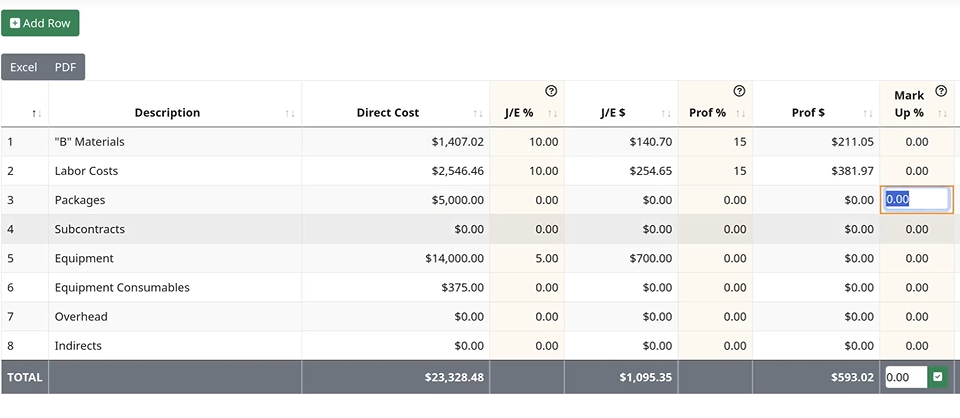
Most full spectrum electrical estimating software platforms offer various ways to perform automated calculations. Automated calculations work to reduce risk by providing values that are driven by takeoff and pricing. This enables a form of parametric estimation.
A key example of this is when calculating permits or bonding costs. These costs are usually calculated on a prescribed formula based on bid value. Other key values that are commonly based on formulas are things like travel, shift parameters and such.
With a properly utilized electrical estimating platform, these formulas can be built into the estimate templates, ensuring that each new estimate that is created has the common formulas pre-built ready to go. This ensures that each value is consistent with the values of the bid requiring only simple validation before submission. Generate precise and detailed estimates swiftly, minimizing the risk of miscalculations and ensuring uniformity.
Real time pricing
Having the capability to incorporate real-time, up-to-the-minute pricing into electrical bids stands as a pivotal element in preconstruction risk mitigation. The persistent challenges of fluctuating material pricing and availability within the construction industry emphasize the need for a digital estimating solution that seamlessly integrates real-time pricing. An optimal digital estimating software should encompass a comprehensive suite of features, particularly the ability to provide up-to-the-minute pricing. Relying on tools like Excel, not explicitly designed for estimating, introduces risks to your contracting business. A solution like Quantify offers contractors various automated methods to input material pricing. Additionally, through a new collaboration with City Electric Supply, users can now access personalized, up-to-the-minute electrical material pricing in Quantify. This partnership guarantees current material pricing for estimates to improve job accuracy, while still allowing flexibility for users to choose their preferred supply house for material ordering.
In conclusion, this blog has delved into some of the ways that estimating software can mitigate preconstruction project risk. Understanding your bid, implementing centralized estimate data storage, leveraging automated calculations, tapping into automated features, and integrating real-time pricing are all important components of risk mitigation for any contracting business. It’s important to note that while this article specifically addresses electrical estimating software, the identical principles are relevant to the mechanical subtrade.
Ready to start mitigating job risk with a powerful estimating platform? Access a free, 2 week trial of PataBid Quantify today.