GDP Unchanged in October: Gains Offset by Declines
Economy GDP Jan 2016

Jan 08 2016


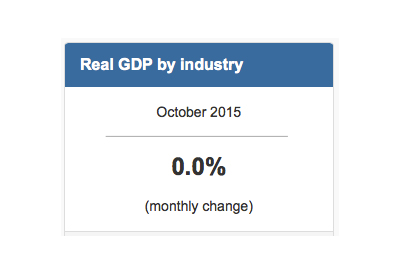
Real gross domestic product was unchanged in October, after falling 0.5% in September. Gains in mining, quarrying, and oil and gas extraction as well as the public sector were offset by declines in manufacturing, utilities and retail trade.

The output of goods-producing industries was also unchanged in October. Mining, quarrying, and oil and gas extraction and, to a lesser extent, the agriculture and forestry sector rose. However, these gains were offset by declines in manufacturing, utilities and construction.

The output of service-producing industries was also unchanged in October. The public sector (education, health and public administration combined) increased, but this was offset by declines in retail and wholesale trade, transportation and warehousing services and, to a lesser extent, the finance and insurance sector.

Chart 1: Real gross domestic product is unchanged in October
Economy GDP Jan 2016

Mining, quarrying, and oil and gas extraction rise

Mining, quarrying, and oil and gas extraction rose 0.7% in October, following a 4.7% decline in September.
Oil and gas extraction expanded 0.8% in October as a result of a 4.5% increase in non-conventional oil extraction, which partially rebounded from a 10.6% decrease in September caused by production difficulties and maintenance shutdowns. Conventional oil and gas production was down in October.
Mining and quarrying (excluding oil and gas extraction) increased 0.7% in October, mainly as a result of growth in metallic mineral and coal mining. Potash mining declined in October.

Support activities for mining and oil and gas extraction decreased 0.6% in October, as a result of declines in both rigging and drilling services.

Manufacturing output falls again

Manufacturing output fell 0.3% in October, after declining 1.0% in September. The declines in September and October followed three consecutive monthly gains.

Chart 2: Manufacturing falls in October

Economy GDP Jan 2016

Non-durable goods manufacturing contracted 1.0% in October. Declines were notable in food manufacturing, beverage and tobacco manufacturing, plastic and rubber products manufacturing and printing and related support activities. In contrast, the manufacturing of chemicals as well as textile, clothing and leather products increased.

Durable-goods manufacturing increased 0.2% in October. There were gains in the manufacturing of computer and electronic products, transportation equipment as well as machinery. Miscellaneous manufacturing and, to a lesser extent, furniture and related products manufacturing declined.

The public sector increases

The public sector (education, health and public administration combined) grew 0.2% in October as all major components were up. Educational services increased 0.3%, while public administration as well as health care and social assistance also rose.

Retail and wholesale trade contract

Retail trade contracted 0.4% in October. Notable declines were recorded at food and beverage stores and, to a lesser extent, at gasoline stations. In contrast, sporting goods, hobby, book and music stores as well as clothing and clothing accessories stores recorded gains.

Wholesale trade edged down 0.1% in October, a fourth consecutive monthly decline. Food, beverage and tobacco wholesaling, miscellaneous wholesaling (which includes agricultural supplies), and motor vehicle and parts wholesaling were down. Notable increases were posted in the wholesaling of machinery, equipment and supplies.

The finance and insurance sector contracts again

The finance and insurance sector decreased for a third consecutive month, edging down 0.1% in October as a result of declines in insurance and banking services. In contrast, financial investment services advanced.

Construction decreases

Construction edged down 0.1% in October as a result of a decline in residential building and, to a lesser extent, repair construction. Engineering construction increased while non-residential building construction was unchanged.

The output of real estate agents and brokers rose 2.4% in October, after falling 1.8% in September.

Other industries
Utilities fell 1.4% in October as a result of declines in natural gas distribution as well as electricity generation, transmission and distribution.
Transportation and warehousing services declined 0.4% in October, mainly because of decreases in pipeline and truck transportation services.

Economy GDP Jan 2016

Source: Statistics Canada, www.statcan.gc.ca/daily-quotidien/151223/dq151223a-eng.htm?cmp=mstatcan.



Related Articles


Latest Articles

  • Ottawa Day 2026: EFC Members Engage with Parliamentarians on Canada’s Electricity Future

    Ottawa Day 2026: EFC Members Engage with Parliamentarians on Canada’s Electricity Future

    March 16, 2026 By Electro-Federation Canada Following EFC’s recent update on our 2026 Ottawa Day, we are pleased to share photo highlights from two days of engagement on Parliament Hill, where members met with federal decision-makers to discuss the future of Canada’s electricity system. More than 40 EFC member leaders and Government Relations representatives travelled Read More…

  • Industrial Construction Intentions Drive Increase in Non-Residential Sector in January

    Industrial Construction Intentions Drive Increase in Non-Residential Sector in January

    March 13, 2026 In January, the total value of building permits issued in Canada increased $607.0 million (+4.8%) to $13.3 billion. The increase was led by the non-residential sector (+$464.0 million) and supported by the residential sector (+$143.0 million). On a constant dollar basis (2023=100), the total value of building permits issued in January rose 4.3% from the previous month Read More…

  • Multi-Unit Construction Drives Growth in December Residential Construction Investment, 2025 Review

    Multi-Unit Construction Drives Growth in December Residential Construction Investment, 2025 Review

    March 13, 2026 The total value of investment in building construction increased $442.9 million (+1.9%) to $23.7 billion in December. The residential sector grew 2.4%, while the non-residential sector edged up 0.6%. Year over year, investment in building construction grew 12.2% in December. On a constant dollar basis (2023=100), the total value of investment in building construction in December rose 1.7% Read More…

  • 5 Strategic Reasons to Attend the Lumen Exhibition

    5 Strategic Reasons to Attend the Lumen Exhibition

    March 13, 2026 In a market where deadlines are tight and projects are increasingly complex, staying competitive is no longer just about technical skills. It also depends on having the right tools, the right information, and the right partners by your side. The Lumen Exhibition is more than just an event—it’s a strategic lever designed to Read More…


Changing Scene

  • A New Guillevin.com, Designed to Simplify Your Purchasing Experience

    A New Guillevin.com, Designed to Simplify Your Purchasing Experience

    March 16, 2026 Guillevin.com was built as a digital working tool, designed to support the way their customers plan, search for, and purchase products today. The goal is simple: to offer a fast, reliable, and intuitive online platform capable of supporting real-world operations; both on the job site and in the office. A platform built around Read More…

  • Nova Scotia Strengthens Housing Legislation to Accelerate Supply

    Nova Scotia Strengthens Housing Legislation to Accelerate Supply

    March 13, 2026 Amendments to existing legislation will mean more housing, improved efficiency in the sector and better alignment of related agencies. The changes extend the Executive Panel on Housing in the Halifax Regional Municipality and give the Minister of Housing new authority to ensure housing projects aren’t delayed. “We are strengthening how we plan, Read More…

  • BC Introduces Public Sector Construction Projects Procurement Act

    BC Introduces Public Sector Construction Projects Procurement Act

    March 13, 2026 Kiel Giddens, MLA for Prince George-Mackenzie and Critic for Labour, has introduced the Public Sector Construction Projects Procurement Act, legislation aimed at ensuring publicly funded construction contracts are awarded through labour-neutral, merit-based procurement. “Here’s the simple question: if labour shortages are driving cost overruns, why would government limit who can work on public projects?” Read More…

  • KPMG Establishes Major Products Delivery Office

    KPMG Establishes Major Products Delivery Office

    March 13, 2026 KMPG: Complex projects require well-structured teams, appropriate delivery models tailored to the project’s needs, robust governance frameworks, and stable execution environments KPMG Canada is entering a defining era of major project development that has significant implications for the nation’s economic future, as the country works to establish new trade partnerships, develop its resources, reinforce self-reliance Read More…