Case Study: Temporary Power for Large Scale Residential Construction
Temporary Power

Ever wonder how large construction projects with sales offices and show suites get power when there is only a generator or temporary power established on the construction site?TheBC Safety Authority (BCSA) pays close attention to these types of installations, since fire alarms, sprinklers, and other building code safety systems are not up and running during the construction phase of the project.

Recently, a BCSA safety officer conducted an assessment of a large multi-family residential site under construction. Working collaboratively with electrical contractors, other trades, safety officials, utilities, and building departments to reach safety solutions is an important part of a BCSA safety officer’s role.

During the inspection, several significant hazards were found.Most notably, townhouses had been energized using the temporary construction service, creating a risk of overload to the service. Had these dwellings become occupied, this could have resulted in a serious fire and shock hazard.

An additional hazard was created by the power cable used to provide power from the temporary distribution system to the townhouses, which was not installed with the necessary mechanical protection.Construction sites typically have heavy machinery operating and it is imperative that the power cables be installed in a manner that protects them from mechanical damage.A break in the armoured cable can result in either a fire (if combustible material is near by) or a shock hazard if the bonding provisions have been compromised.

Addressing the hazards
The safety officer first documented his findings in a certificate of inspection and contacted the electrical contractor to develop a plan to rectify the identified non-compliances.The contractor submitted an application for a variance, as required by the Safety Standards Act, to energize the show rooms and sales offices.The variance included a request to energize a specific portion of the site, and outlined the wiring method used to provide power to this area of the site, and the signage required at strategic locations on the site, including mark ups on the site’s safety plans.The safety officer granted the variance and the electrical contractor completed the installation and the obligations outlined in the variance.

To reduce the safety hazards on the site, branch circuits inside each dwelling had all unnecessary circuit conductors disconnected from circuit breakers. The heavy loads such as space heating, furnaces, dryers, ranges were also disconnected.The safety officer then informed BC Hydro and the electrical contractor that a “hold connection” be placed on the permanent installation permit.This ensures that when the permanent installation is ready for power, the necessary work is completed to transfer and disconnect the temporary power in the showrooms to remove the risk of a possible back feed.

When dealing with sites that have both permanent and temporary electrical systems, closely review your electrical code, specifically the stating that interconnection of temporary power installations and permanent installations shall not be interconnected unless by special permission.

This article was first published online by the BC Safety Authority, http://safetyauthority.ca.
 

Related Articles


Latest Articles

  • Ottawa Day 2026: EFC Members Engage with Parliamentarians on Canada’s Electricity Future

    Ottawa Day 2026: EFC Members Engage with Parliamentarians on Canada’s Electricity Future

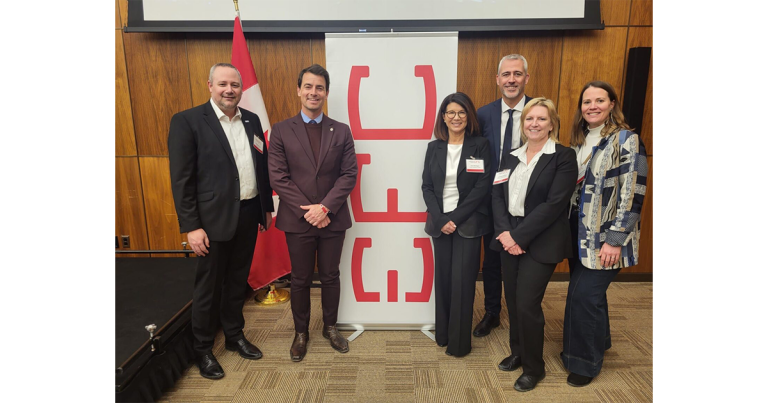
    March 16, 2026 By Electro-Federation Canada Following EFC’s recent update on our 2026 Ottawa Day, we are pleased to share photo highlights from two days of engagement on Parliament Hill, where members met with federal decision-makers to discuss the future of Canada’s electricity system. More than 40 EFC member leaders and Government Relations representatives travelled Read More…

  • Industrial Construction Intentions Drive Increase in Non-Residential Sector in January

    Industrial Construction Intentions Drive Increase in Non-Residential Sector in January

    March 13, 2026 In January, the total value of building permits issued in Canada increased $607.0 million (+4.8%) to $13.3 billion. The increase was led by the non-residential sector (+$464.0 million) and supported by the residential sector (+$143.0 million). On a constant dollar basis (2023=100), the total value of building permits issued in January rose 4.3% from the previous month Read More…

  • Multi-Unit Construction Drives Growth in December Residential Construction Investment, 2025 Review

    Multi-Unit Construction Drives Growth in December Residential Construction Investment, 2025 Review

    March 13, 2026 The total value of investment in building construction increased $442.9 million (+1.9%) to $23.7 billion in December. The residential sector grew 2.4%, while the non-residential sector edged up 0.6%. Year over year, investment in building construction grew 12.2% in December. On a constant dollar basis (2023=100), the total value of investment in building construction in December rose 1.7% Read More…

  • 5 Strategic Reasons to Attend the Lumen Exhibition

    5 Strategic Reasons to Attend the Lumen Exhibition

    March 13, 2026 In a market where deadlines are tight and projects are increasingly complex, staying competitive is no longer just about technical skills. It also depends on having the right tools, the right information, and the right partners by your side. The Lumen Exhibition is more than just an event—it’s a strategic lever designed to Read More…


Changing Scene

  • A New Guillevin.com, Designed to Simplify Your Purchasing Experience

    A New Guillevin.com, Designed to Simplify Your Purchasing Experience

    March 16, 2026 Guillevin.com was built as a digital working tool, designed to support the way their customers plan, search for, and purchase products today. The goal is simple: to offer a fast, reliable, and intuitive online platform capable of supporting real-world operations; both on the job site and in the office. A platform built around Read More…

  • Nova Scotia Strengthens Housing Legislation to Accelerate Supply

    Nova Scotia Strengthens Housing Legislation to Accelerate Supply

    March 13, 2026 Amendments to existing legislation will mean more housing, improved efficiency in the sector and better alignment of related agencies. The changes extend the Executive Panel on Housing in the Halifax Regional Municipality and give the Minister of Housing new authority to ensure housing projects aren’t delayed. “We are strengthening how we plan, Read More…

  • BC Introduces Public Sector Construction Projects Procurement Act

    BC Introduces Public Sector Construction Projects Procurement Act

    March 13, 2026 Kiel Giddens, MLA for Prince George-Mackenzie and Critic for Labour, has introduced the Public Sector Construction Projects Procurement Act, legislation aimed at ensuring publicly funded construction contracts are awarded through labour-neutral, merit-based procurement. “Here’s the simple question: if labour shortages are driving cost overruns, why would government limit who can work on public projects?” Read More…

  • KPMG Establishes Major Products Delivery Office

    KPMG Establishes Major Products Delivery Office

    March 13, 2026 KMPG: Complex projects require well-structured teams, appropriate delivery models tailored to the project’s needs, robust governance frameworks, and stable execution environments KPMG Canada is entering a defining era of major project development that has significant implications for the nation’s economic future, as the country works to establish new trade partnerships, develop its resources, reinforce self-reliance Read More…