Report Highlights Employing Polycarbonate Components to Design Sustainable Luminaires
July 29, 2019
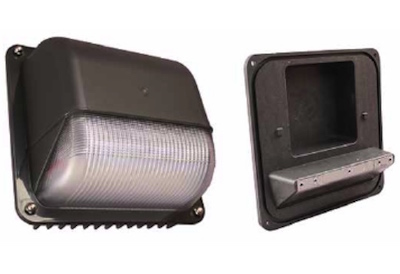
Electronic waste is a huge issue, with Statista estimating nearly 50 million metric tons were generated globally last year alone.* Some of the materials traditionally used in LED lamp and luminaire components contribute to e-waste, and the industry is seeking more sustainable material alternatives. Thermally conductive (TC) polycarbonates, like those from Covestro, can replace aluminum in heat sinks, providing just such a replacement option. (The back enclosure of the A.L.P. Lighting Recruit wall mount fixture, shown in photo, is injection moulded from Makrolon TC polycarbonate.)
To help the lighting industry reduce its environmental footprint, Eneref Institute, a research and advocacy organization for sustainable development, recently released a report that advocates for the use of polycarbonate for heat sinks in LED luminaires. The report, titled Employing Polycarbonate Components to Design Sustainable Luminaires, examines opportunities to replace aluminum component parts in these applications with polycarbonate.
According to the report, thermoplastic heat sinks are a more environmentally friendly option as the energy needed to recycle thermoplastics is one-fourth that of aluminum. As a thermoplastic material, polycarbonate requires less energy for shipping and utilizes a drilling process that is less destructive to the environment than mining for aluminum. Additionally, polycarbonate can be economically recycled into secondary, post-industry applications.
In addition to these key benefits, Makrolon TC polycarbonates from Covestro offer several other advantages over aluminum in heat sinks. For example, these materials safely dissipate heat at a significantly lower weight and feature the option to be integrated with other components.
“With a reduced complexity through integration of functionalities, Makrolon TC polycarbonates offer a competitive, sustainable edge over other material solutions,” says Antti Ake, global head of LED lighting — Polycarbonates, Covestro. “At Covestro, sustainability is at our core, which is why we work to create products and technologies that benefit society and reduce our environmental impact.”
Eneref is not advocating for the use of polymers, like plastic bags or bottles, which should be recycled but more often end up as unrecycled waste, according to Seth Warren Rose, founding director, Eneref Institute. “Instead, we are advocating for the use of polymers as fully reclaimable, reusable and recyclable products.”
Download the report here..
Covestro LLC is one of the leading producers of high-performance polymers in North America and is part of the global Covestro business, which is among the world’s largest polymer companies with 2018 sales of EUR 14.6 billion. Business activities are focused on the manufacture of high-tech polymer materials and the development of innovative solutions for products used in many areas of daily life. The main segments served are the automotive, construction, wood processing and furniture, electrical and electronics, and healthcare industries. Other sectors include sports and leisure, cosmetics and the chemical industry itself. Covestro has 30 production sites worldwide and employed approximately 16,800 people at the end of 2018.
Find more information at www.covestro.us or www.plastics.covestro.com.
Eneref Institute is a research and advocacy organization for social responsibility and sustainable development. The goal of Eneref Institute is to raise awareness for clear, specific solutions that foster an earth-friendly economy. Eneref Institute works to promote sustainable solutions with US and international government agencies as a liaison between government and industry. Eneref develops influential initiatives that lead others, with messaging designed to build advocacy for common sense solutions that achieve effective results. Visit www.eneref.org.
Photo source: Eneref report Employing Polycarbonate Components to Design Sustainable Luminaires.
* “Global E-Waste – Statistics & Facts,” Statista; https://www.statista.com/topics/3409/electronic-waste-worldwide/
![Guide to the Canadian Electrical Code, Part 1[i], 26th Edition– A Road Map: Section 76 — Temporary Wiring](https://electricalindustry.ca/wp-content/uploads/2026/05/EIN-Stock-Guide-Code-Canada-Map-1200-768x403.png)


![Guide to the Canadian Electrical Code, Part 1[i], 26th Edition– A Road Map: Section 76 — Temporary Wiring](https://electricalindustry.ca/wp-content/uploads/2026/05/EIN-Stock-Guide-Code-Canada-Map-1200.png)